
To wrap things up in this three-part series, I will be looking at three thoughts on travel that you might want to consider before and during your next trip. These include: 1) electronic gear you might be thinking about taking with you and what you need to know to travel with that gear, 2) some “on the ground” tactics to use when you get to your destination, and 3) what not to take with you when you go.
Electronic Gear
Electronic gear is now deeply embedded in all our lives. Whether for good or for bad we use it and need it, so we need to know how best to travel with it. Before you stuff your device in your suitcase or pocket and head out on the road, there are a few issues you need to be aware of before you start using it at your travel destination.
Know Your Voltage
The first thing you need to be aware of is what voltages does your device support. In North America our wall outlets churn out 110/120 volts. In many other parts of the world, it is 220/240 volts.
The two voltages do not mix. If you plug your North American 110/120 hair dryer into a 220/240 outlet it will get fried. I’m not certain what happens when you do the reverse, but I imagine there simply would not be enough power to make your European device work in North America.
The good news is that many of the electronic devices we now carry around with us are what is referred to as “dual voltage”. They work just fine plugged into either. That typically includes cell phones, laptops, tablets, etc. All you need to ensure is that you have the necessary adaptors to stick on the end of the device’s plug, which fits into the wall socket wherever you are.
That said, make sure you know exactly what the voltages your device and charger are designed to accommodate before you leave home. Just because I have said cell phones are typically dual voltage, that does not mean that all cell phones in the world are dual voltage.
The items that are typically not dual voltage are things like hairdryers, curling irons, electric razors, etc. You will find that in some bathrooms in hotels in Europe and other places, you will see a traditional North American style socket. Many of these in fact do provide a 110/120 electric feed because they know people are coming with these types of grooming devices from North America. That said, a young friend of ours destroyed her curling iron by plugging into one of these. You should confirm with hotel staff what voltage the one in your room provides.
If you have a single voltage North American device that you absolutely must take with you, you can get such a thing as a voltage converter. We have one from the era where electronic devices were still not dual voltage. They are a bit of a pain to carry around with you though.
Plug Adaptors
 For your dual voltage devices all you need to do is snap on an adaptor that fits the local wall outlets to your device’s plug wherever you are. The ones pictured below are the different styles that you would need for England and most of the rest of Europe. You can easily find online, the adaptors you should be buying for whatever country you are travelling to. Here is a piece from the folks at Skyscanner, the discount flight compiler, that you might find useful.
A final thought on plug adapters. Make sure that you take several. You will lose them. Most frequently they get left in a wall socket when you casually pull out your adaptor. They are inexpensive and you can find them in most electronics stores. Even if you don’t manage to pick some up before you leave – (but don’t do that) – you should find them easy to locate wherever you go in the world.
Cell Phone
 The one item you should take with you for sure is your smart phone. It is the easiest way to have a computer/camera/notepad/calendar/email/ web browser/language translator/guide map/book and newsreader/address book/ entertainment device/ etc. in your pocket. It is the modern-day equivalent of the Swiss Army knife.
I know you didn’t need me to remind you of the many functions that your cell phone provides, but it doesn’t really hurt to see them listed out like that from time to time. They are indispensable tools when traveling.
If you are travelling for more than two weeks do not – I repeat – do not pay for roaming fees. They will cost you a small fortune. If you are travelling to Europe by way of example, Rogers will charge you $14.00 per day to a maximum of 15 days – plus taxes, I assume. The first thing you need to do upon your arrival, wherever you are going, is to get a SIM from a local provider installed in your phone.
This is incredibly easy to do. You may even be able to find a store in the airport before you leave to go to your hotel. It is not difficult to find a retail outlet that provides plans for multiple service providers, or one that provides plans for just one. All of them offer inexpensive pay-as-you-go plans. In all likelihood you will be able to get one that will provide you with international calling as well as regional service so that you can call home for no additional cost.
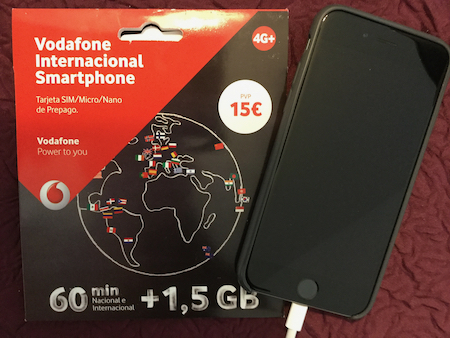
The photo here is of the very first plan that I bought in Spain. As you can see it did provide calling all over Europe as well as all over North America. When I bought it there was a special offering that doubled the number of gigabytes available. The last time I bought a plan it cost 20 euros and included 20 gigabytes of data and unlimited calling throughout Europe – we no longer worry about using our cell phones to phone home.
If we need to make phone calls home, we use the phone function in Skype. I have not checked recently but previously we bought over 300 minutes of phone call time for $10. The Skype system allows you to call from your laptop or tablet to a home phone virtually anywhere in the world.
iPad
I suppose I should have used the term “tablet” here instead of identifying a specific product, but I’m not sure I know anyone who owns a tablet that is not an iPad. Even all my die-hard Windows/Android using friends generally all have iPads.
Sure, a cell phone will provide all the features that you will find in a tablet, but it is nice to have a larger screen to do some things, like reading books. Although I prefer reading actual paper books at home, they are just too cumbersome to take out on the road. I do all my travel reading on an iPad. And I find it easier to search guidebooks, book tickets, look at maps, and search for travel related information on a screen that is significantly larger than my phone.
So, a tablet is not an absolute necessity, but nice to have with you. Given its minimal weight and easy storage I have no problem packing this second device wherever I go. I have switched to using the iPad mini. It is very compact and is a size that is very comfortable to hold and use.
Laptop
A laptop is generally not considered an essential item to travel with, but for some of you it might be an essential. Both the Love-goddess and I take our laptops with us everywhere we go because we are generally working on something. If you do not have a very specific must-have purpose, leave it at home.
On the Ground
Once you get to your destination there are several things that you can do to enhance your trip experience.
Visit the Local Tourism Office
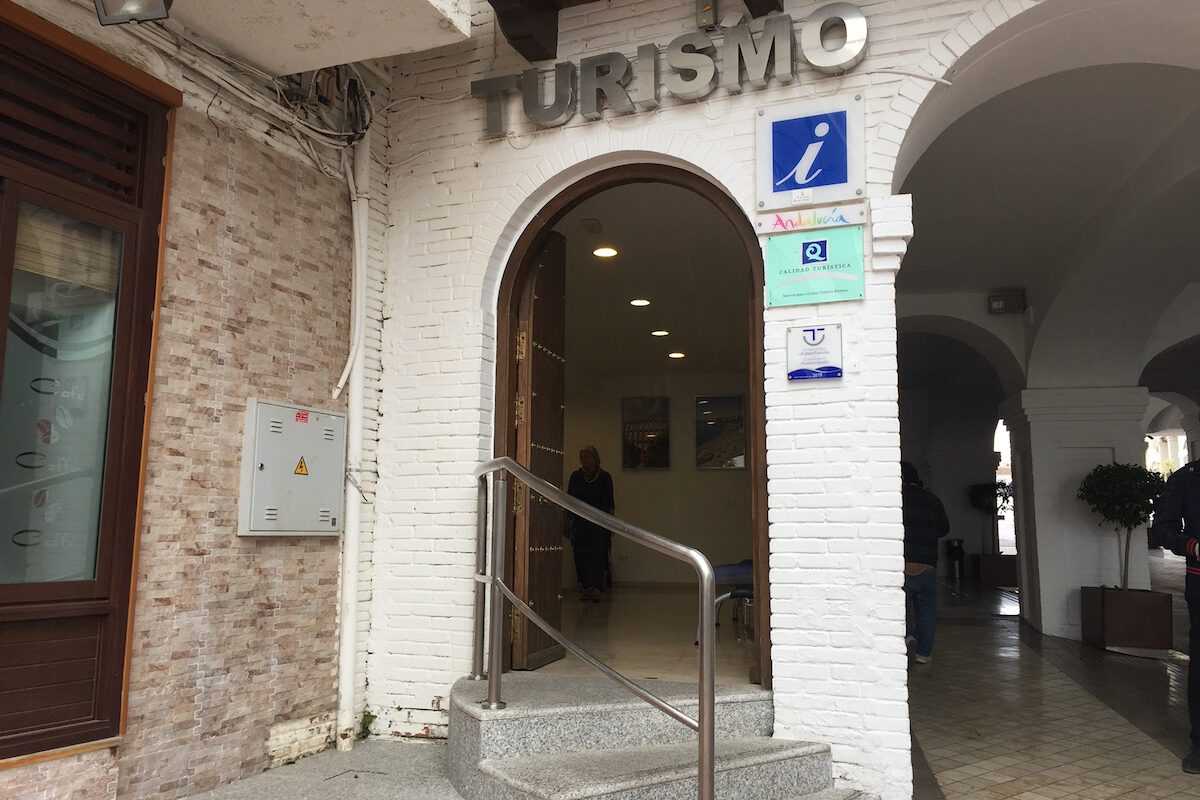
 I find one of the most useful stops I make when I’m on the road is a visit to a local tourism office. You will find them in most cities and towns. You may even find one in the airport where you arrive.
English is the “Lingua Franca” of the tourism trade, so there will always be a staff member who can help you in English. These folks can provide you with easy-to-use free local maps and bus schedules, offer directions to places you want to visit, and even suggest places to visit or events to attend that may not be on your radar.
Another good reason to visit tourism office is because all the information they have at their disposal is up to the minute. Some of the things that you may have found in a guidebook may no longer be relevant.
And they are good problem solvers. The last time we flew into Madrid we arrived without knowing that all the taxi drivers were on strike protesting the presence of Uber. A quick stop at the tourist information desk got us information on how to take the bus to the general area of our hotel.
The second photo above is me using a local map at the bus stop where we disembarked, along with my home printed map of the area around our hotel, to plot out the path to our accommodation… I had not yet got a local Sim for my phone, so no Google maps.
Hotel Front Desk
I have found over the years that folks working on the front desk or the concierge desk at hotels can often provide as much useful information as a tourist office. Typically, they have local maps for you to use with the location of the hotel you are staying at clearly identified on it.
Secondly, I have found them to be a great resource when it comes to selecting a restaurant. Sometimes you have to be a little persistent with them about that. Frequently they will just tell you about the restaurant that draws the most tourists in town. My experience is that these are the ones to avoid. Often the question that provides the best result is “where do you go when you go out to eat, or where would you go, given a choice?
Eating
 Speaking of eating. Eating is one of those activities that will use up a reasonable amount of time during your travel day, just like at home. So, it’s a good idea to do it as efficiently and in as economically reasonable a manner as possible. You may modify the number of meals you have in a day and what you are eating, but you are probably going to do it at least twice a day. If you attempt to eat in restaurants for each and every meal it will soon get very expensive. Here are a few ways to try and mitigate that cost and have some fun while you’re doing it.
Prepared Food
Get prepared food from grocery stores and even variety stores. If you are travelling in Europe it’s important to remember that Europeans have very high standards for the food they eat – even the ready-to-eat stuff. You can buy prepared individual items or prepared meals in grocery stores and even in some variety stores that are definitely a step above the Canadian gas station hot dog. 🙂
The two photos above are from a grocery store in Stockholm Sweden called Hemköp. They had an excellent selection of healthy and tasty foods that we purchased several times during our stay. We have done this many times in many different cities.
Restaurant Meals
 Let’s face it. You can’t eat all of your meals in the hotel room or go on little picnic outings for all of your meals. You will have to eat in restaurants from time to time.
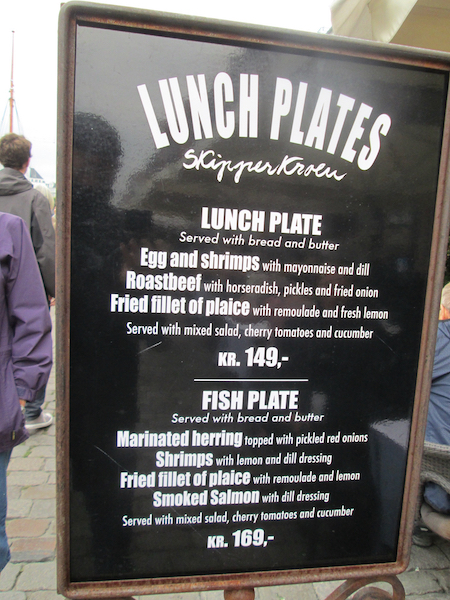
The best way to incorporate a restaurant meal into your day is to have your major meal at lunchtime. Many restaurants in most countries we have travelled to have typically offered lunch specials. The photo below is the sandwich board outside a restaurant in Copenhagen that we ate at one day. We ordered both specials and shared them.
Breakfast
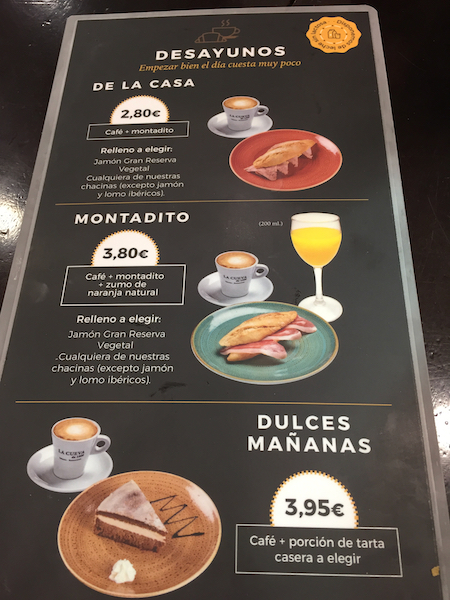
Whatever you do, do not pay to have breakfast in the hotel in which you are staying. We never do this. I suppose I should clarify that. We will often have breakfast at the hotel in which we are staying on the first morning after we have arrived from Canada. I am usually too exhausted and too disinterested to wander around the neighbourhood looking for a place to eat. In Europe most hotels will charge between €11 and €15 for breakfast. Typically, you can find a decent breakfast close by for three to five euros. The second photo below is the place we normally have breakfast in Granada, Spain.
Or, if you are packing your travel spoon and plastic bowl that I mentioned in a previous post in this tip series, you can have a cereal breakfast in your hotel room. Most grocery stores and variety stores stock cereal similar to what we have at home, and small containers of milk to go along with them
Selecting Restaurants
I already mentioned asking at the front desk of the hotel, but the one that I fall back on time and time again – I keep telling people about my strategy, but I don’t think they believe me – is that we peer in the windows of restaurants. If there are lots of folks eating, and they don’t appear to be tourists, we go in. 🙂 This has worked out many times.
Medical Issues
OK, we have never had a medical issue where we needed to consult a doctor in our travels – touch wood. But occasionally things do pop up; an unknown minor illness arises, a prescription has run out, or you need to find medication to treat a headache or common cold. In these cases, we have learned that it can be very helpful to go straight to the local drugstore and talk to the pharmacist.
In many countries we have travelled to, it seems that pharmacists have authority over medical consultation or the issuing of medications that can only be undertaken by a doctor in Canada. This can be particularly helpful if you have run out of one of your medications and have not brought a written prescription with you – even though you should have done that.
My first personal experience with consulting a pharmacist while travelling occurred in the winter of 1974/75. I was hitchhiking around Europe and ended up in Torremolinos, Spain for a period of time. One day I had to go to the pharmacy and seek medication for a problem I was having. Having absolutely no facility with Spanish at the time I pointed to my stomach and made up a Spanish word… “constipado”… which, in fact, turned out to be a real word. That worked, as did the medication she gave me. 🙂
Things to Not Take or Use
If you are planning on attempting to travel later this year, here are a few simple things that you can leave behind.
Water Bottle
If you are planning on taking your favourite metal water bottle with you, don’t. You are committed to carry it around with you whether you are using it or not, and it is one of those things that is easily stolen from a backpack.
Yes, you do need to have a water bottle with you, but there is an easier way to do it. As soon as we have checked our bags and gone through security at the airport I go and buy myself a bottle of water – remember, they will not let you take a water bottle filled with liquid through security.
Typically, I buy one that appears to be the most durable, often including a pop-up top. This gives me some extra water to drink on the flight and a perfectly acceptable bottle to keep refilling and using at our destination. If you lose it, or if you’re tired of caring it around, you can just recycle it.
Extra Hygiene Products
Don’t load up your suitcase with extra toothpaste, deodorant, hair gel or spray, dental floss, shaving cream, razor blades, etc. You can buy these things all over the world and often they will be the exact same brand that you use at home. If you can’t find what you normally buy, be adventurous and try something new. You should be able to find something that is equivalent.
Books
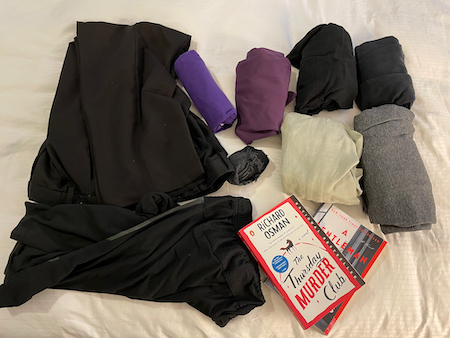
Below you will see a photo that I took of all the things I schlepped down to Nova Scotia with me that never got used. Amongst those were the two books I took. Big mistake. I only took the books because we were driving, I would never do it if we were flying.
What I normally do is buy e-books and read them on my iPad. I’m not familiar with all e-book suppliers, I normally get mine through Apple’s online bookstore, but my experience is that they tend to be cheaper than a print book – as they should be – and they’re formatted such that they are quite easy to read on a tablet. That is my primary approach. On occasion, I will grab a small used paperback book if I find one. When I finish reading it I either recycle it or leave it for someone else to read.
If you absolutely “must-read” paper books, then take one small paperback with you and then replace it with another as you travel. You can buy English books pretty much everywhere in the world. I found one of the most amazing science-fiction bookstores I have ever come across in Stockholm.
Bulky Camera
Unless you are a serious hard-core photography fanatic make do with the camera in your cell phone. If you don’t think you know how to use it properly do a whole bunch of online searching, training, and practicing before you leave home. I’m sure you will be able to find all kinds of instructional suggestions and YouTube videos to help you better understand how do use your specific device.
Cell phones are ubiquitous throughout the world, so no one notices anyone taking some shots with their device. Hanging an expensive DSLR camera around your neck labels you as a tourist and a target.
Personal Beauty and Personal Care Devices
This is a tough one of course. All of us, but especially women, use these things on a regular basis, so they are important to have. I have already discussed these under voltage, but I would offer a few suggestions. The first might be to try to get along without taking any of them with you. Most hotels have hairdryers, at very least, in their rooms and at some hotels you can get one if you ask at the front desk.
Secondly, if you absolutely have to take them with you, eliminate the voltage problem by buying yourself some new dual voltage beauty and personal care devices. They are readily available… I just checked on Amazon… then all you have to worry about is having the right adaptor.
Thirdly, buy the device when you get to wherever you’re going. That way you don’t even have to worry about having the right adapter. We still travel with European hair clippers that I bought in Lyon France in 2002. Because I am no longer “cursed with hair” the Love-goddess simply trims me “down to the wood” once a week.
Don’t Use Review/Rating Sites
OK, I know I am not going to dissuade you from using rating sites like TripAdvisor. Lots of folks love them and use them.
I try to avoid using them because I know they are fraught with limitation – I need to write an article about this – and I don’t necessarily want to select restaurants or places to visit based upon what other North Americans favour. I am always looking for interesting, new, atypical types of experiences that are recommended by locals.
You have already just read about some of the sophisticated techniques that I use when I make my choices, including peering in the windows of restaurants, and asking folks who work in hotels. I don’t ask taxi drivers because I think their offerings are based upon where they most often drop off tourists.
I have to admit that when travelling in Europe I often use Rick Steves’ guidebooks – stored on my iPad of course – to make decisions around hotels, restaurants, and places to visit. This approach has led to many interesting and enriching “local” experiences.
Two Brand New Tips
To conclude this piece, I am going to throw out a couple of new travel tips suggestions that came to me as I was planning, and during our recent trip to Nova Scotia.
Photo of Unused Stuff
When I got home from the trip down east, I took a photo of everything I took with me that I didn’t use. That is the photo below. The next time I travel, I will look at this and make sure I reconsider taking these things on my next trip. This seems like an effective and easy way to focus your thinking on what you really need to take with you.
Take a Second Collapsible Bag
If you followed my trip down east, you will know that this was my first serious attempt to travel with one just one carry-on bag. It worked out fairly well, but I did acquire a few things on the trip that would not fit in the bag.
Before leaving on our trip, I was checking out Rick Steves’ site and came upon a suggestion that he made that made good sense to me. Throw a collapsible second bag into your carry-on bag that you can unfurl and load up for the trip home.
He suggested that this was a good thing to do when you are travelling because it allows you to pack up your laundry and any new clothing, souvenirs, or gifts that you might’ve purchased on your trip. You can then check this bag if you are flying home because if it doesn’t make it, or takes longer to arrive, it doesn’t matter nearly as much as having your checked bag not arrive when you begin your trip.
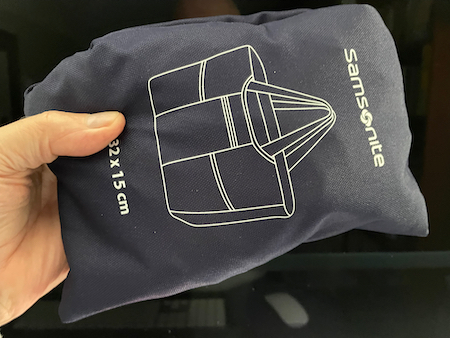
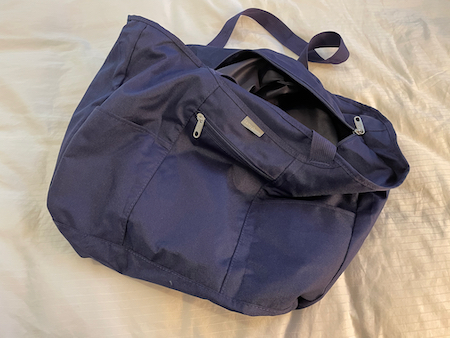
Rick sells these collapsible bags on his website, so I suppose he does have a bit of an interest in promoting these things; but I agree that the whole idea is great in principle. This led me to order a Samsonite collapsible bag online and take it with me. And in fact, I did end up needing it to pack up some things for the trip home.
Well, there you go, hopefully you have found one little nugget amongst these many tips that you can use yourself. Enjoy your next travel experience – soon, I hope.
I would love to read some of your own travel tips in the comments section below.
Visited 16 times, 1 visit(s) today


