
Three posts and 7902 words later my multi-part series devoted to rewriting the rules of golf for older retired golfers draws to a close. This final offering offers up a concise easy to read and use PDF summation of these new guidelines.
Specifically, the PDF condenses a set of modified rules for retired, older, and mid-to-high-handicap golfers which are designed to speed up pace of play, reduce excessive penalty strokes, and put more enjoyment back into the game, without changing golf’s core character and challenges.
For the record, what you see below, and can now download if you so choose, was created by Anthropic’s Claude AI in less than a minute. That is the power of these AI agents. What would have taken me hours if not days do draw up was completed in seconds … and is way better that what I could have done.
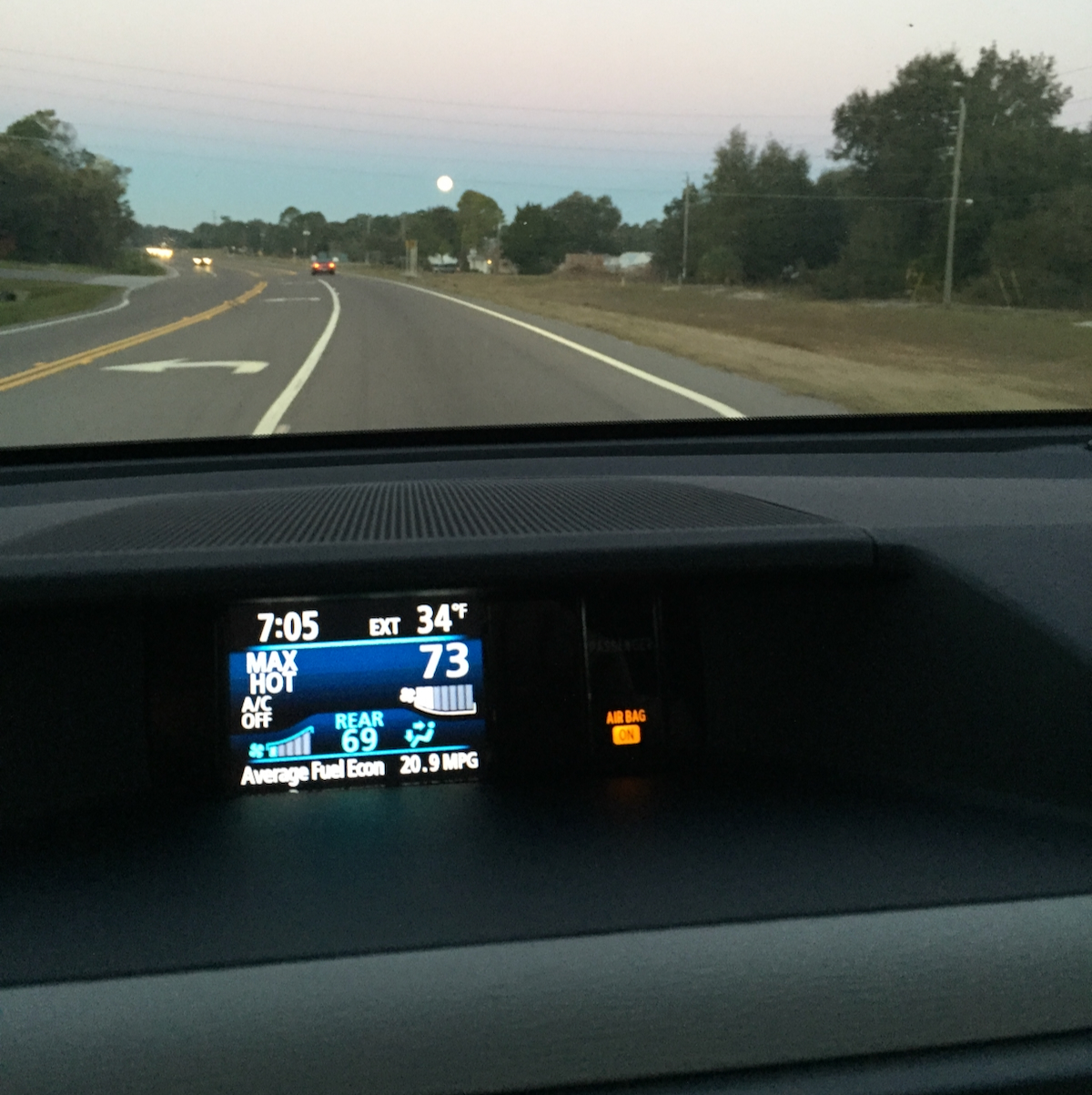
I would be remiss if I did not thank my many golfing associates who allowed me to use photos of them from our many golfing adventures as title images for this series. Thank you, lady and gentlemen, you know who you are. This final one was taken on a golf getaway in Florida where the outside temperature was 34°F as we drove to the course. We are hardy golfers if nothing else.
Click on the following link to download the document. At the end of this post, I will discuss the steps you may have to take to get the PDF fully downloaded onto your device.
The Yikes! I'm Retired-Modified Rules of Golf for Retirement (1 download )
The Yikes! I’m Retired…Modified Rules of Golf for Retirement
A Quick-Reference Rule Sheet
Golf’s official rules keep the game fair and consistent for low-handicap and professional play, but they can add unnecessary frustration for retired, older, and mid-to-high-handicap golfers — especially on courses that aren’t in pristine condition. This sheet condenses a set of modified rules designed to speed up pace of play, reduce excessive penalty strokes, and put more enjoyment back into the game, without changing golf’s core character and challenges. The “Legend” indicates rule origins.
Legend: Existing Official or Commonly Used Rule (used as-is or as the default) — New/Modified Rule — Recommended Alternative Rule to Official Rule
*Note: The “Legend” icons do not appear on this page, but they will be present on the downloaded document. You will see the icons I am talking about in the very last image below.
-
Foundational Rules: Essentially “Winter Rules,” played year-round
- Lift, Clean & Place — Anywhere, anytime.
- Improve Your Lie — Move your ball within a 6/12-inch radius, even in the rough.
- Hidden Ball (not “Lost Ball”) — If a ball is buried in leaves or heavy primary rough, and should be able to be found, search for a reasonable amount of time, then drop a new ball and play on with no penalty.
- Gimmies — Any putt within ~3 feet is automatically holed.
- No Mulligans — There needs to be a set framework of rules to play by, not an “anything goes” free-for-all approach. (That said, we recognise that some groups allow Mulligans. If so, perhaps players can agree on a maximum number taken in a round.)
- Two-Putt Maximum — In spring, or when the putting greens have been “sanded/aerated”, or they are blemished don’t count more than two putts per hole (a one-putt still counts as one).
-
Tee Selection
- Hybrid Tees — Play a mix of tee colours throughout the round if necessary: default to one tee (e.g., White) but move forward one or two tees on holes your group finds too difficult.
- Play Whichever Tees Are Appropriate for Your Group — There’s no shame in the forward tees; they’re built for seniors, juniors, high-handicappers, and shorter hitters (e.g. drives under 200 yards).
-
Pace of Play
- Play Ready Golf — If everyone agrees and it’s safe, hit — regardless of who’s farthest from the hole (applies to fairway shots, the tee box “honour,” and approach shots to the green).
- Eliminate “No Closer to the Hole” aspect of many rules — Off the green, don’t worry about whether your placed/dropped ball ends up marginally closer to the hole. A couple of inches or a couple of feet doesn’t really matter. No closer still applies as-is on the putting green.
-
Off the Tee & From the Fairway
- The “Hosel Rocket” (Shank Out of Bounds off the tee) — No relief here; play the official rule: stroke and distance.
- Missed the Fairway and Lost (In Primary Cut)— Treat as a Hidden Ball: search briefly if a ball is buried in leaves or heavy Primary rough, then drop and play a new ball with no penalty.
- Fairway Blemishes — Improve lie on any fairway shot to offset divots, bare patches, etc.
Out of Bounds (OB) / Lost Ball (LB)
- Official OB/LB Rule — Stroke and distance (return to where you last played, add one penalty stroke, and hit away).
- Model Local Rule E-5 — USGA/R&A option: drop in the fairway near where the ball crossed out of bounds, for a two-stroke penalty instead of returning to replay. the two-stroke cost is worth it — noted here as a legitimate but uncertain option.
- Recommended Alternative to E-5 — Instead of dropping in the fairway, drop in the first cut or primary cut within a club length of the fairway, for a one-stroke penalty.
- Another Alternative to E-5 — Take two-club-length relief from where the ball went OB/lost (as if it were a lateral hazard), with a one-stroke penalty.
- When “OB” Isn’t Really Severe — If the out-of-bounds area (e.g., bordering private yards) is easily playable, but you are not allowed to, apply the lateral-hazard two-club-length relief instead of full stroke and distance.
-
Hazards (Penalty Areas)
Red Stakes
- Play “As It Lies” — No penalty and improve your lie under these rules.
- Official Relief Options (one-stroke penalty) — Stroke-and-distance, back-on-the-line, or lateral relief (two club lengths from where the ball crossed the margin, no closer to the hole).
- Modified Lateral Relief for Ball in Water — Instead of measuring from where the ball crossed the margin, take relief directly opposite the point where the ball entered the water.
Yellow Stakes
- Treat Like Red Stakes — Including lateral relief, which isn’t normally permitted in yellow-stake areas under official rules.
Large Water Hazards
- Two-Balls-In-the-Water Rule — After two shots go into the same water hazard, drop a ball 3 or 4 feet off the green along the line between the water and the flag, take one penalty stroke, and play on. Groups may agree to invoke this after just one ball in the water.
Sand Traps / Bunkers
- Rake-and-Place (violates official rules) — If bunkers are poorly maintained, rake a clean patch near your ball’s position and play your ball from there.
- Free Lift Option — On especially rough bunkers, take a free lift out and drop nearby.
Dangerous Animals
- Official Rule 16.2 — Free relief is allowed if playing the ball as it lies would risk serious physical injury (e.g., alligators, bears, coyotes).
-
Maximum Score Per Hole
- Cap Hole Score at Triple Bogey (+3) — For mid-to-high-handicap and retired golfers, modeled loosely on the official “net double bogey” handicap rule.
- Alternative: Quadruple Bogey (+4) — Slightly less forgiving if groups want to play a stricter format.
- How to Apply It — Either finish the hole and record the capped score or pick up your ball and move on to the next hole as soon as it’s clear you’ll exceed the cap to speed up play.
-
Around and On the Green
- Near the Green — Improve/fluff up your lie in the fringe/rough, but you must still proceed with an actual chip or pitch.
- Putting Order — Farthest from the hole putts first, by default — or switch to Ready Golf if your group agrees.
- Ball Placement Wiggle Room — If a ball mark or blemish sits in your line, you may nudge your ball a couple of inches to the side.
- Two-Putt Maximum on the Green — Especially useful in spring when greens are rough.
- Gimme Distance — Group agrees on a length (commonly ~3 feet), measured using one designated putter (typically 35-36”).
Download Assist
I am offering up some thoughts here on the download process because this is the first time I have made a document available for download on my website. The experience may vary based upon whatever browser you are using.
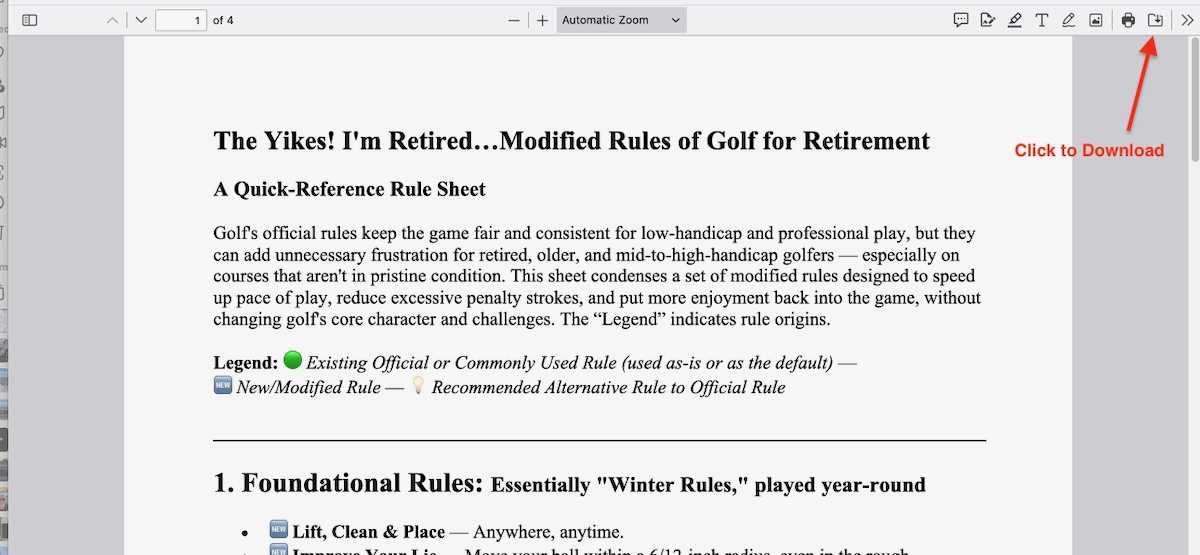
I use the Apple browser Safari, and the following is what I experienced. When I clicked on the download link, a new tab/window opened, offering up the look that you see in the image below. It was unclear to me immediately if the document had been downloaded into the “download” folder on my hard drive. I discovered later that it had been, but I did go through the following process just to make sure I had a copy.
I clicked on the “save” icon, as indicated with the red arrow and “download” text. Clicking on the folder immediately copied the PDF into my download folder. As it turns out, I was downloading a second copy unnecessarily.
If you are having issues, feel free to flip me an email at “greg.mccaughey@retirednowwhat.ca”. If you just want to print it once the rules have opened in a new tab/window, just go ahead print it from there.
Happy Retirement Golfing!