

So, we have addressed all the basics involved in wintering in Spain that you need to know; how to get there, how to rent there, and practical day-to-day matters to help you settle in. Now we come to either the last thing you need to concern yourself with about in your first few days, or the official beginning of your “living in Spain” adventure. You can decide.
Grocery shopping in Spain at a basic level is no different than in Canada. There are major grocery stores and there are lots of alternatives if you don’t like shopping in them.
Let’s begin with the chains. There are five grocery chains at which we typically shop here in Spain; Mercadona, Carrefour (the French chain that the Canadian company Alimentation Couche-Tard attempted to buy), SuperSOL, El Corte Ingles, and Maskom.
To see a larger version of all the photos simply click on them. The photo will pop up in a new tab or window, allowing you to examine any of the images in greater detail.
Grocery Chains
We have all five of these within walking distance this year. If I had to classify them, I guess I would say that El Corte Inglés and Carrefour tend to offer higher end shopping, with Mascom residing at the other end of the spectrum. That is not to say that one chain is better to shop at than any other. We have stuff we buy at all five of these, because often only one store will have it. The prices don’t really vary that much.
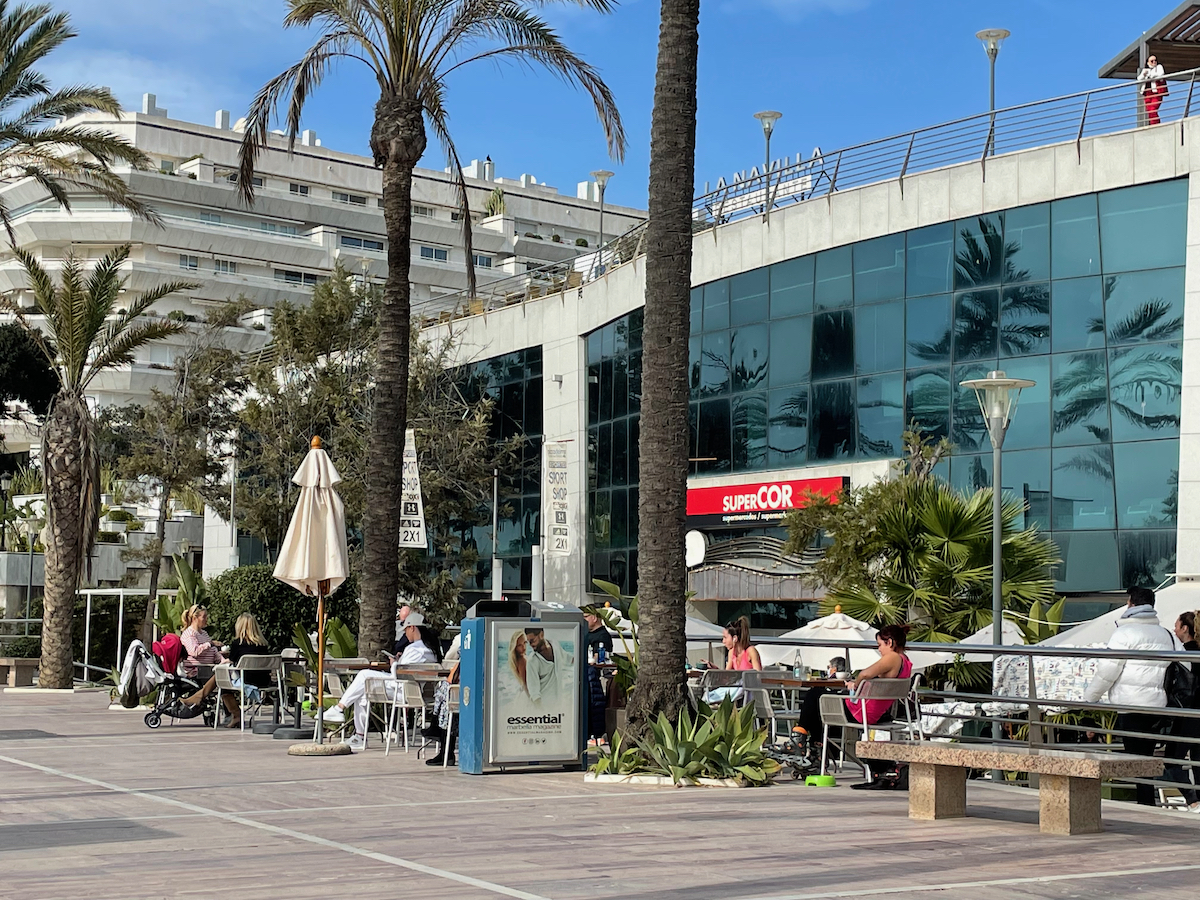
1) This might be my favourite grocery store in the world. 🙂 If only because it sits right on the Boardwalk alongside the Mediterranean. It does not get any better than this… well, for grocery shopping anyway.
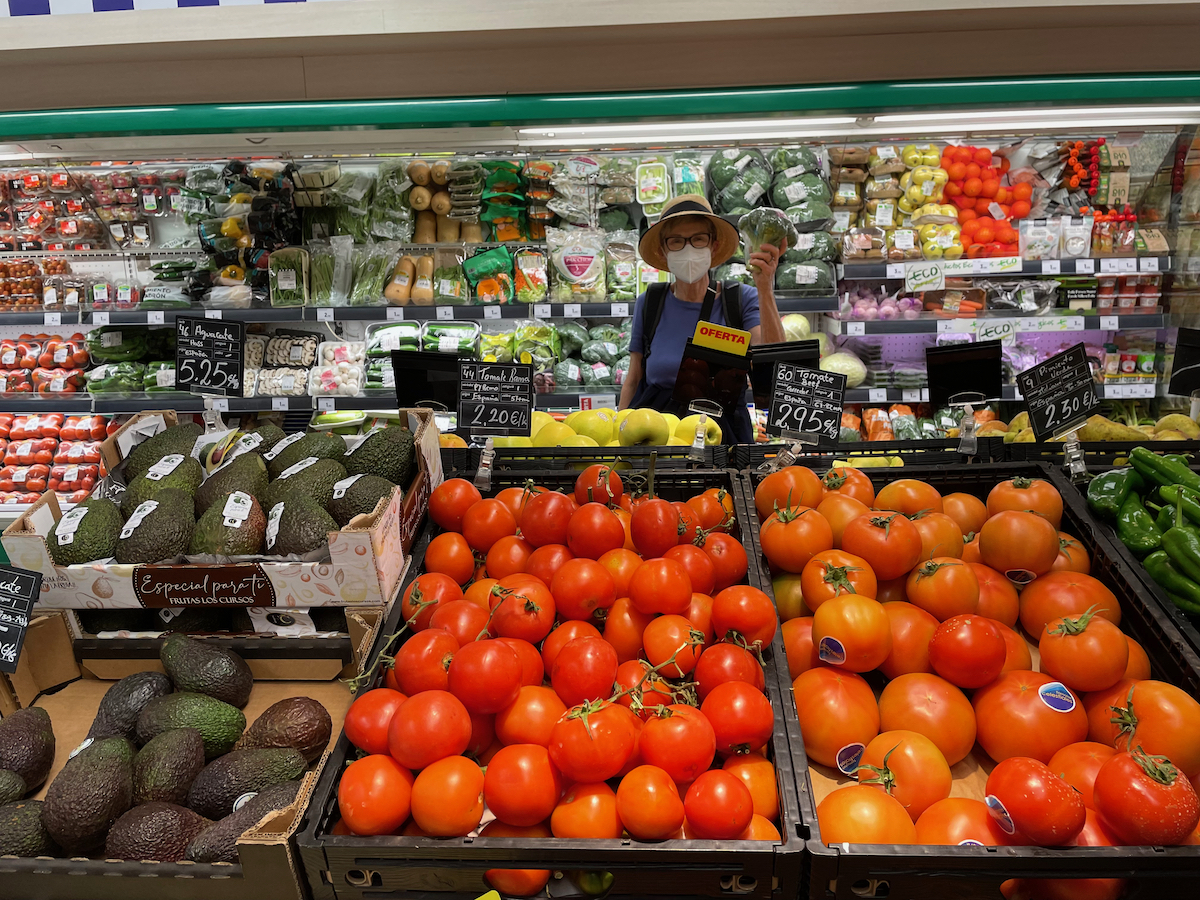
2) Looks like the produce section in any Canadian grocery store you walk into, doesn’t it? What I wanted to show you in this photo is the little black squares stuck in the top of all the fruits and vegetables containers right here in front of you. Unless you have wonderful vision you’ll have to click on this picture and zoom in on the larger one that pops up to read the little squares. 🙂
In the top left corner of each there is a number. As you can see, the two varieties of tomatoes are numbers 44 and 60. As you fill your bag with an item, you remember that number and then go to the next step.
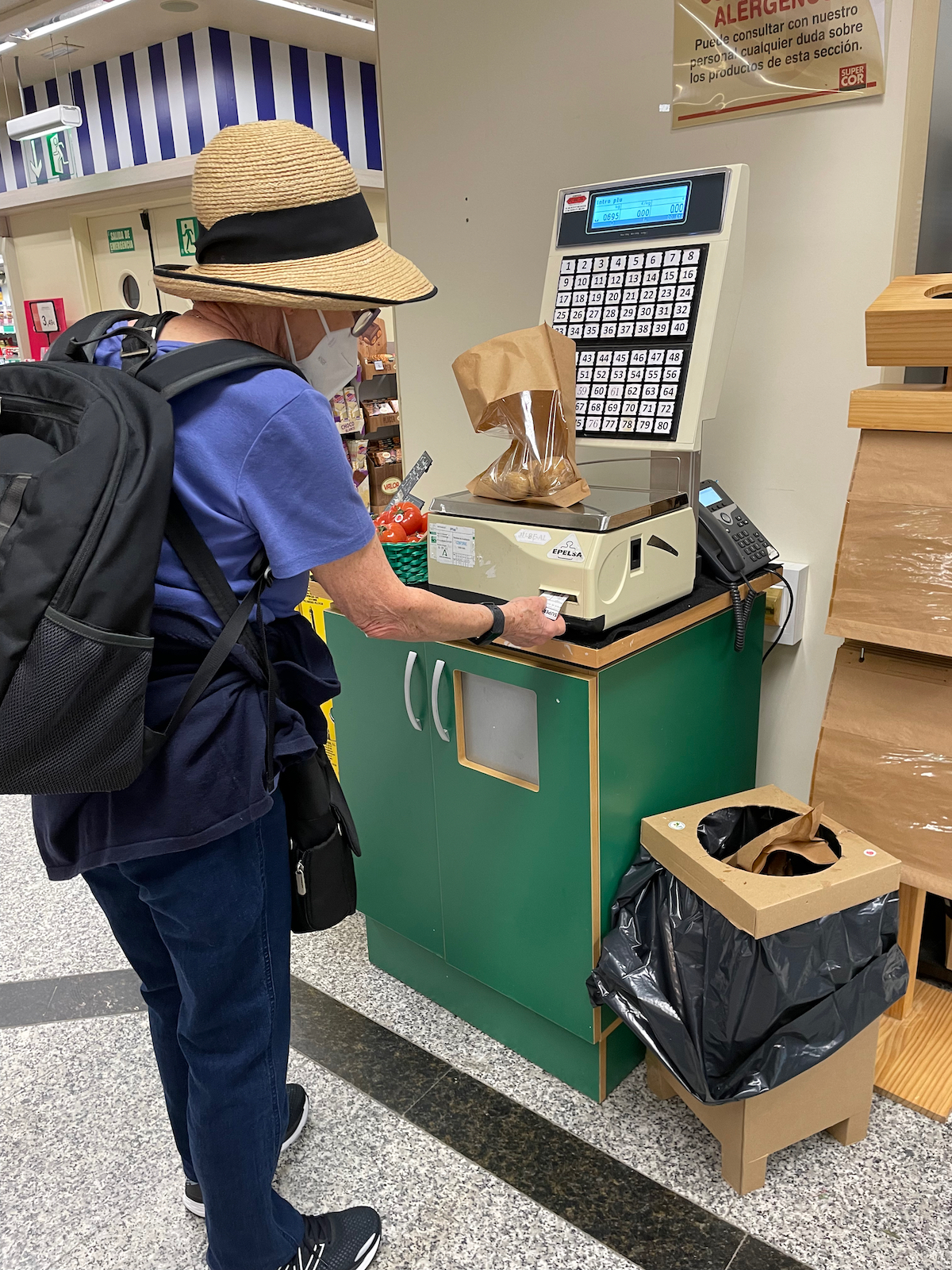
3) In the next step you put your produce on the scales and you push one of those little white squares with the corresponding number. The machine weighs your selection and prints out a sticker to adhere to your bag. This will get scanned at the checkout.
These are interesting new bags we have not seen before. They are paper with a clear face. I’m sure that it’s to prevent shoppers from loading up a paper bag with avocados, weighing as if it were potatoes, and then sealing it with the price sticker so the cashier could not see inside.
Make sure you look for these machines and use them. It’s not a major chore and it sure saves time at the checkout not having to wait around for them to weigh and price everything like happens in Canada. If you do forget, and wind up at the cashier with items not properly weighed and priced you will be sent scurrying back to do so – with scorn and general humiliation heaped upon you in front of a whole lot of people… Trust me I know. 🙂
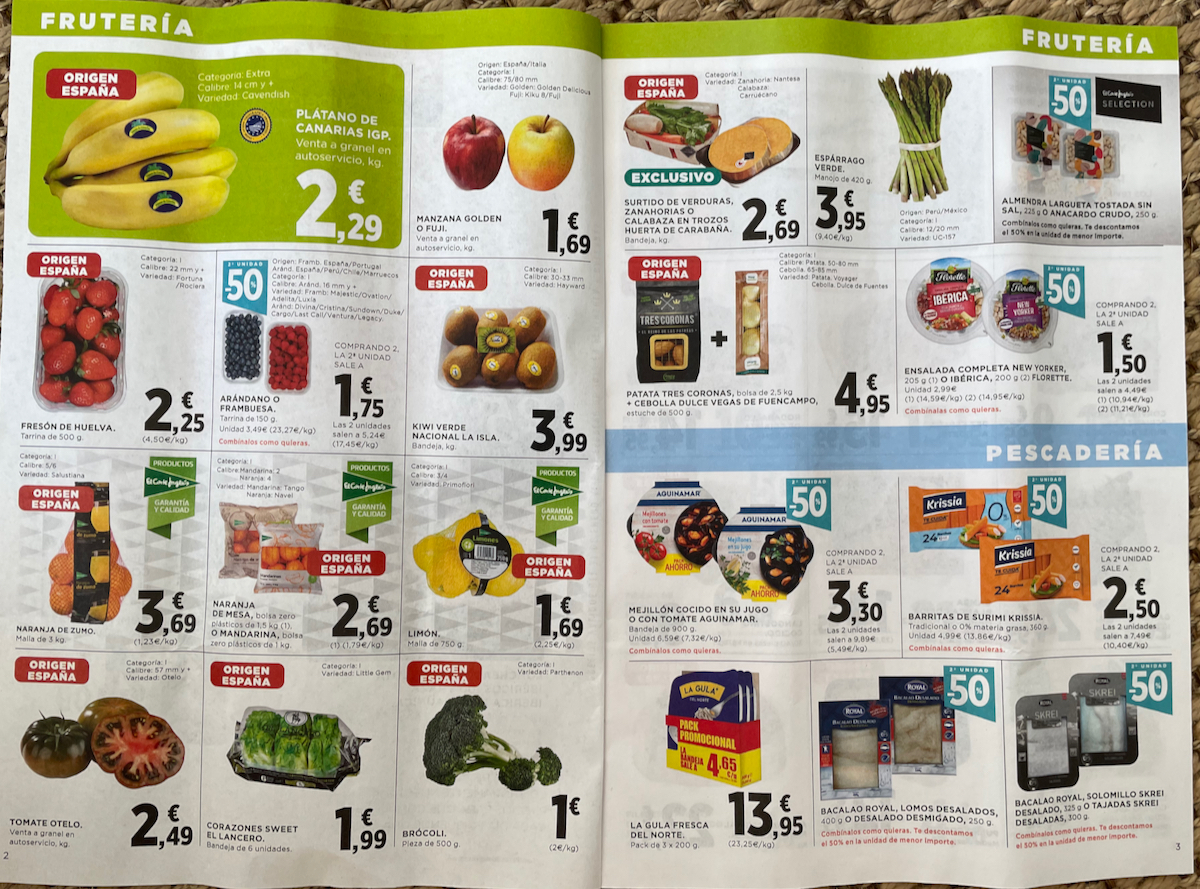
4) A SuperCOR weekly flyer. A couple of things to note. The items that are priced by weight are per kilo. The labels that say “ORIGEN ESPANA indicate they are grown in Spain – probably right here in Andalucia. The Costa del Sol is a major market garden for all of Europe, and February and March are prime harvesting season.
To compare prices with products you buy at home you will have to do some number crunching of course. Take the strawberries for example. In the fine print it says €4.50 per kilo. In Canadian dollars that is approximately $6.75, so about $3.68 a pound… Or $.68 per 100 g. Take note of the price of the kiwis. This will come up again later.
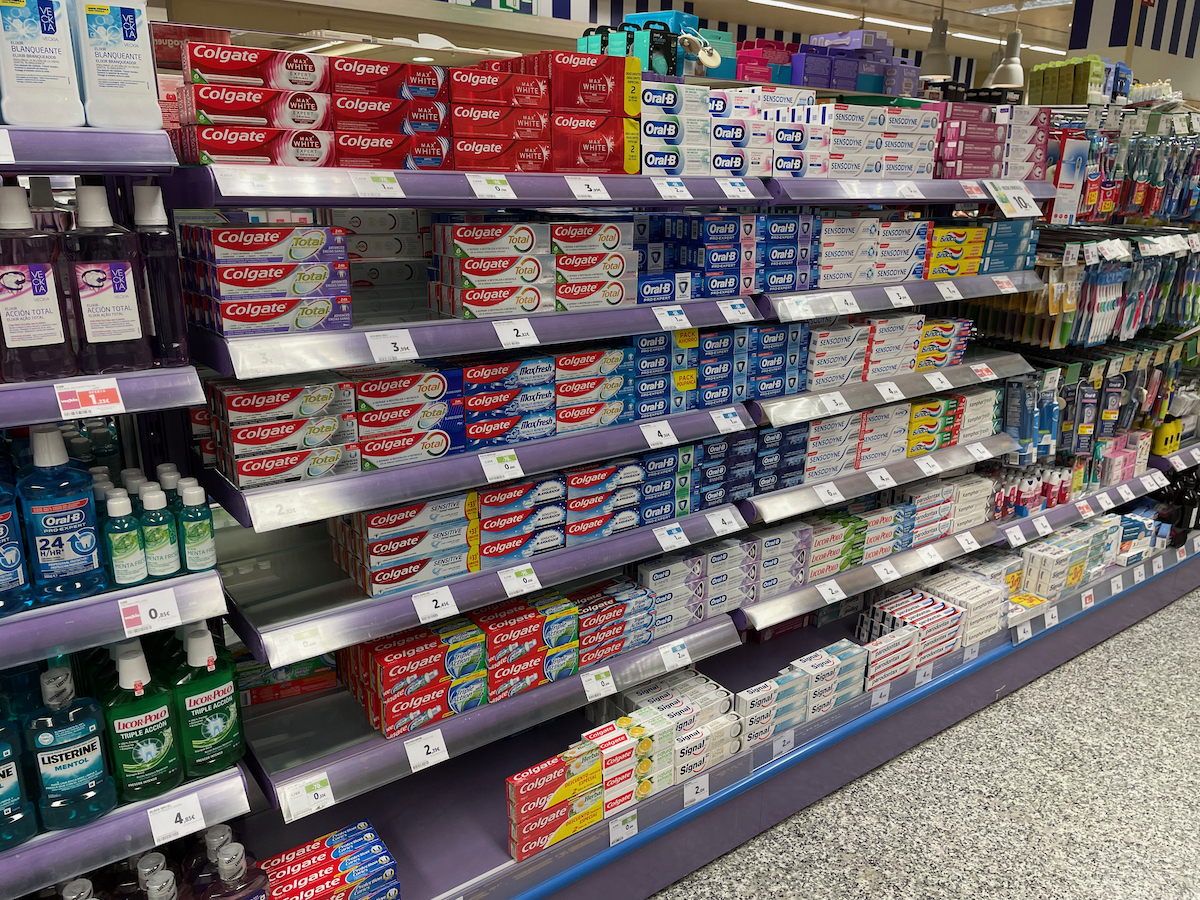
5) I threw this in just to remind people that most of the products that we buy and use at home can be had here. Yes, a couple of European or Spanish products can be seen at the far end of the toothpaste shelf, but as you can see, most of the shelf space is taken up with widely available international brands. Don’t take extra hygiene products with you. You will be able to buy what you need here.
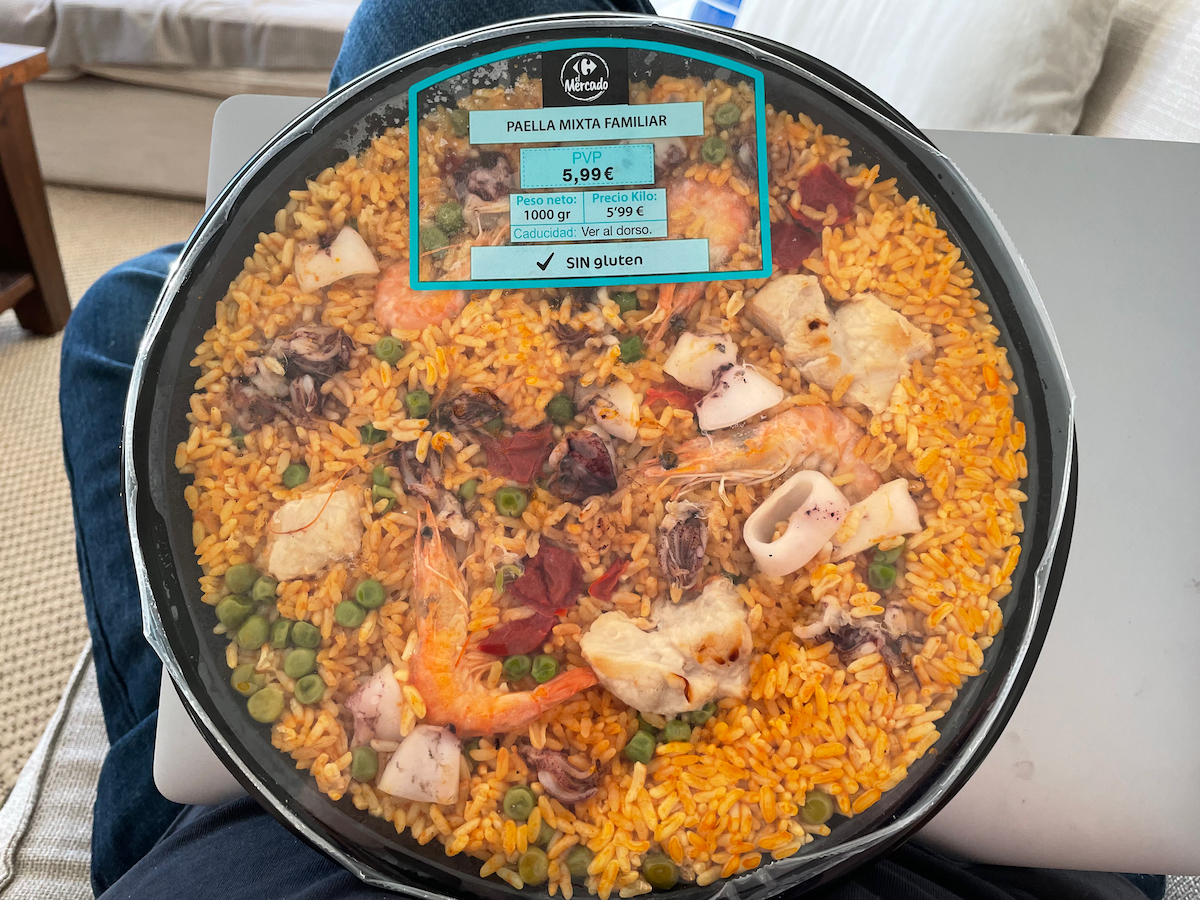
6) I wasn’t really feeling like cooking the first day we went shopping so I was tempted by this. Prepackaged Paella! It even had lots of interesting stuff in it, so I grabbed it. Big mistake. Processed food is processed food, don’t waste your time and money on something like this.
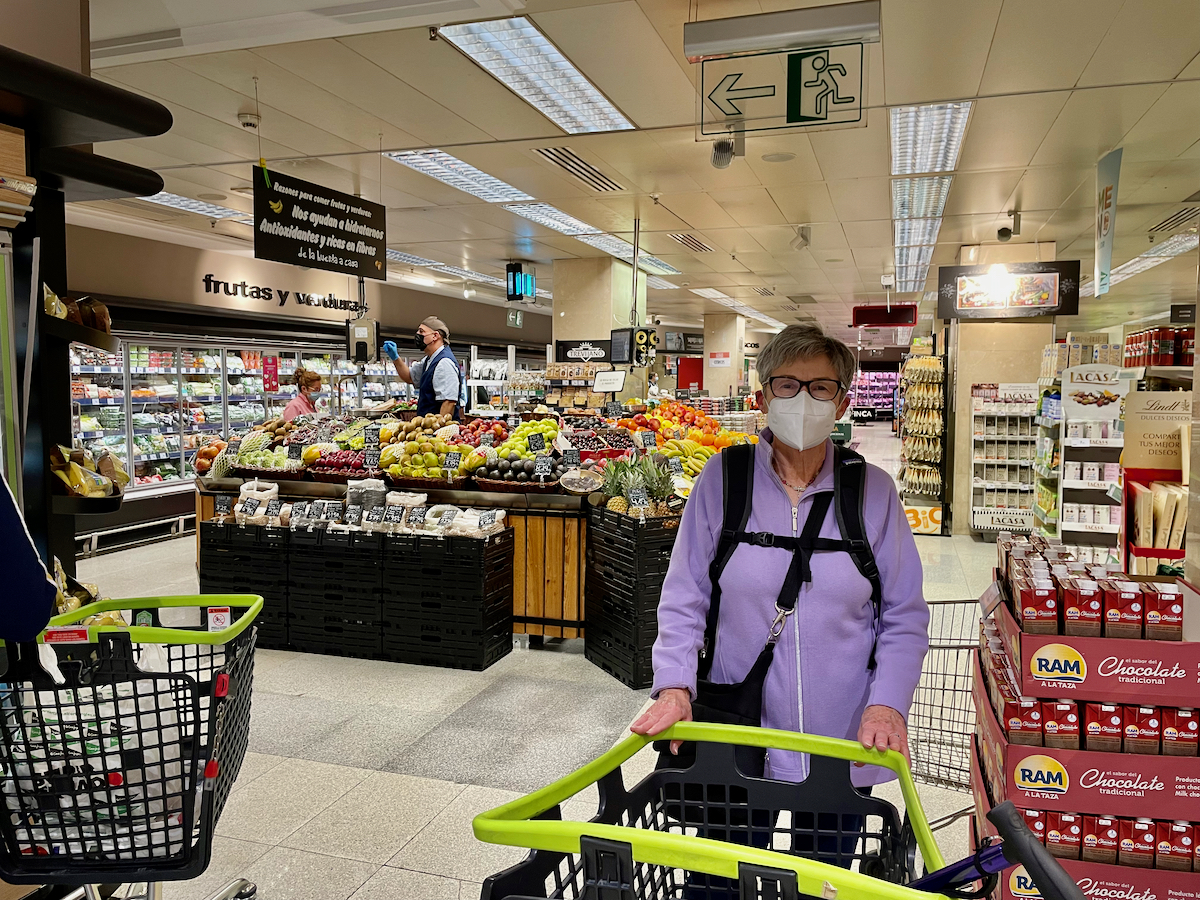
7) I got the Love-goddess to stand with a shopping cart, so it looked like I was taking a picture of her. I was really taking a picture of the guy in the background. This is typical of smaller outlets that sell fruit and vegetables that you do not often see in large grocery stores. They have a fruit and vegetable salesperson.
The job of the vendor is to pick out for you what you want … you do not touch the fruits and vegetables. You tell him or her Specifically what you want – e.g. something that’s ripe and ready to eat or something that will not ripen for a few days – and he or she will do his best to give you exactly what you want. And they know their fruits and vegetables, so trust them. You may or may not ever see one depending where you shop.
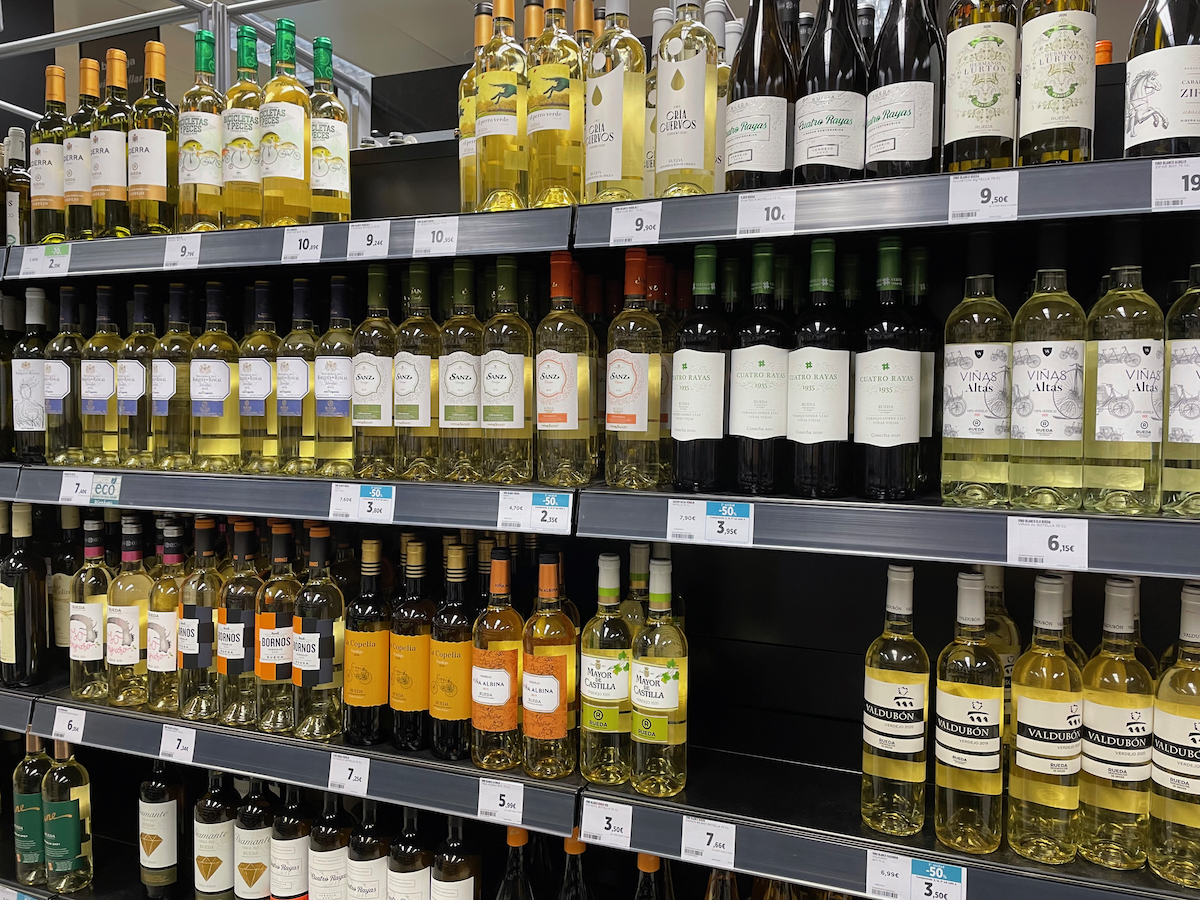
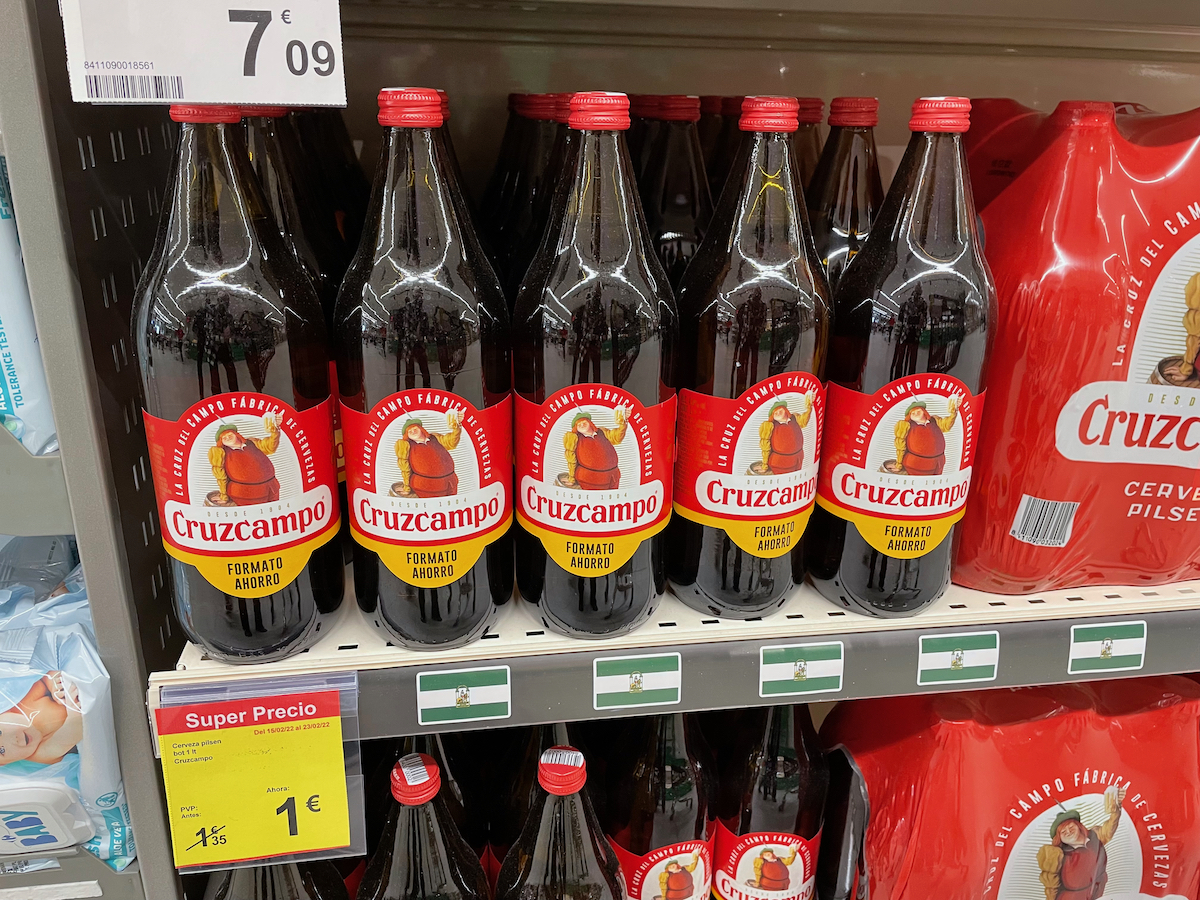
8) And here is the good stuff. All the major grocery stores sell beer, wine, and liquor. Check out the prices on these puppies.
9) As I said to a friend at home. I am in beer heaven… one litre bottles of beer for one euro i.e. $1.50.
Alternatives to Chains
Shopping in grocery chain stores just like at home is not what you had in mind? Not to worry, there are other options.
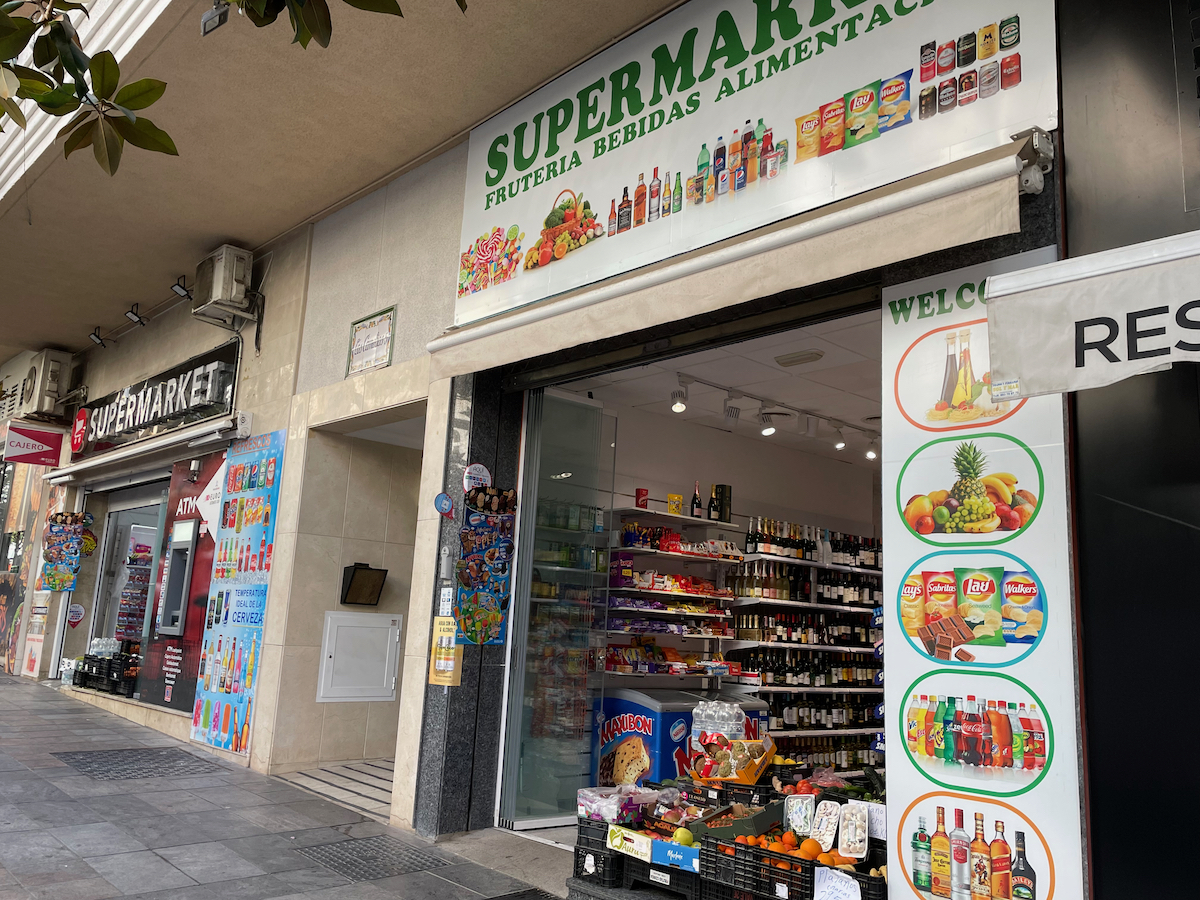
1) Supermercados – First up amongst these are the small “Supermercados” or “Supermarkets” that proliferate in every neighborhood. Smaller scale, but they typically have a little bit of almost everything you need. Although, it is kind of hit and miss as to whether or not they have meat products.
I sure one of the reasons that there are so many of them is that, like most retail outlets in Spain, all the large grocery store chains are closed on Sunday. The small stores are not. If you need groceries on Sunday, you simply head off to one of these local shops. I took this picture last week – managed to capture two of them side-by-side.
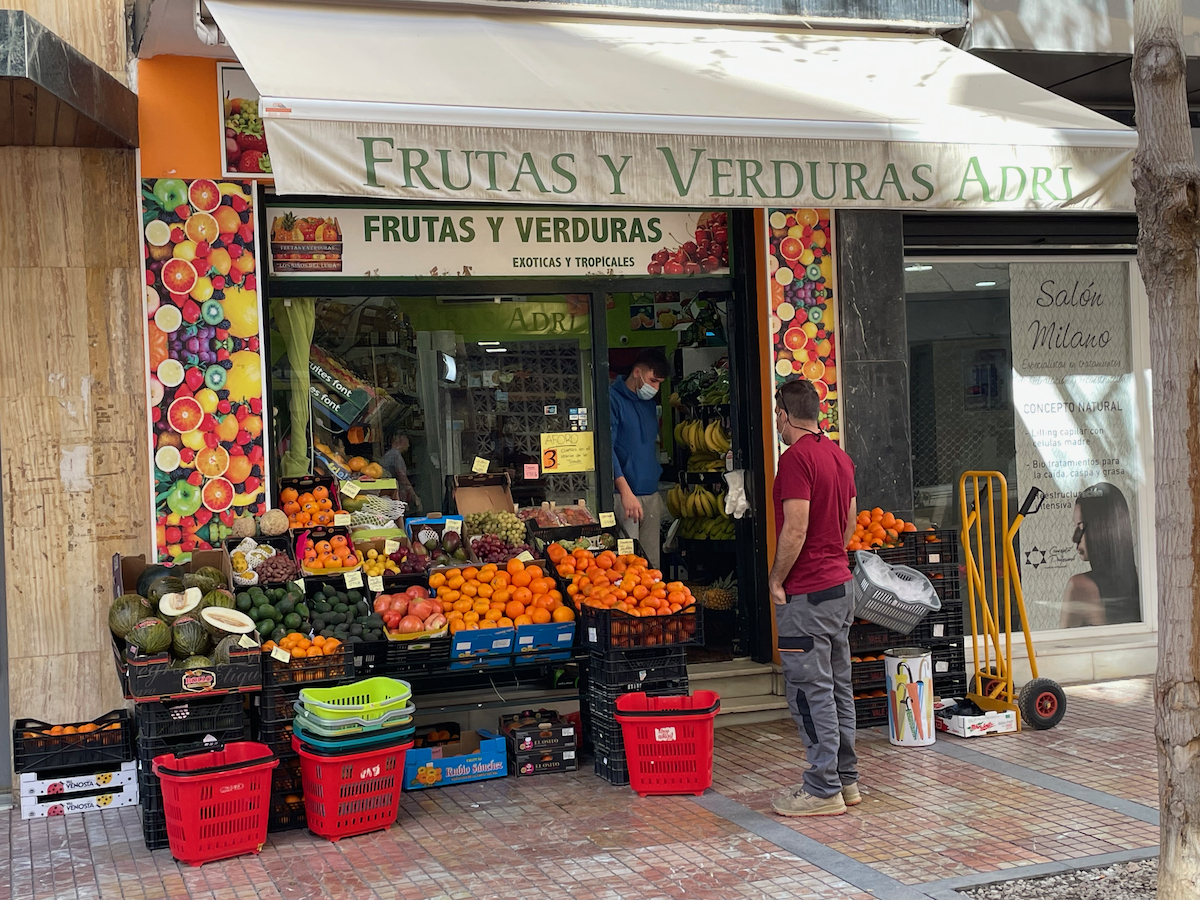
2) Fruterias – These are very small independent shops that sell only fresh fruit and vegetables. These are the stores where the vendor will likely pick out what you need. They are everywhere. There is one on the street level of our building.
The one in the picture is just around the corner from us. I tried taking a picture of the one in our building but couldn’t get a proper angle and the people lined up waiting to get in were eyeballing me suspiciously. 🙂 All these outlets appear to be operating with the “one person in the store at a time” rule during the current health crisis.
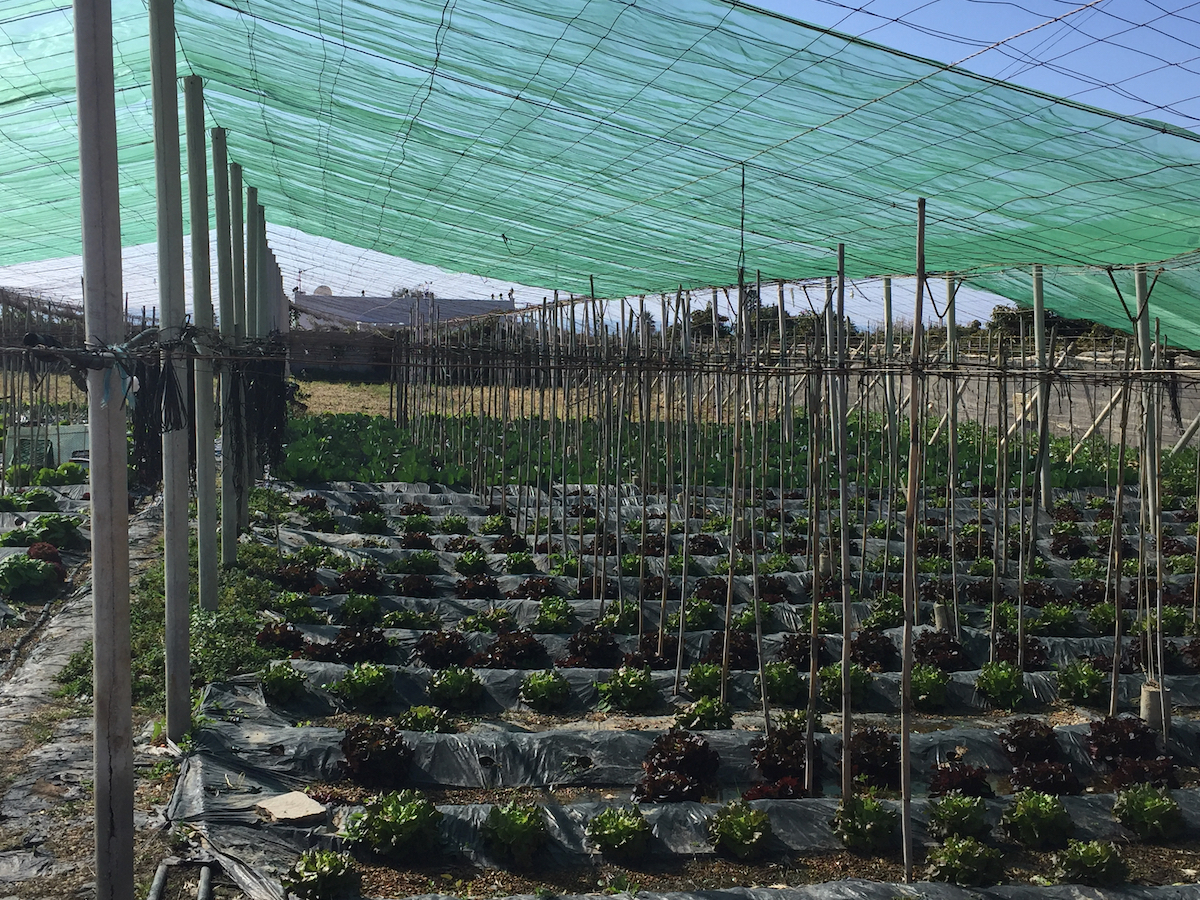
3) Farm Stands – This is an option if you are staying in the town of Nerja. It is up that way where market garden production predominantly takes place. Around the perimeter of the town, you can walk to a number of these small farms. Many offer farm-fresh fruits and vegetable from stands they have set up.
BUT! Do not question the quality of the tomatoes by asking the stand operator if they are bad when they have dark spots on the outside. It’s a long, sad personal story and it involved a vendor pulling out her knife and cutting open the tomato in question to reveal that it was fine. After which, she glowered as she weighed and priced our purchases, and then stuffed a couple extra free tomatoes in the bag to add insult to injury. Oops!
In the Nerja area, you will also find some folks putting boxes of fruit and vegetables out for sale on the front steps of their homes. I am assuming it is the honour system, you take what you need and leave an appropriate amount of money.
Permanent Markets
Yes, there are a few permanent markets in all the towns along the Costa del Sol, which are open daily. These following photos are of the Malaga Atarazanas Central Food Market. I now identify it as my favourite market in Europe, and trust me, I have seen a lot of them. I cribbed this first photo, and the two immediately following, from the “www.guiarepsol.com” website. Their pictures do much better justice to the facility than my own. Check them out if you would like to see additional photos from the market.
1) This centre structure is an original Moor era construction. The new cast iron halls on both sides were added on much later. The location was originally a shipbuilding yard. This market definitely deserves a visit, or several visits, no matter where you are staying on the Costa.

2) The centre hall. That is an enormous stained glass window at the back of the building. It alone is worth the visit.

3) Of course, tons of fresh seafood can be had. I imagine many of these goodies were swimming in the Mediterranean the day before this picture was taken. The market has every sort of fish, seafood, meat, and fruits and vegetables you could possibly ever want – and at very reasonable prices. The prices, typically, are better than the grocery stores.

4) I took this picture in 2017. I suspect that everything you see here in the picture was grown locally, or someplace else in the warmer parts of Spain. The bananas would have come from the Canary Islands, which are part of Spain but much further south off the coast of Africa.
This is a good point at which to begin to review food pricing. Here, as in the grocery stores, all the pricing for weight is by kilogram. We have strawberries at €1.50 for 1 kg., or, to convert, $.96 per pound. And yes, the strawberries here are always enormous.
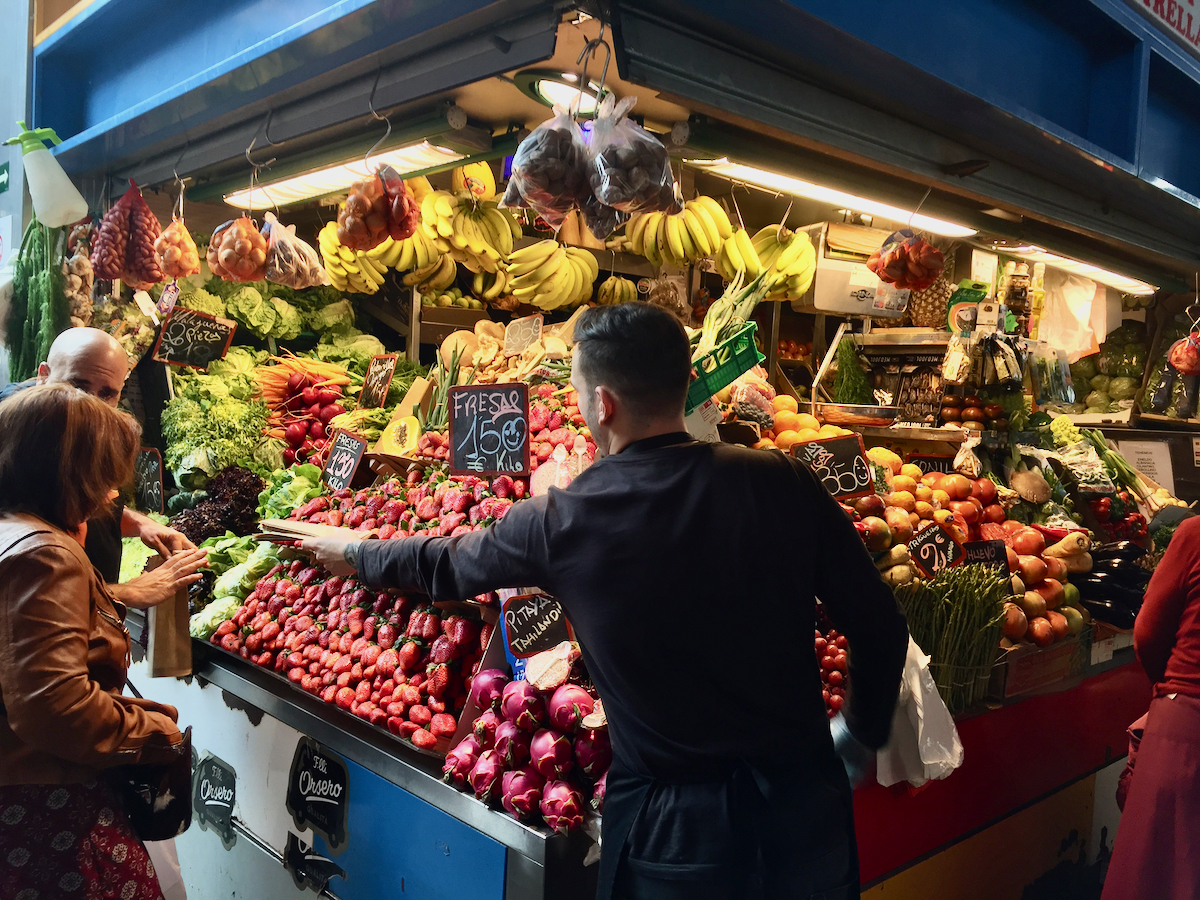
5) I always used to say that the Boqueria market in Barcelona was my favourite market in Europe. And I may have switched allegiance to the Malaga market simply because I have not been there in several years. This is one of the things that I love about the Boqueria. You could buy these little cones of just about anything in the market for one euro. The idea is you grab one and walk around snacking as your shop. I wonder if they are still doing this during the pandemic?
The cones often have homemade fries stuck in the bottom of the cone like this one. I am showing you this one rather than others I have taken, simply because it has that cute little quail’s egg on top. 🙂

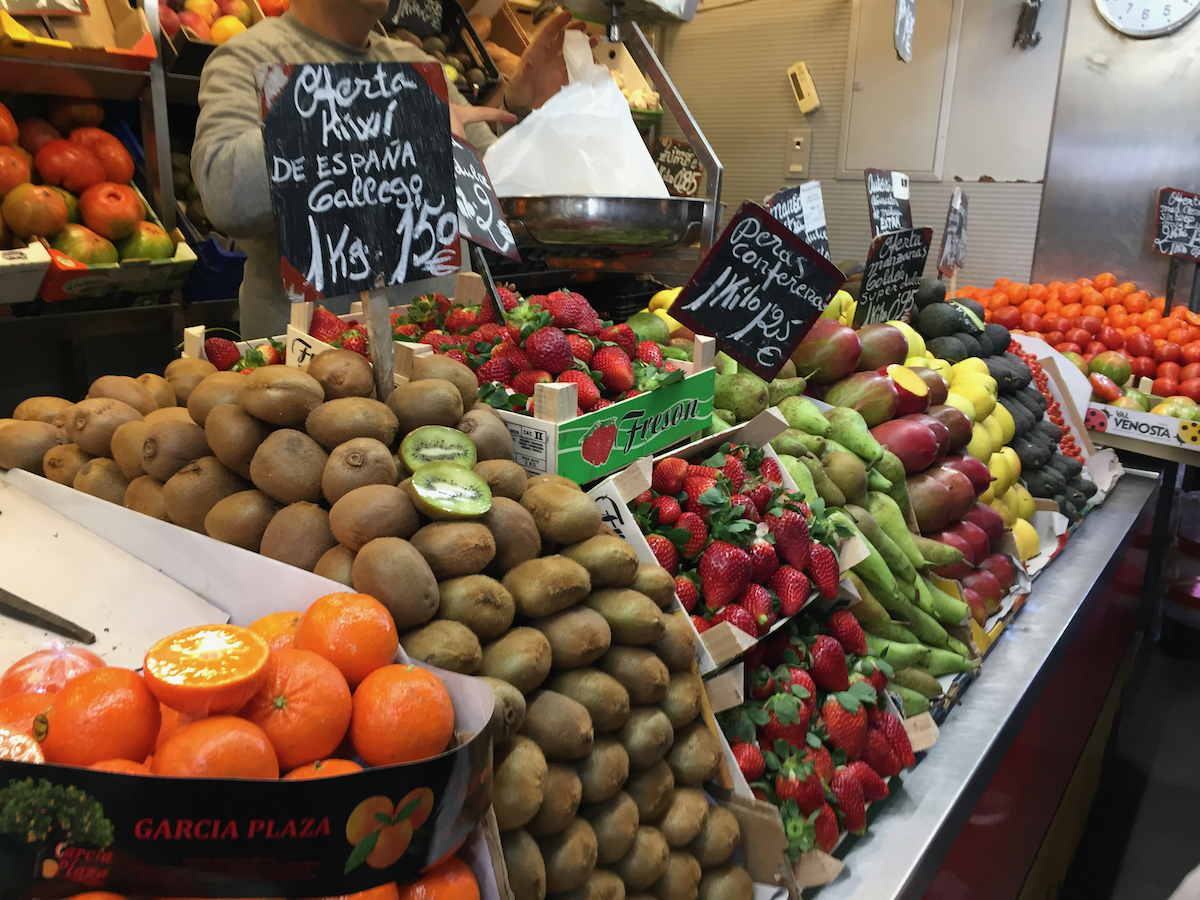
6) This photo is somewhat more recent, 2019. I cannot read the price of the strawberries but check out the price of the kiwi – €1.50 for a kilogram. And Bosh pears for €1.25. Kiwi will come up again shortly.
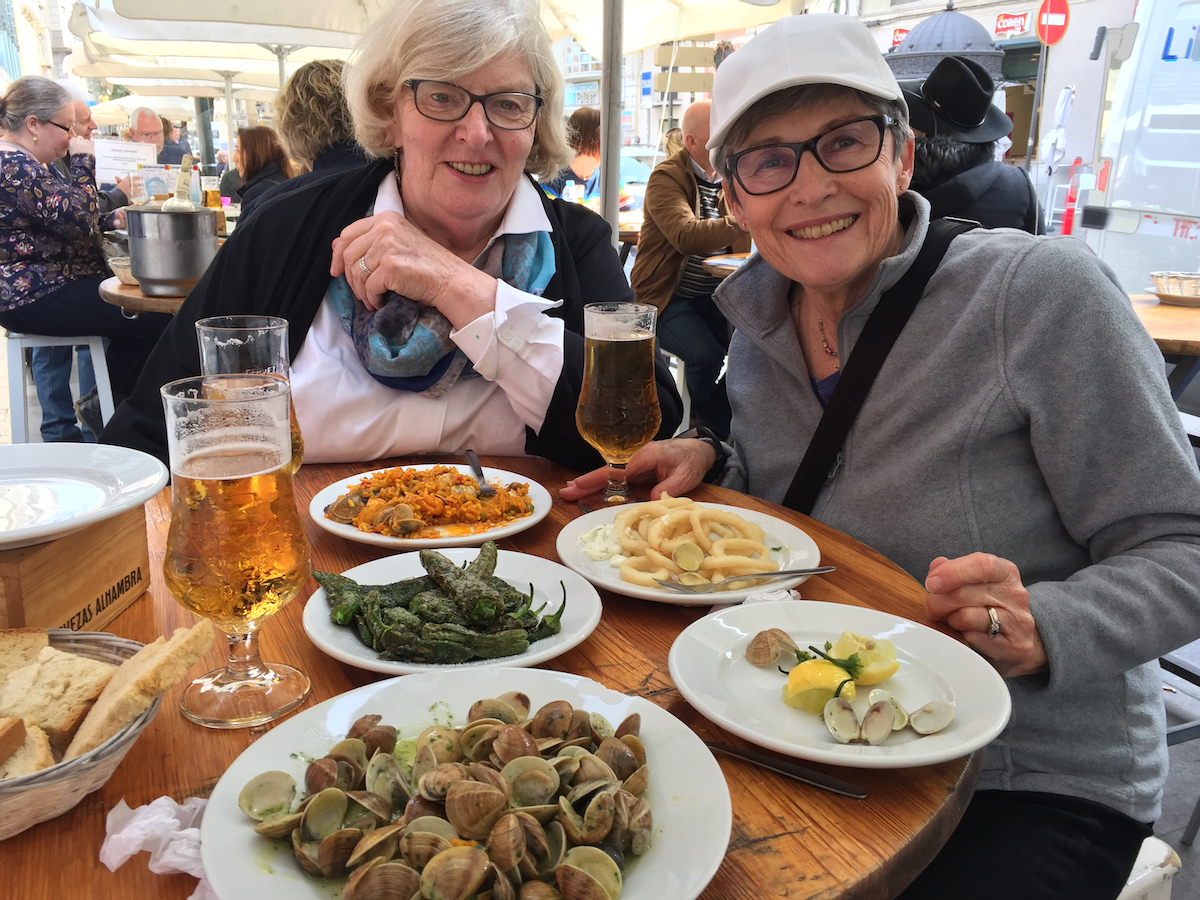
7) This is yet another reason to love the Malaga market. They have small restaurant areas on the sidewalk out front. Here I am having a plate of clams. The Love-goddess is having calamari and her longtime friend Johanne… who married us along with another of the Love-goddess’ friends (both ordained ministers) … is having Paella. Yes, we were married in stereo!
The green peppers are delicious. They are adorned with salt and grilled. They are not in the least bit spicy.
Local Market Options
As mentioned, some of the other towns along the Costa have permanent markets but most simply have day markets that come together on one or two days of the week. They are great places to buy fruits and vegetables but typically do not have meat or seafood.
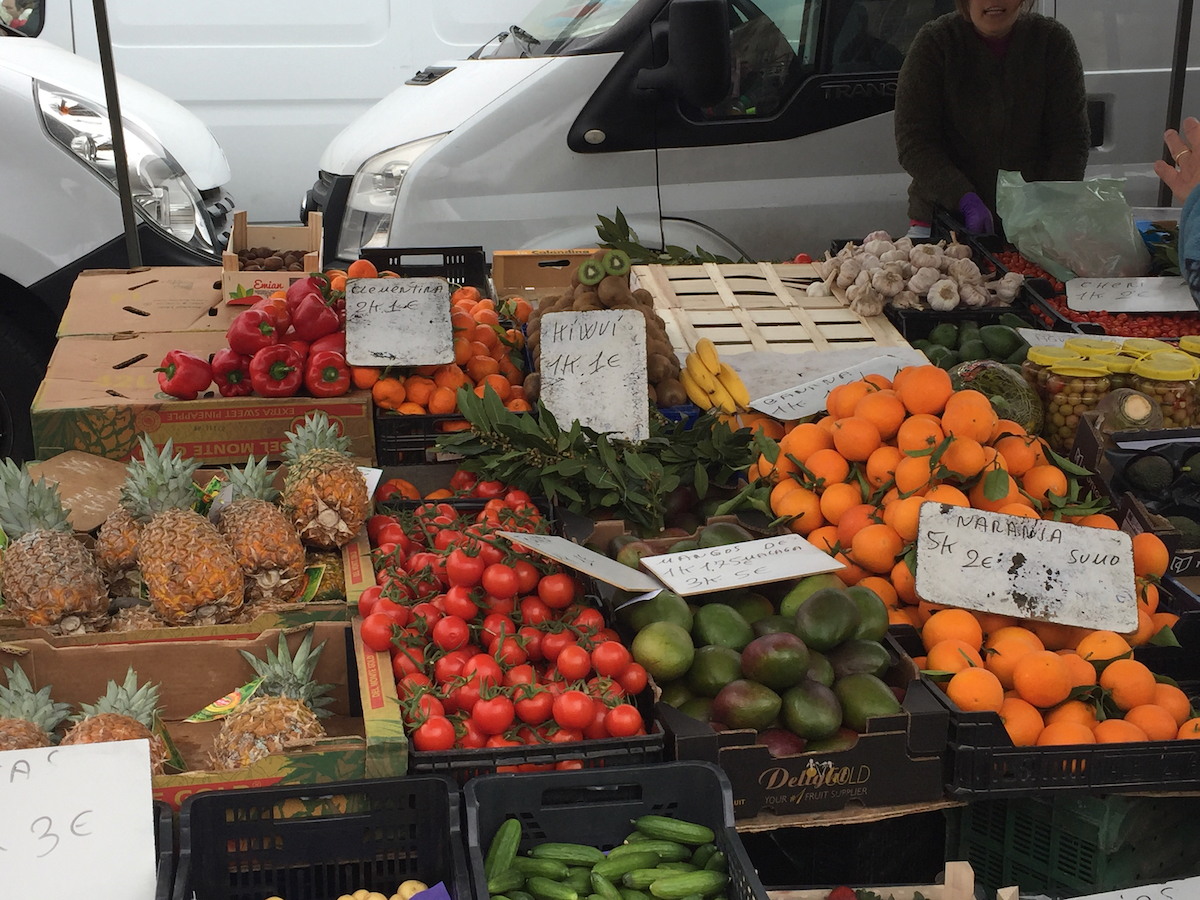
The next couple of photos were taken in 2019 at the day market in Fuengirola. Here in the first one, you see that you can purchase a small flat of strawberries for €3.50. You should be able to read a few of the other signs as well.
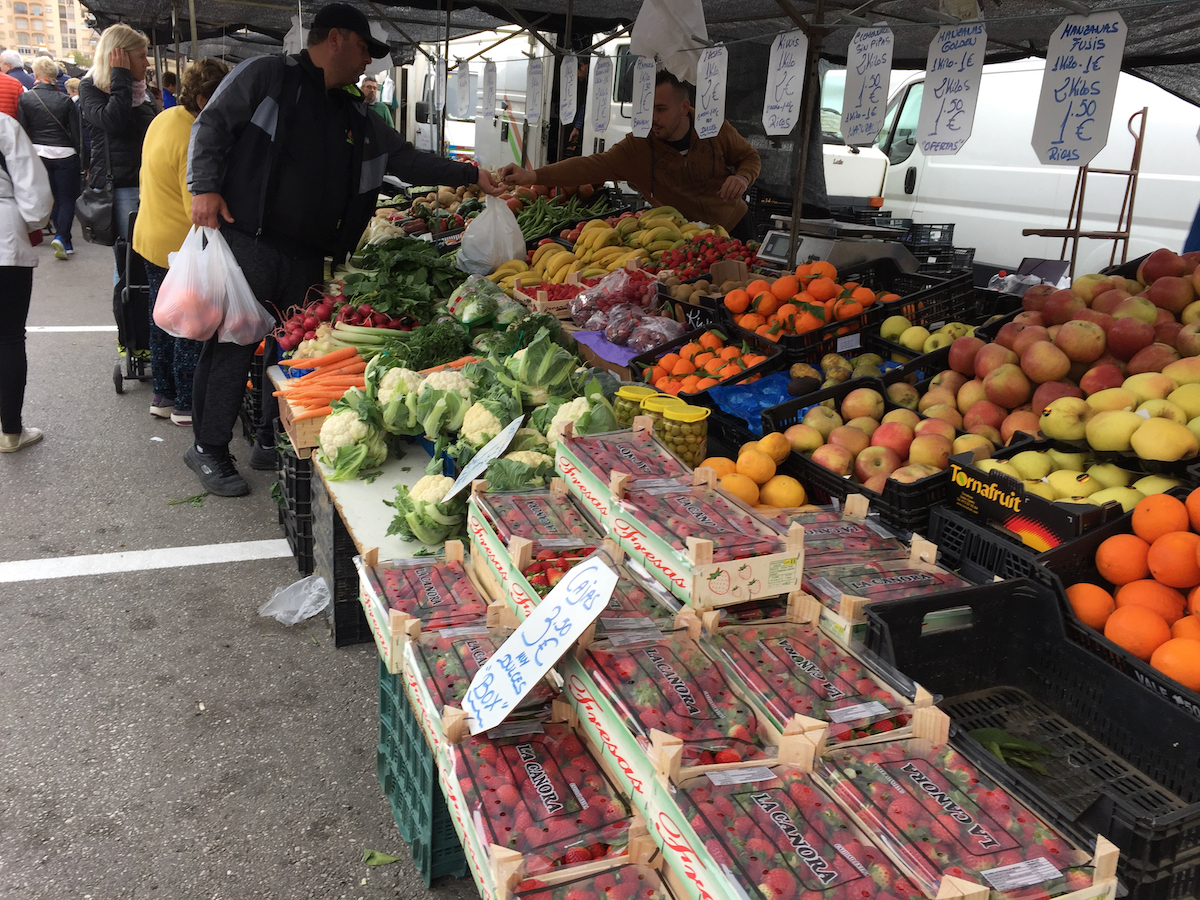
And now we return to the kiwi. As you can see, on this day you could buy 1 kg for one euro. Even less than at the Malaga market that year. Check out the other great prices; 3 kg of mangos for €5.00, 5kg of clementines for one euro, and 5 kg of oranges for two euros. These oranges are “Zumo”, or juice, oranges.
Of course, prices will be slightly higher in 2022, but I’m sure the pricing will still be favorable. We have not been to a day market yet so I cannot actually report on that.
After a day of shopping, one goes home and prepares an interesting European meal. In this case I have made the classic French dish, “Lapin à la moutarde à l’ancienne”, and Romano beans. Best served with crusty bread and a nice white wine. I will let you do the translating. 🙂
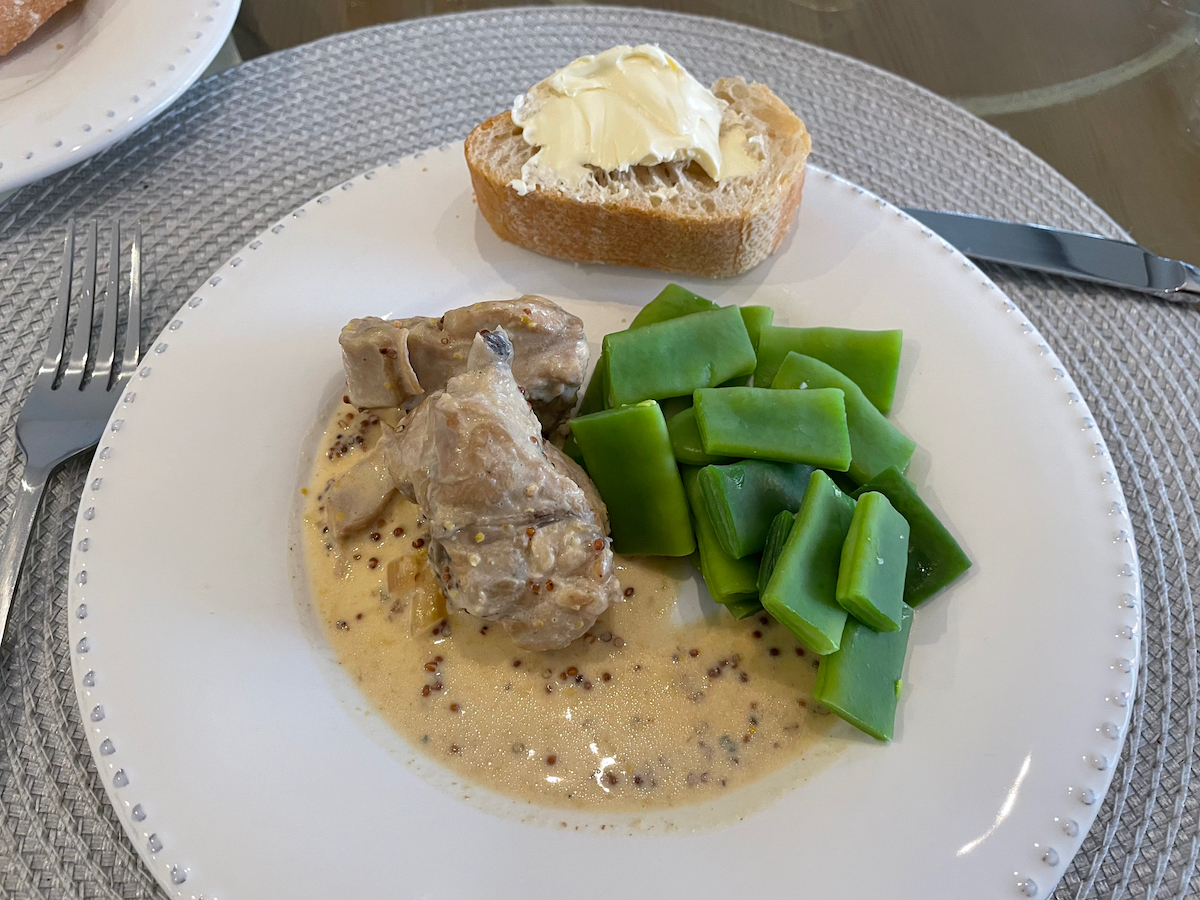
Bon Appetit!
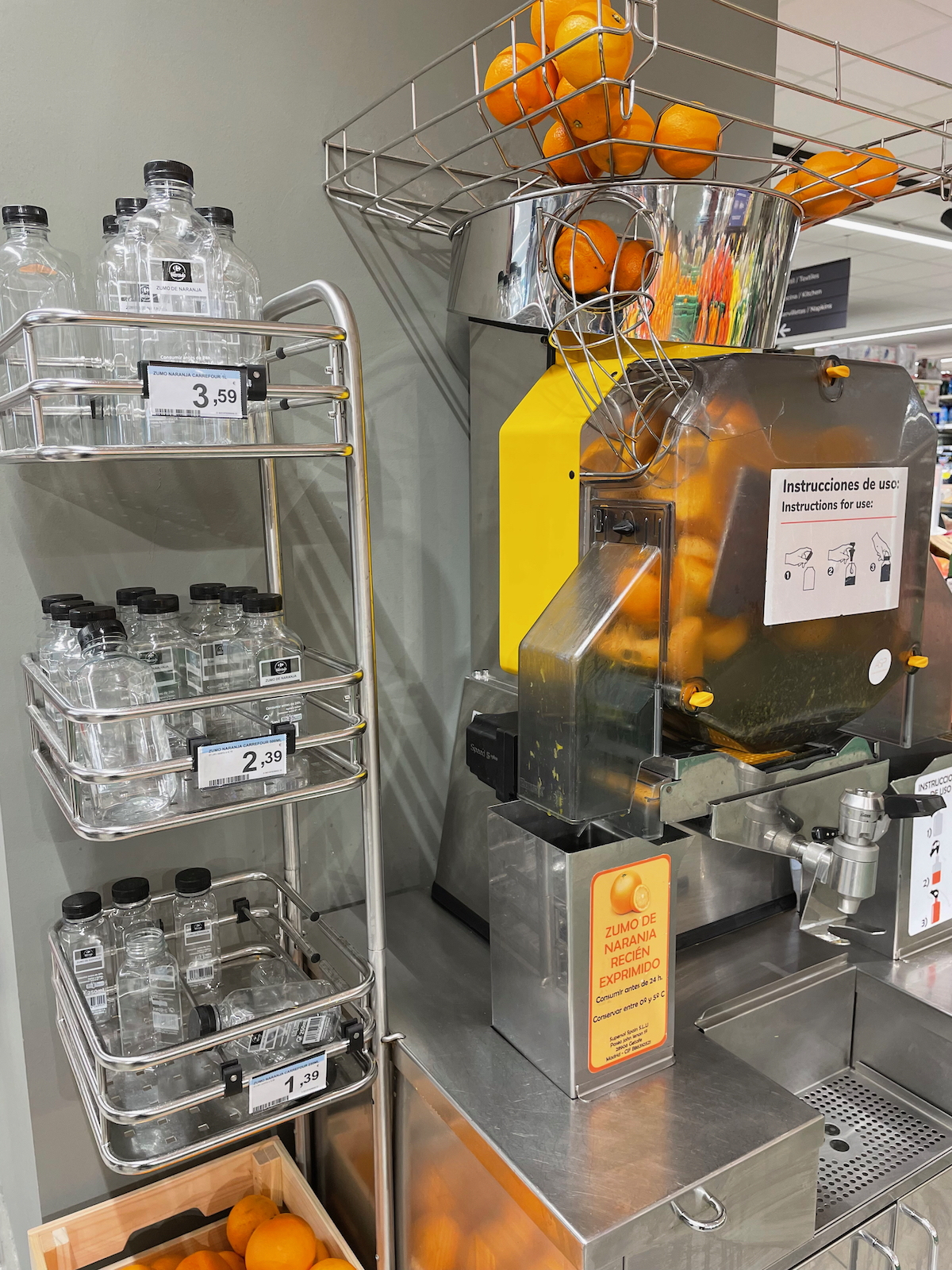
* Bonus Photo – Yes, you can whip yourself up some fresh squeezed orange juice in most grocery stores, but don’t bother. It is expensive and the packaged stuff is better than what we get at home.



Thank you for yet another informative post. These details are so valuable to those of us considering / planning for a winter in Spain.
Have you given any consideration to next year and what effect the current conflict in Ukraine may have on your plans? We are at the point we’d like to book something, but have hesitated due to this uncertainty.
If you’re willing, could you share your thoughts on how your plans may change (or not) for next year.
Cheers from Ontario!
Glad that you are finding the information useful. Hopefully, you will find future articles valuable as well.
In regards to your question about plans for next year. We have decided that returning here is definitely a possibility. Things happen so quickly that it is difficult to project ahead as to what will be going on in the Ukraine a year from now, and how that will impact travel to Europe from North America. Generally, things appear to be carrying on normally, other than the occasional pro-Ukraine march, as you may have seen on our Facebook page. Our back up plan is to travel to Vietnam for our winter get-away. You may have read that we don’t really get too concerned about booking until around November, so we have lots of time to get that sorted out.
Thank you for your thoughts on this. Most appreciated!