
Mr. Carney, please fix the OAS and restore the GST to the original 7% level.
Circling back to the start of this piece after it is mostly finished, I must report that I am finishing this article as Donald Trump has just had a hissy-fit about Doug Ford’s ads and has broken off trade negotiations with all of Canada… again! I also do this in advance of this fall’s November 4, budget. Current conditions reinforce the importance of moving forward without the United States as much as we can, and the need to consider all actions and possibilities.
All of that notwithstanding, what I really want to talk about here are a couple of specific issues that I personally would like to see Prime Minister Carney act on as part of Canada’s reinvention. Yes, the ideas and projects that people most often talk about are certainly important and will play a critical role in the reconfiguring of our economic future. I refer to those items including increasing defense spending, eliminating provincial trade barriers and restrictive regulations, developing new trading partners, building international trade-related infrastructure, housing, immigration, and building new pipelines, all while maintaining a focus on climate change.
Before I get into that though, I probably should, in the spirit of full disclosure, talk about my own political inclinations, hopefully to make it clear that I really don’t have any political skin in this game.
My Political Leanings
I consider myself to be a bit of a political agnostic. Since I turned 18, I have voted in every election, regardless of the level of government for which I have been able to vote.. I really feel it is my responsibility as a Canadian citizen to get out there and cast my vote each time a municipal, provincial, or federal election takes place.
I would also like to state that I consider myself a political centrist. I tend to lean slightly left of centre around social services and benefits and slightly right of centre when it comes to fiscal matters. I would further like to declare that I have voted at one time or another for all three of the major political parties.
To repeat, I have no political skin in this game.
Low Expectations
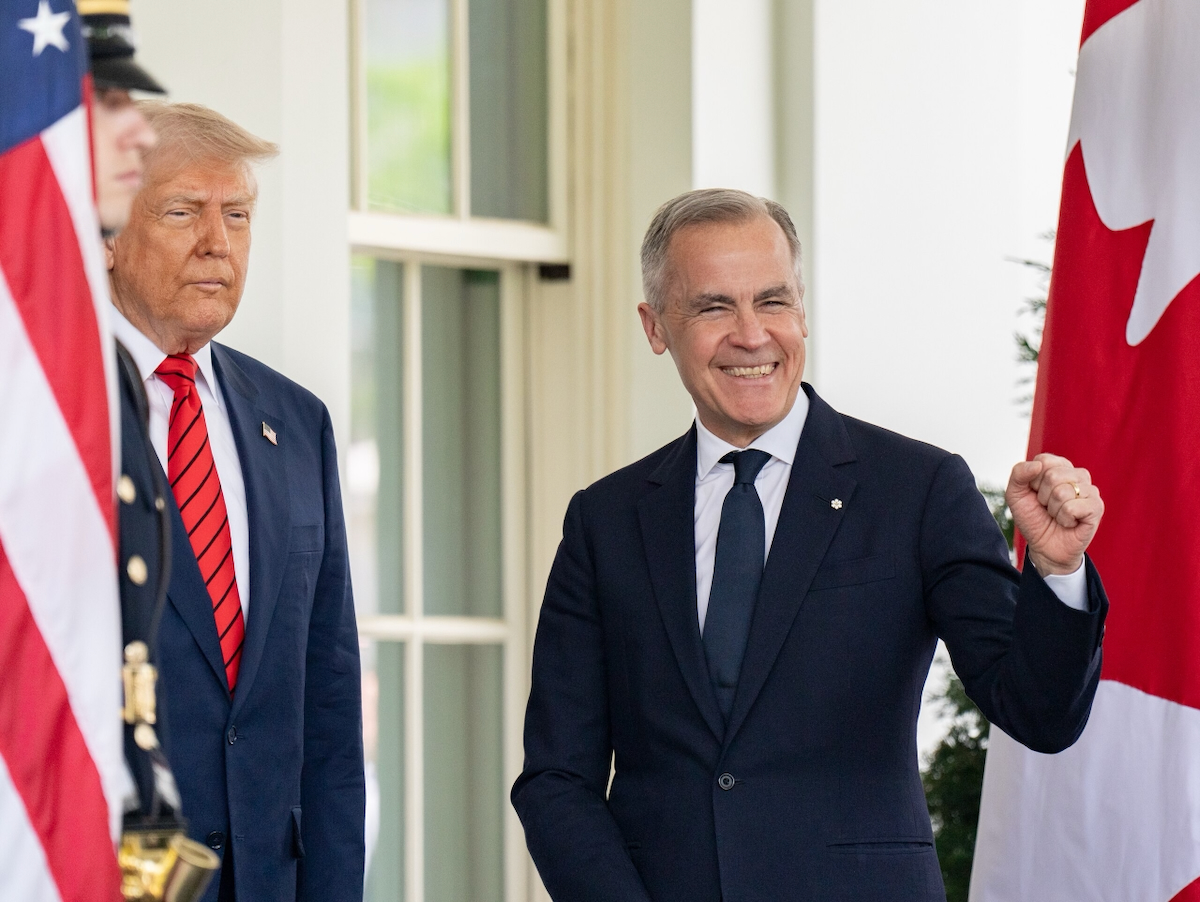
I would also like to formally declare that I have extremely low expectations when it comes to how much the federal government can achieve when dealing with the Trump administration over US-Canada trade. All I am hoping for is that our team can minimize the damage.
And as Canadians, that is what we need to prepare ourselves for. An era of a greatly reduced expectations, and probably an antagonistic relationship with the United States until the Gong Show in the White House ends. The long list of actions and builds detailed above, certainly must be implemented as quickly as is reasonably possible. But…
This is going to take a decade at least, so let’s not fool ourselves into thinking that there will be a quick solution to our trade problems with the United States. Unless we can get our hands on the Epstein Files or whatever “Kompromat” the Russians have on Trump of course, and that might expedite a quick positive trade deal for us. 🙂
Whatever the country ends up doing there will be a price to pay. The federal government will have to raise more money and cut spending in some areas. This is my two cents on how we achieve that.
Return the GST to the Original 7%
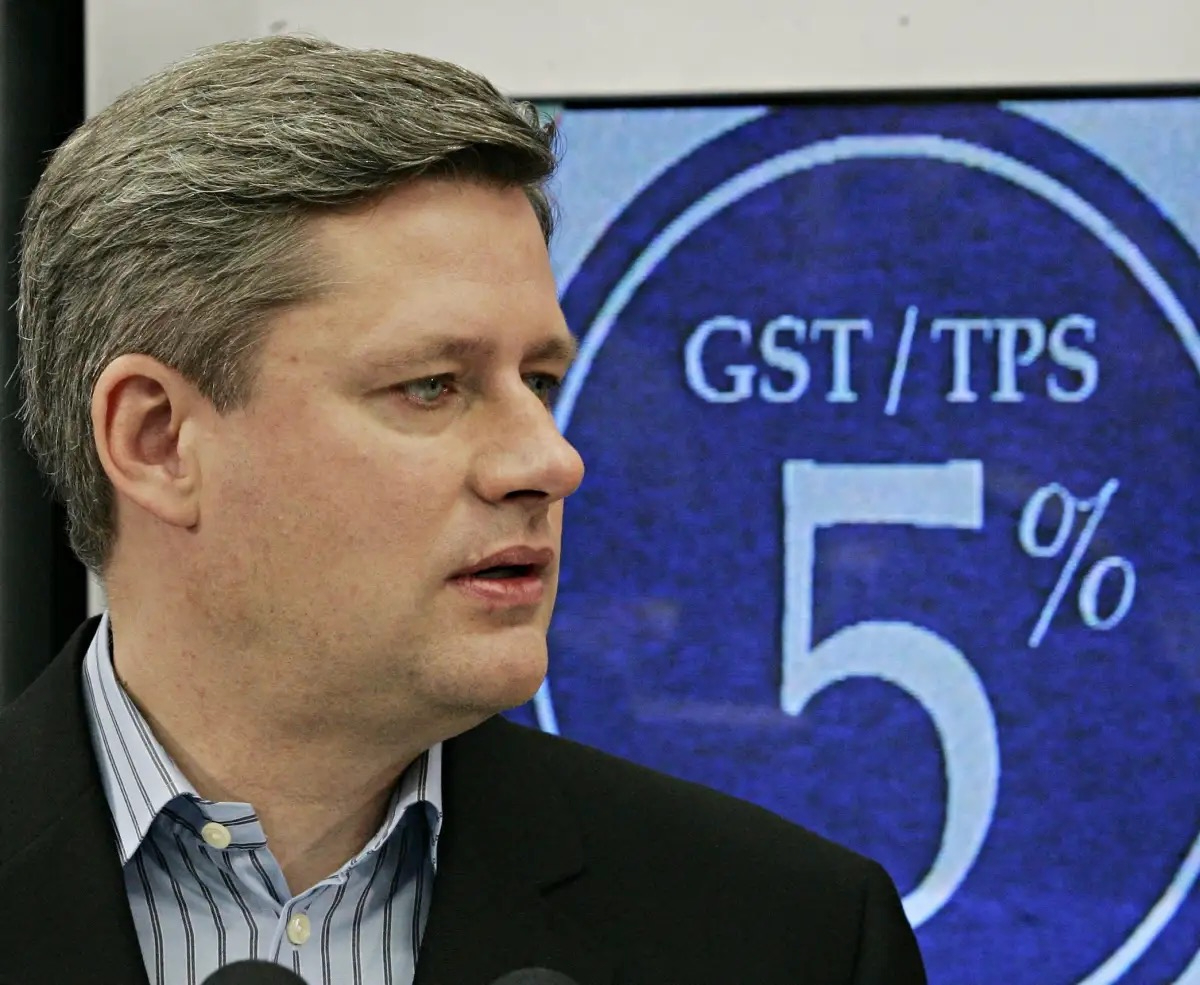
This has been a pet peeve of mine since Stephen Harper reduced the GST from 7% to 5%. That was done in good times, but as soon as more difficult times arose, the budget quickly slipped into a deficit position, which it would not have done if the GST had been left alone. Let me refresh your memory about what happened.
And here, ladies and gentlemen, is where ChatGPT becomes a very useful research tool. Not wanting to spend an entire day gathering the facts, I asked ChatGPT to do the following:
“Please provide all of the relevant facts, dates, and names related to (my introductory paragraph for this section)” … and then to … “Combine the Timeline of GST Reduction, Economic, Fiscal Impact and Budgetary Consequences Information into two or three usable paragraphs”
This is what it came up with –
“Stephen Harper’s Conservative government came to power in early 2006 on a campaign promise to cut the federal Goods and Services Tax (GST) by two percentage points. At the time, the tax stood at 7%, where it had remained since its introduction by Prime Minister Brian Mulroney in 1991. Under Finance Minister Jim Flaherty, the government reduced the GST to 6% on July 1, 2006, and then again to 5% on January 1, 2008. These cuts were made during a period of strong economic growth and healthy federal surpluses that had been built up under the preceding Liberal governments of Jean Chrétien and Paul Martin.
Each one-point reduction in the GST cost the federal government roughly $6–7 billion annually in forgone revenue, leaving Ottawa with $12–14 billion less each year after the full two-point cut. Economists and the Parliamentary Budget Officer later noted that this significantly reduced the government’s fiscal flexibility.
When the global financial crisis struck in 2008–2009, the combination of stimulus spending and lower tax revenues quickly pushed the federal budget into deficit—the first since the 1990s. Many analysts have argued that if the GST had remained at 7%, the government could have weathered the downturn with smaller or possibly no deficits. The decision to cut the GST during good times thus became a long-term constraint on federal finances, shaping debates about tax policy and fiscal responsibility for years afterward.”
You may be thinking, so why is this guy calling for more taxes? For the record, I think “user taxes” or “consumption taxes” are a much fairer form of taxation for most Canadians. People who have more money spend more money and end up paying more in taxes than the people who have less money.
Additionally, it is applied when people spend money, not when they earn it. The one criticism that has come forward about user taxes is that they somewhat unfairly result in lower-income individuals spending a higher portion of their income on taxable goods and services and therefore pay a higher effective rate relative to their income.
Be that as it may, it is here to stay, so let’s get it back up to the level at which it was originally calculated to best serve Canada’s needs. At the same time, let’s offset this increase in costs with another reduction in the basic taxation rate, or by increasing the GST/HST Credit rebate for low-income Canadians.
And Let’s Hide It for Pete’s Sake!
The truly most annoying aspect of the HST… The combined federal GST and provincial PST that we ultimately end up paying for goods and services is that it is always added on at the end. So, you never know what your total cost is going to be for an item until you pay for it – unless you have your calculator at the ready to calculate that when you look at the price tags. Every other country in the world that has a HST builds it into the price that you see on the shelf. This add-on annoys all Canadians, and it really irritates international visitors.
Please Reform the OAS
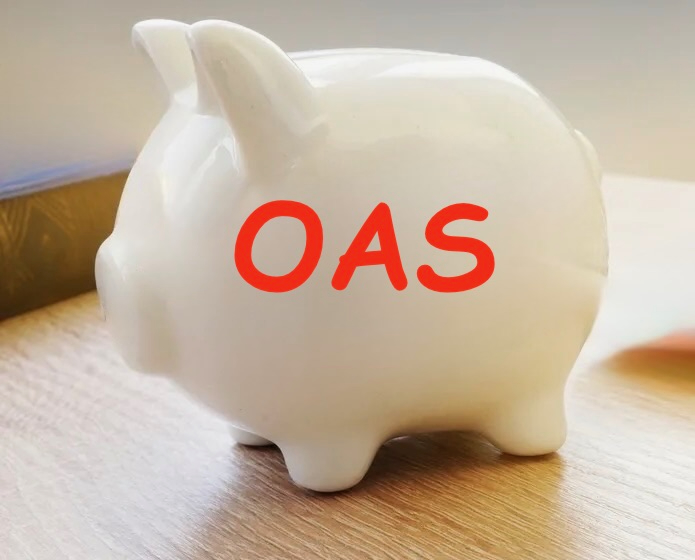
I return to one of my favourite fiscal pet peeves, the inequality inherent in the OAS and the enormous cost burden it puts on Canadians. OAS provides a monthly pension payment to most seniors who are over 65 – because most of us meet the simple eligibility requirements. It is free money. We did not pay into it like we did with CPP, and no tax dollars are specifically collected to help fund it. It just comes out of the general tax coffers.
For the 2024-2025 fiscal year, Canada’s Old Age Security (OAS) payments are projected to be $81.1 billion, representing about 18% of all federal program spending, which is $449.2 billion. OAS costs are projected to triple by 2045. The second largest is the Canada Health Transfer, which is projected to be $52.1 billion.
I addressed this problem previously in a post entitled “Is It Time to Blow Up the OAS … Is It Up to Those of Us Who Are Receiving It to Fix It?”. I suggest you go and read that in full. The points I made in my effort to show how important it is that OAS be majorly reformed were there to demonstrate that people who really don’t need this free money should have the amount they receive greatly reduced, and those who really would benefit from this extra money get more of it. The current system pays out significant amounts to high-income retirees while failing to lift many low-income seniors out of poverty.
You have probably read or heard somewhere that OAS can be “clawed back” for higher-income individuals. The problem is that the level at which the claw-back begins is set way too high and drags on incrementally at a glacial rate before high-income Canadians lose it all. As you will see in a second, you must be making some very serious coin annually in retirement to reach OAS “end times”. Let me explain.
Quoting from my own article –
“Individually, in 2024, all seniors can have income up to $90,997 before the government starts to take back some of the OAS money given to us. They will claw-back 15% of any extra dollars of income you make after that amount. My simple example is as follows. If your income is $1,000 over the threshold, they will claw back $150.”
Furthermore –
“After starting to lose income to claw-back at $90,997, an individual does not lose all of it until they have an annual income of $148,065.”
To me, the other disturbing aspect of this high-income end point amount for individuals is that the situation is even worse/better for couples. If you were not aware of this, in retirement, individuals in legal relationships can share or split some of their individual incomes for tax purposes. For many couples, this means that their taxable incomes become almost identical – the highest-income individual can have their income greatly reduced for tax purposes.
And the net benefit of this income sharing is as follows.
“For a couple who can split most of their income, it means that they will not lose every penny of OAS they collect until they have a combined income of $296,130.”
So, this is how things currently sit. A single person will lose all their OAS when they hit $148,065, while a legal couple will continue on their merry way harvesting free OAS monies until they have made a collective $296,130 … close to $300,000 a year before they lose all their free OAS money. I am hoping that seems as outrageous to you as it does to me. It is my belief that single people have a tough enough time in retirement without having the insult of having married friends continue getting free money when they really don’t need it.
In the interest of full disclosure, the Love-goddess and I are in that group where we hardly lose any of our OAS money. We both consider this to be profoundly wrong and do not think that we should be receiving any OAS funds at all. We are quite prepared to walk the walk and not just talk the talk.
That all said, I do not think any Canadian government in a minority position is going to invoke changes to the OAS, and then have to potentially face an election soon afterwards. So, I’m not really expecting anything dramatic to be proposed in next week’s budget.
If you want to learn more about a major initiative to even up the OAS playing field as part of their work on generational unfairness, I suggest you read articles by Dr. Paul Kershaw and look at the information provided by his group Generation Squeeze. Here is a link to one of his many articles available in the Globe and Mail dealing with the OAS question, “It’s time to reform Old Age Security – and a scathing auditor’s report confirms it”.
Why I Do Not Feel Totally Guilty About Trying to Take Away Your OAS
Another potential alternative source of free retirement money available to all Canadians is the TFSA. Please raise your hands if you are a couple with a very nice retirement income if you do NOT have a TFSA. I am thinking that there are probably not too many of you.
I cannot honestly recall whether I have read many financial articles that discussed the very real importance of the TFSA as a source of ongoing free retirement income. It may just be me, or is it a bit of an unspoken retirement “elephant in the room” … OK it’s more of an unspoken retirement “perk in the room”. Perhaps I’ve just not been paying close enough attention. 🙂
Again, to use ourselves as examples, we each have a TFSA to which we have fully contributed and combined they spit out more tax-free dividend income each year than what we receive in OAS payments. I am not saying that TFSA income should be considered when determining OAS claw-back, but at the very least, I would like you to consider how you benefit personally from that when you are deciding whether to support my efforts to get OAS reformed or not.
Hmmmm … perhaps tax-free TFSA income should be considered when determining claw-back. Food for thought.
Mr. Carney, thank you for listening… I may have more to say on other matters. Let me throw one out here for you, I think it’s time to implement “Mandatory Voting”.
Addendum – Kudos to Rob Carrick
Just after I finished this piece, I received an email from “Rob Carrick’s Substack” project entitled “Carney says Canadians must make sacrifices – here are a few ways he could go” In it he talks about increasing the GST and the needed changes to the OAS. Good to see Rob at least speaking about both issues because he has a much larger platform and a more recognized voice than I do.


