
Now that we’ve looked at bigger picture issues related to our proposed new set of rules for golf in retirement, it is time to look at some particularly challenging obstacles found on every golf course. Occasionally, my mind thinks their sole purpose is to suck the joy out of playing golf. :-)Those being the “Out of Bounds” areas and the “Hazards”.
Before we begin discussing all the badness, a bit of a reprieve. Let’s chat about doing the right thing, hitting solid shots down the fairway.
You Hit the Fairway!
Let’s say you’re a great driver of the golf ball and absolutely every time you tee off, your drive lands close to the middle of the fairway at a reasonably long distance away and you repeat this every time. I suspect that there are golfers all over the world reading this who are laughing hysterically to themselves because golf shots often end up in a place much worse than the fairway.
Hypothetically speaking though, even if you were able to do that, there are still challenges out there, even on the most well-maintained fairways. There are divots created by other golfers that your ball can roll into. There are dried out patches of fairway and damp patches that can have a negative impact on your next shot. In the official golf rules, you must hit from all these localized adverse situations without any sort of relief, except when they are are deemed to be unplayable.
We are no longer going to live with these fairway blemishes ruining our day. On each and every shot from the fairway you are going to get to invoke the “improve your lie” rule (if you feel it is necessary).
That’s great of course but given that we can’t all hit perfect drives off the tee all the time, let’s look at the less-than-optimal results that can occur.
Unfortunately, it’s not unusual for less-than-optimal or true “badness” to come into play on many holes with your very first swing of the club, the tee-shot.
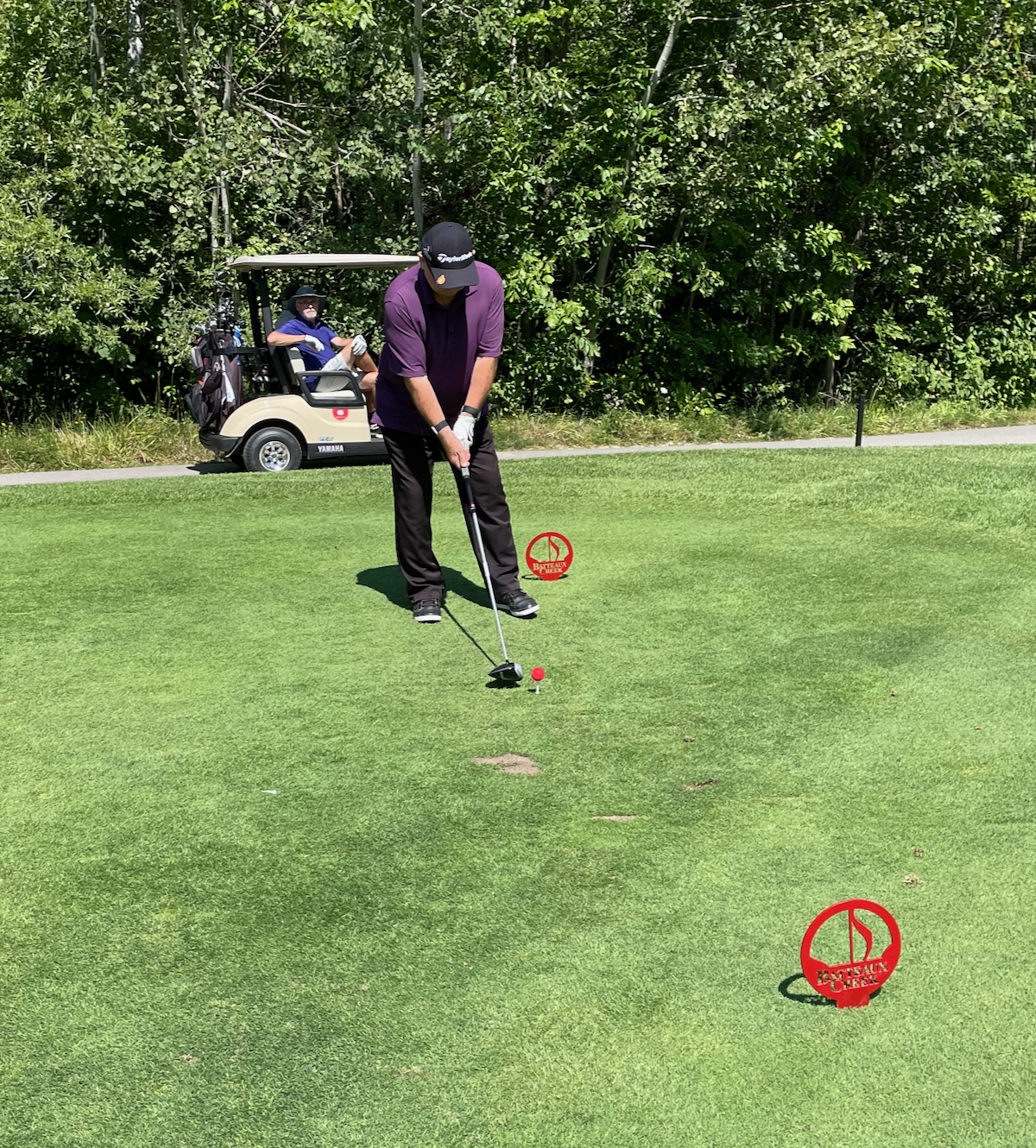
Not In the Fairway – The Crappy Tee Shot
Yes, there are lots of crappy things that can happen right off the tee. Hard to imagine, given that the ball sits about an inch and a half off the ground on a little stick just primed for easy picking. Let’s drill down into the crap.
The Dreaded Hosel Rocket!
This is absolutely the worst thing that can happen when you stand up in the tee box and take a mighty swing … shall we call it, imperfectly?… and the ball takes off in a direction, greatly deviated from where you thought it would go.
For example, a miss-hit sends the ball shooting off at a wild, almost logistically impossible 80-90° angle out of bounds or into an area of extreme rough. It is referred to as the dreaded “Hosel Rocket” or Shank. It is the most hopeless feeling in the golf world.
On shots like this, the regular rules of golf must be followed. The only viable option is to take “stroke and distance”. That means you tee up again, take a penalty stroke (stroke #2), and hit your drive (stroke #3) over. Hopefully, this time it goes straight and not back into the rough, or you are standing there once again, hitting shot #5 off the tee.
That is the worst-case scenario. Let’s look at some other not so good scenarios, but with better options for your next shot.
We Missed the Fairway … By a little
We hit a decent drive, but our ball is not on the fairway or the First cut. It’s nestled out there somewhere in the sometimes very unpleasant Primary cut of rough. Just like when we’re playing winter rules in the spring, we should spend a limited amount of time looking for a hidden ball in this area.
It’s all about maintaining a good pace of play and not driving our fellow golfers or the golf group behind us crazy as we take extended periods of time searching for a lost ball. Every time you have a situation like this, just drop a new ball, a free drop if you will, in the general area where you think the ball ended up and swing away without taking a penalty stroke.
If you’re feeling a little queasy about taking a free drop, remember this. In Pro tournaments there are people whose job involves scurrying over to where a golfer’s ball has landed in the primary cut or other bad places and placing a little flag on a thin metal stick beside it so that the golfer can find it without searching. Recreational golfers have no such luxury. Drop a ball and move on.
And I will probably repeat this several times, because we are playing “improve your lie.” Make sure you move your ball around a bit in this longer grass to provide yourself with a more favourable position to hit from. This is often referred to as “fluffing up” your lie. However, this should be done with a club face, and never with your hand… again, not a free for all.
We Missed the Fairway and the First and Primary Cuts … By a Lot
Time to discuss the true round-stifling stuff, places you really can’t play from or aren’t allowed to play from. Let’s discuss what happens when you don’t land in the fairway, or even in the First or Primary cuts. You end up “out of bounds” or lost in a place in the extreme rough … commonly referred to as “the Shite”… where you’ll never find your ball or from which you will never be able to play.
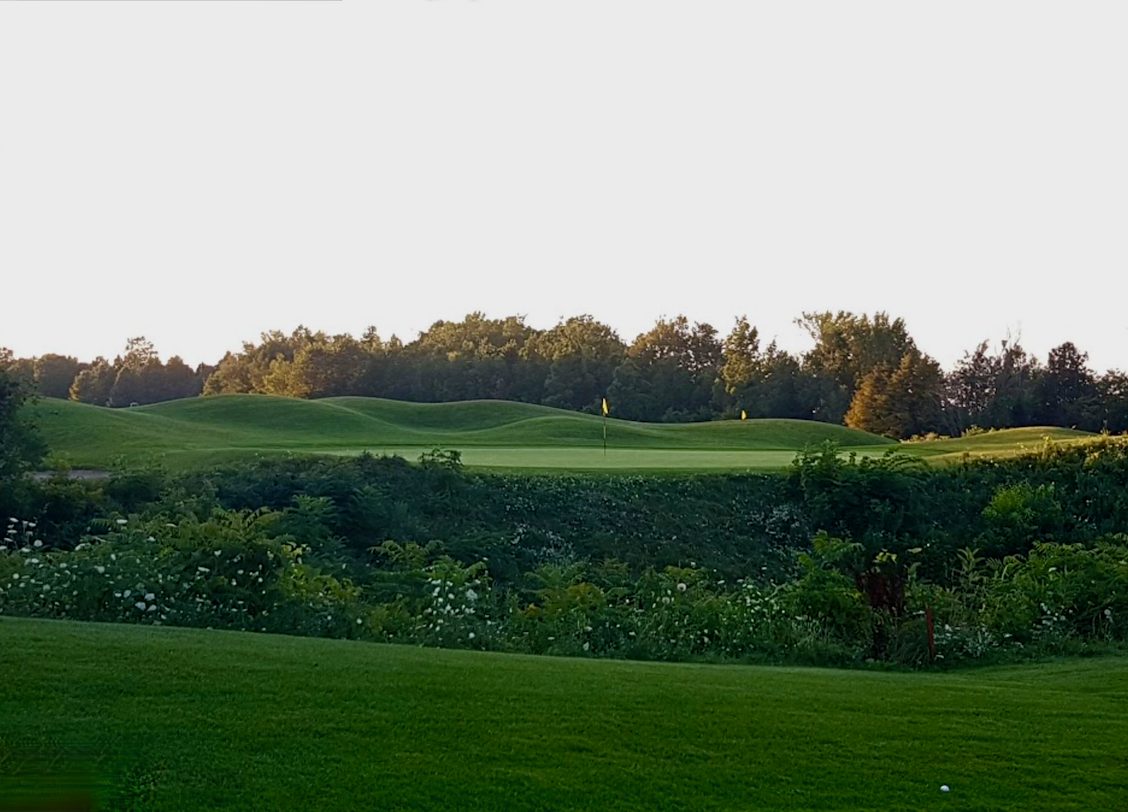
We Went Out of Bounds or Lost a Ball in the Shite
“Out of bounds” is kind of straightforward. These are the areas into which you have hit a golf ball that you are not allowed to play out of under any circumstance. Often it means you have left the grounds of the golf course entirely, hit into an environmentally sensitive area, or the ball has ended up sitting on someone else’s property.
A “Lost ball” is exactly what it says. You have hit your ball somewhere and cannot find it. That may be out of bounds, or it may simply be in a wooded or overgrown area on the course that is considered in-play.
For the record, areas that are designated as “out of bounds”, are typically marked off by a string of white stakes. Occasionally they aren’t because it’s something so obvious like a fence separating a golf course and a field of corn.
If you hit a decent drive, but your ball goes go out of bounds or into the rough where it is totally lost, the official rule states that you must take “stroke and distance,” You are required to return to where you hit from, take a one stroke penalty, and hit again. The same rule applies if you hit your ball OB or into an area where it is lost from the fairway, or from anywhere else where you have taken a shot.
I’m not going to delve into hitting provisional balls or the fact that if you go searching for your lost golf ball and find it, you then must walk it back to your original spot and hit again. This is all time-consuming stuff and really slows down the game. No one should be doing it. You need to be doing something less punitive.
A Kinder and Gentler Way to Address Going Out of Bounds or Losing a Ball
A kinder and gentler, and less time-consuming rule is definitely required here. Interestingly, the official rules of golf now provide a very viable option. That is the alternate rule “Model Local Rule E-5”. Here is what it states:
“Model Local Rule E-5 is an optional rule designed by the USGA and R&A to speed up the pace of play by allowing golfers to drop a ball in the fairway after hitting it out of bounds (or losing it) instead of walking all the way back to the previous spot.
Taking this relief comes with a two-stroke penalty rather than the standard one-stroke stroke-and-distance penalty.”
If you are interested in reviewing the entire USGA explanation for this rule, you can access it by following this link.
The following video explains the E-5 rule:
So that is lovely, a chance to come out sideways and drop on the fairway. But, at the cost of a two-stroke penalty rather than just one. A kinder and gentler modification to that rule might be to bring it out and drop it in a spot not as advantages as the fairway. For example, drop it on either the First cut or in the Primary cut within a club’s length from the fairway and take a one stroke penalty. I’m not clear in my own thinking about how I feel about this, so I will leave that for you to ponder.
An Alternative to Rule E-5
A commonly used and practical alternative approach that avoids stroke and distance, and the Rule E-5, is to take two club length relief from where your ball went out of bounds or into the shite, take a one stroke penalty, drop a ball and hit from there. Technically, this is an option like what is available when you hit into a lateral hazard indicated by red stakes, which I’ll be talking about later.
When Out of Bounds Isn’t Really “Out of Bounds”
What I described earlier probably made it seem like out of bounds was an inaccessible place on the other side of a fence, in a deep crevasse, buried in an impenetrable forest, or out of reach in an environmentally protected area. All of those are places where you could never hope to have a swing at a golf ball anyway and probably where you are not even going to be able to find your ball.
Sometimes that is true, but a lot of times it’s much less catastrophic than that. I have discovered on several occasions over the years that when my ball lands just on the other side of the white sticks, it is easily found and it is in a perfectly acceptable spot to hit a golf ball from.
When you find yourself in a similar situation, as all golfers will, you may find yourself standing there scratching your head, wondering “why the white stakes?” Most frequently an out of bounds boundary in a situation like this is simply protecting private property from being used or trespassed on by golfers.
Here is a visual example of what I am talking about. This is the Monterra course in Collingwood that we play every summer. The image is the satellite view in Google Maps of the first hole, a par five. As you can see all along the left side of the fairway there are private homes whose backyards abut the golf course.
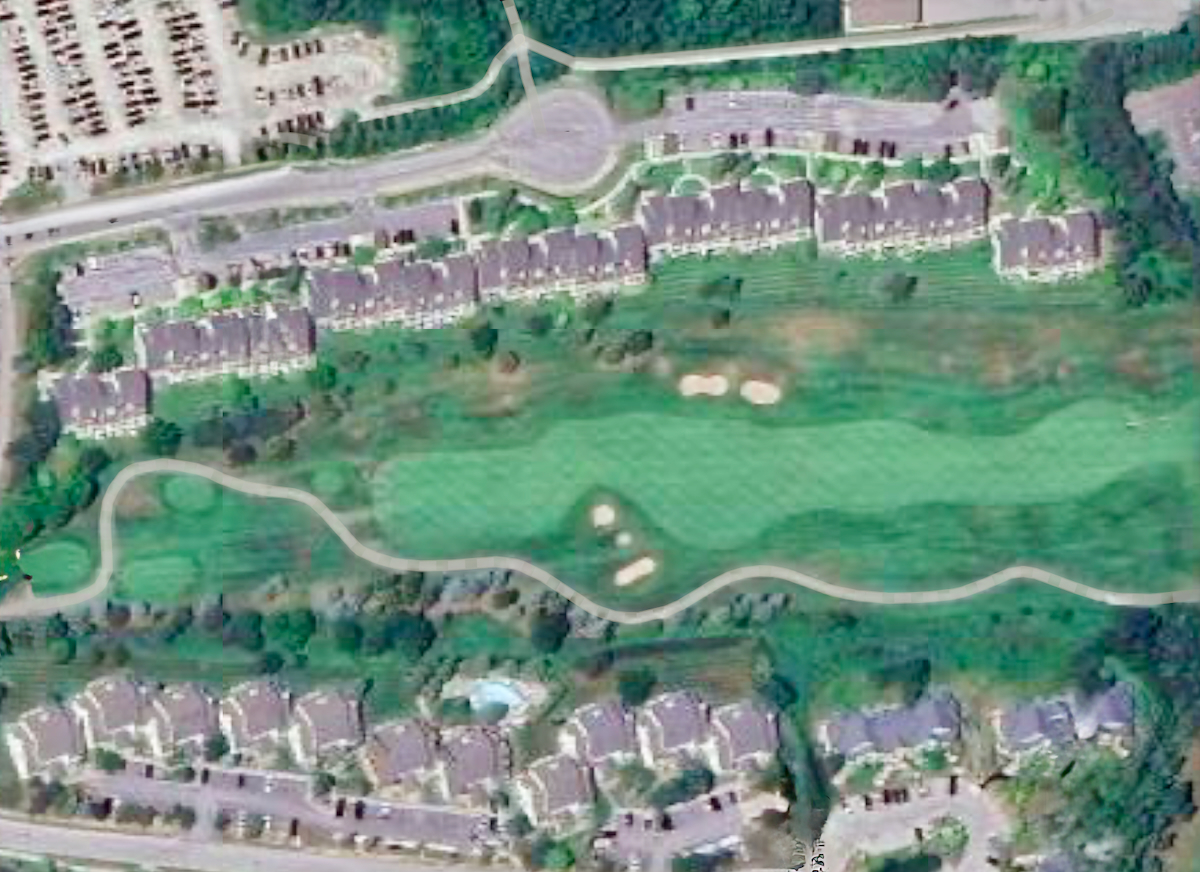
You can’t see them here, and I can’t remember exactly where they are, but there are white stakes separating those individuals’ properties and the golf course. I believe there is even a bit of a buffer zone between the white stakes and the backyards where potentially you could play from. There is no fence.
This example presents a perfectly acceptable area to play a shot from but again you are supposed to play stroke and distance. I’m sure the main reason is to keep golfers from wandering onto someone’s yard and taking a divot out of their lawn.
However, it makes absolutely no sense to play the time-consuming stroke and distance. Again, you could apply the Model Local Rule E-5, but it might make more sense just to take the lateral hazard, two club relief rule and hit away.
I will leave you with a final thought. Perhaps there should be a dual-coloured white-red stake hazard where, when you find yourself out of bounds in what would normally be a very playable area you can use the lateral hazard, two club length relief rule.
Our discussion about out of bounds and lost ball complete, let’s move on to the oh-so enchanting obstacles on a golf course traditionally known as “hazards”.
The Hazard of “Hazards”
Apparently, golf course hazards are designed to add strategy, create risk-and-reward choices, and test a player’s skill. Allegedly, they force golfers to think carefully about every shot instead of just hitting the ball straight.
The Webster’s dictionary defines “hazard” as:
“A hazard is anything that has the potential to cause harm, injury, illness, or damage to people, property, or the environment. It is the root source of danger.”
Geeeeeez … no kidding.
Clearly, course designers throw them in to generally undermine our efforts, mess up our scoring, infuriate us, and generally suck the joy out of the game of golf. Perhaps a little overstated, but they are definitely a pain in the backside.
Interestingly, the term hazard has been dropped from the official rules of golf. These areas are now referred to as “penalty areas”. You can slap lipstick on a pig …
At times, these hazards feel like they are insurmountable obstacles in our path to golf glory. And every golfer knows the extended messing-up of just one of the 40 and 80 total hazards on a modern golf course can induce a single hole score of biblical proportions. This even happens to the pros in tournament play. John Daly took an 18 on the 6th hole of the Bay Hill Invitational in 1988.
To digress slightly, given that one hole can be so totally devastating to a round, I think it’s important to limit the damage related to the single hole blowup. I am going to suggest a cap on the number of strokes you can count on any given hole. I will present my thoughts on that in Part Three.
So, that is what golf course hazards are in general terms, now let’s get into the specifics…