Given that I’m going to be writing about a few restaurants during our 2024 stay in Marbella I thought this might provide you with some additional relevant information. In this article from 2022 I mention a couple of restaurants we ate in and enjoyed in Marbella that year, along with a few in other places. It also has some reasonably good general tips about restaurant dining in Spain right at the end.
The title photo for this piece was taken at a restaurant in Nerja, called Antica Roma. It was taken in 2017, our first year wintering in Marbella on the Costa. We wanted to have a look at Nerja because we’d heard from others that it was an interesting town.
A mutual friend hooked us up with Bill and Lorraine, the couple on the left, who had been wintering there for over a decade at that point. We offered to buy them lunch, if they agreed to tour us around a bit… and they got to pick the restaurant. Great choice guys.
I have several goals in mind for this article. First is to provide you with a sense of what the food is like, because it is absolutely fantastic. Secondly, I want to give you a bit of an idea of the cost involved in eating out here. And thirdly, I hope to share with you a few or our dining-out tips and important information you need to know.
The article most directly deals with restaurant eating on the Costa Del Sol, but it generally applies to all of Spain. I will start with visits to a couple of restaurants we have eaten at this month, followed by other places we have eaten while wintering here, and finish it up with a favourite restaurant in Granada. Lots of great cities can be visited within only a few hours of wherever you are staying on the Costa… but that is another article.
To see a larger version of all the photos simply click on them. The photo will pop up in a new tab or window, allowing you to examine any of the images in greater detail. There continues to be an issue with sizing looking at our photos on cellphones… we are still working on it.
Recent Restaurant Visits in Marbella
I will be showing you actual receipts from different restaurants in my effort to demonstrate pricing to you. Needless to say, they are all in Spanish, so I will offer translations. In Spain, always ask for an English menu (Menú inglés). Many restaurants offer them because English is the secondary Lingua Franca throughout Europe. Some will have just one menu with offerings in both languages. Look for the English in small print under the offering.
1) Let’s begin with an important detail. The official lunch hour in Spain does not begin until 2 p.m. Bill and Lorraine pointed this out to us during our visit because they didn’t want us ending up ravenously hungry before we stopped to eat. 🙂
Some restaurants will not even open their doors until that time. The reason is this – most businesses, other than grocery stores and a few other services, close for lunch between 2 and 5 PM. The following photo is a typical sign on businesses here. Restaurants, of course, are open during lunch hours. Here in Marbella most are open and serving by noon. They know which side their bread is buttered on, to use a food metaphor.

2) Next let’s talk restaurant selection. A tried-and-true method for selecting restaurants in Europe has rarely failed us over the years. We try to eat in restaurants where it is obvious that only locals are eating there, no ex-pats or tourists.
One Sunday, early in our visit, we walked “through” this restaurant… big wide sidewalks here. I snapped this photo later in the day as we were wrapping up our walk. I’m not sure if you can tell or not, but the place is crock-a-jock full of people, on the patio and in the restaurant. When we walked through, every single person was speaking Spanish. It met the criteria so we agreed to go back and have lunch there.

3) So, here we are during the next week. We arrived at the restaurant well before lunchtime so we would not get there at a busy time… just after 1 PM. It was a beautiful day. In just about every restaurant in Spain you get these items to start with. They throw down a little plate of olives for you to nosh on and a basket of bread. The olive tapa is free, but if you eat the bread you pay for it. If you don’t eat the bread, you do not pay for it.
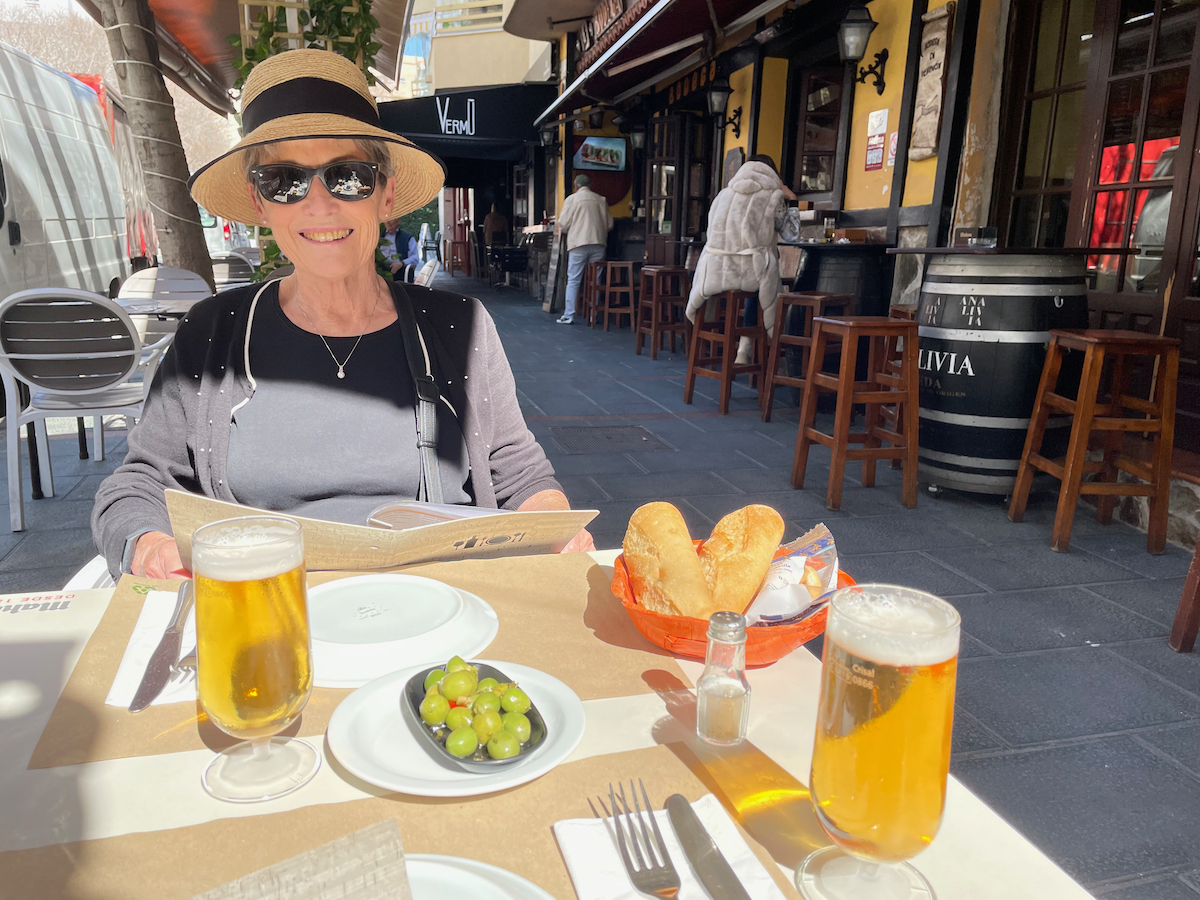
4) Let’s talk food. Right in front of me is a lamb skewer “tapa”. If I had known, it was going to be this big I might’ve ordered only one thing. But I HAD TO order the plate in the center. It is called Carrillada, which are braised pork cheeks… one of my faves. The Love-goddess had a fish platter.
As you can see, they will often throw a bunch of chips on the dishes you order. The other dish we had, not shown, was called “Gambas al Pil Pil” (Pil Pil shrimp)… another favourite. Gambas al Pil Pil will pop up in a later photo.
We both ordered a “half ration” plate for our mains. Many restaurants will offer a dish in up to three sizes. Here is an example (Racion 8,50 €, Media (half) Racion 5,50 €, Tapa 2,70 €). The sizes are increasingly smaller. Typically, you see this more in restaurants catering to the Spanish, not tourists.

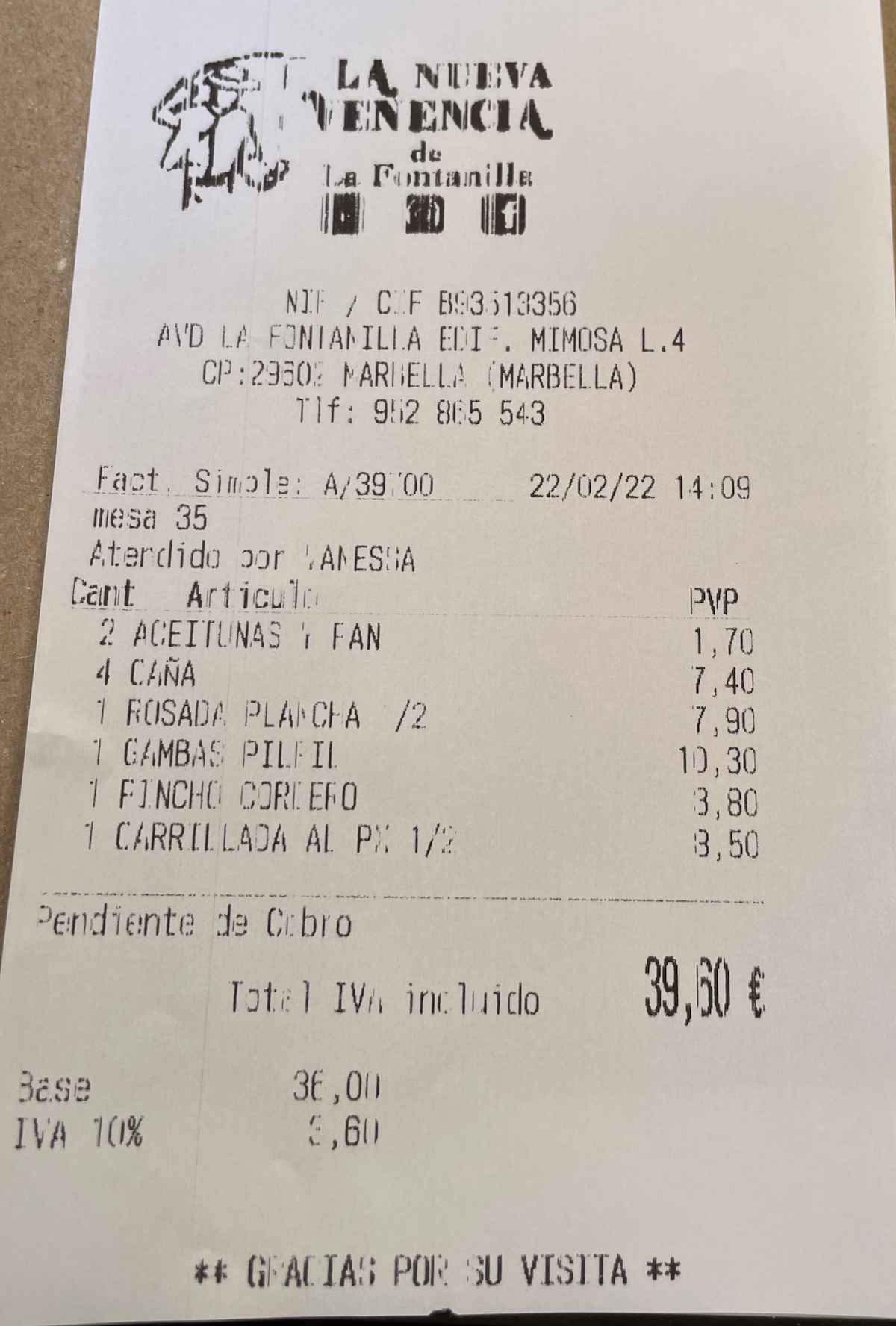
5) And there you have it, the total bill. We had four beers, we ate the bread, and had four separate dishes. 39.60 € is currently the same as $57.03 CAD. You don’t tip usually, but it is good practice to leave all the change, or even throw down a couple extra euros if you really liked the food or the service.
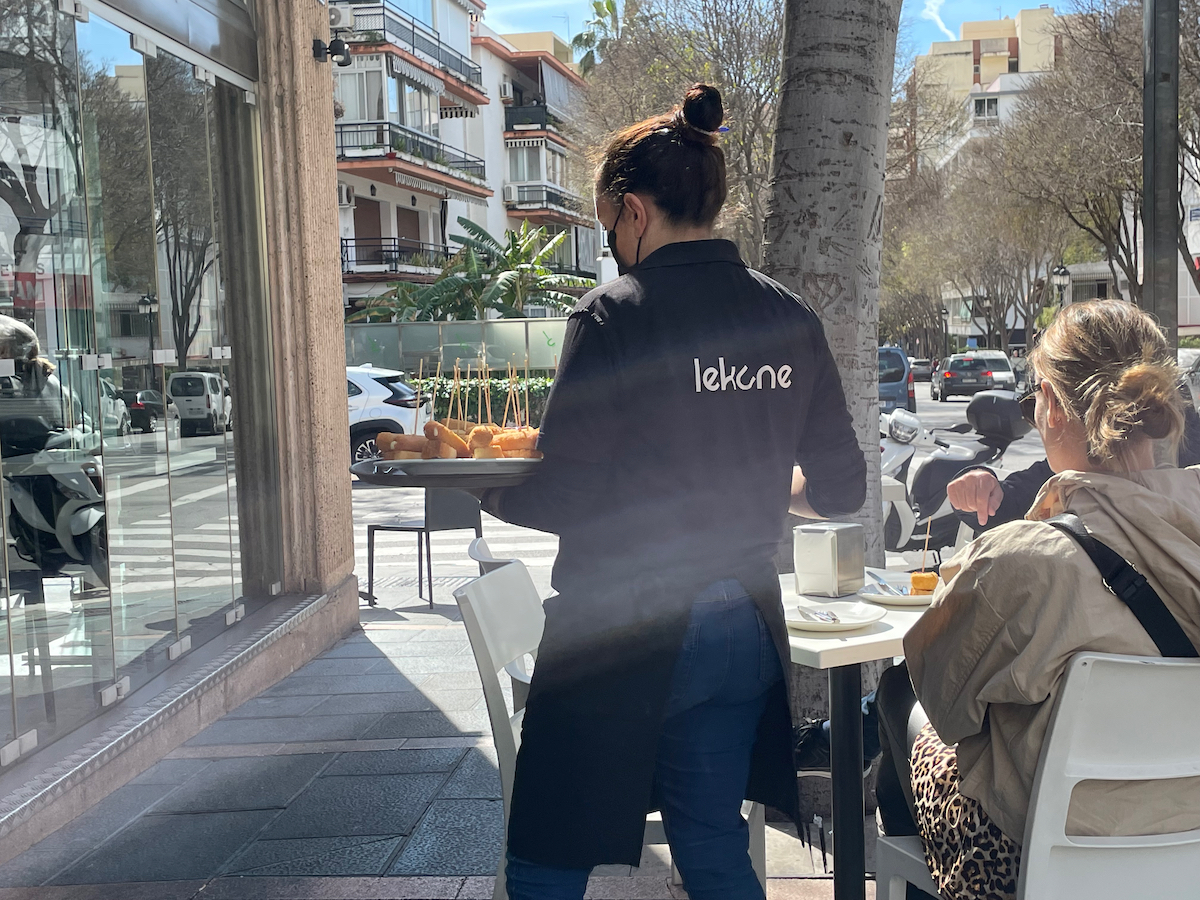
6) On Wednesday, we decided it was time for another lunch out. We had our eyes on this place down the street that is always very busy. Possibly because the patio on both sides of the building is always in sun. But we assumed it had good food as well because they were lots of locals and ex-pats eating there. So, we decided to give it a go.
I took this photo after we had finished and left. Still as busy as it was when we arrived. We were lucky to get a table.

7) We felt like, and performed like, total newbie tourists here … totally embarrassing. 🙂 The server spoke virtually no English at all, so we communicated through pantomime. She dropped two plates and a glass holding cutlery and napkins on the table. After that she managed to convey to us that it was a Pintxo bar.
Adding even more awkwardness to the situation, I motioned with the plate and pointed inside to see if we had to go in to get our food, as is occasionally the case in Pintox bars. She was finally able to convey how the system worked. Like some other Pintxo bars we have been in in Spain, they bring trays of goodies around and you decide whether you want one or not. Duh!
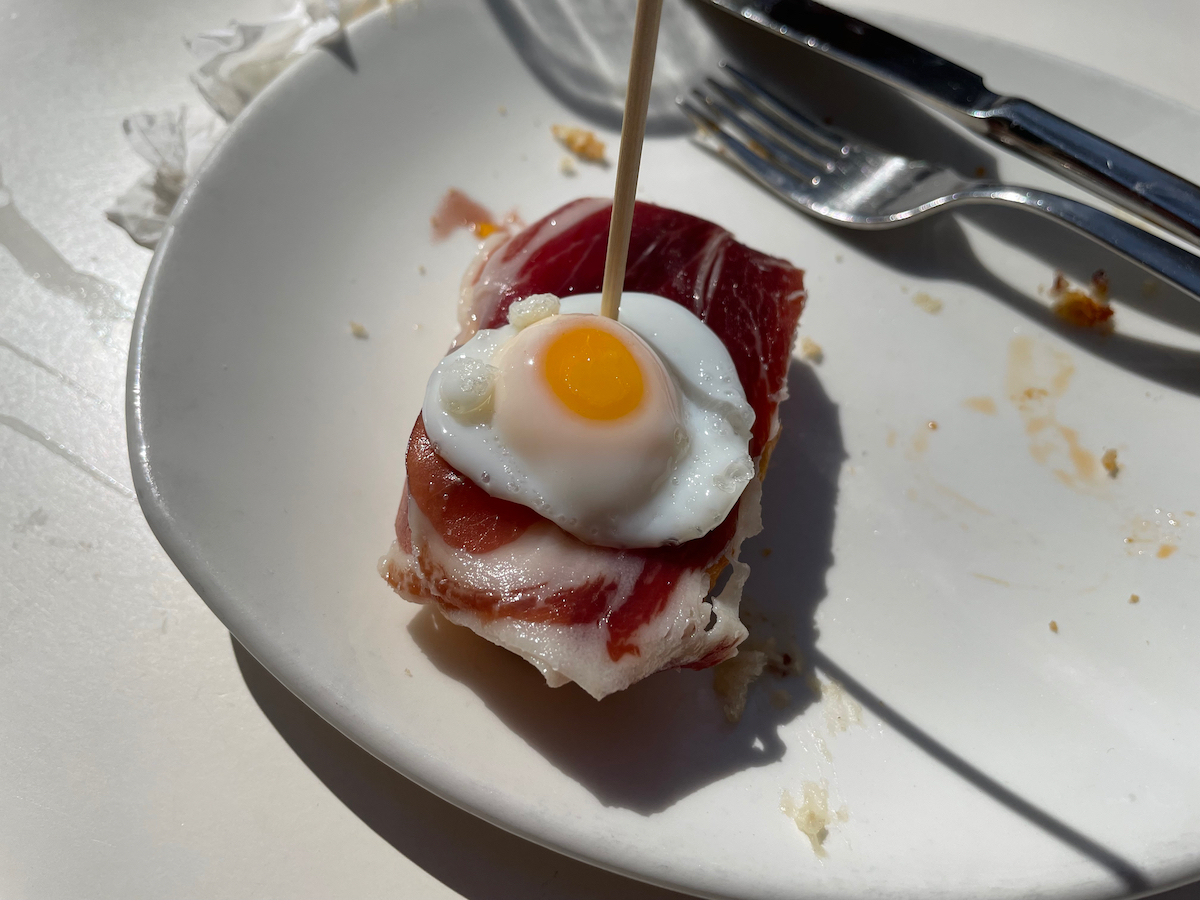
Pintxos are what tapas are called in northern Spain in the Basque region. They are generally presented as in the image below, a little slice of bread with something good on top. They typically have a stick stuck in them. When it’s time to tally up the bill, all they do is count your sticks.
8) We were both full at this point, but if you bring around something with a lovely slab of Jamon (cured ham) and a little fried quail’s egg stuck on top, I must have it.
9) At some point the server pointed out to us that we were supposed to put our little sticks back in the glass. Ooops!
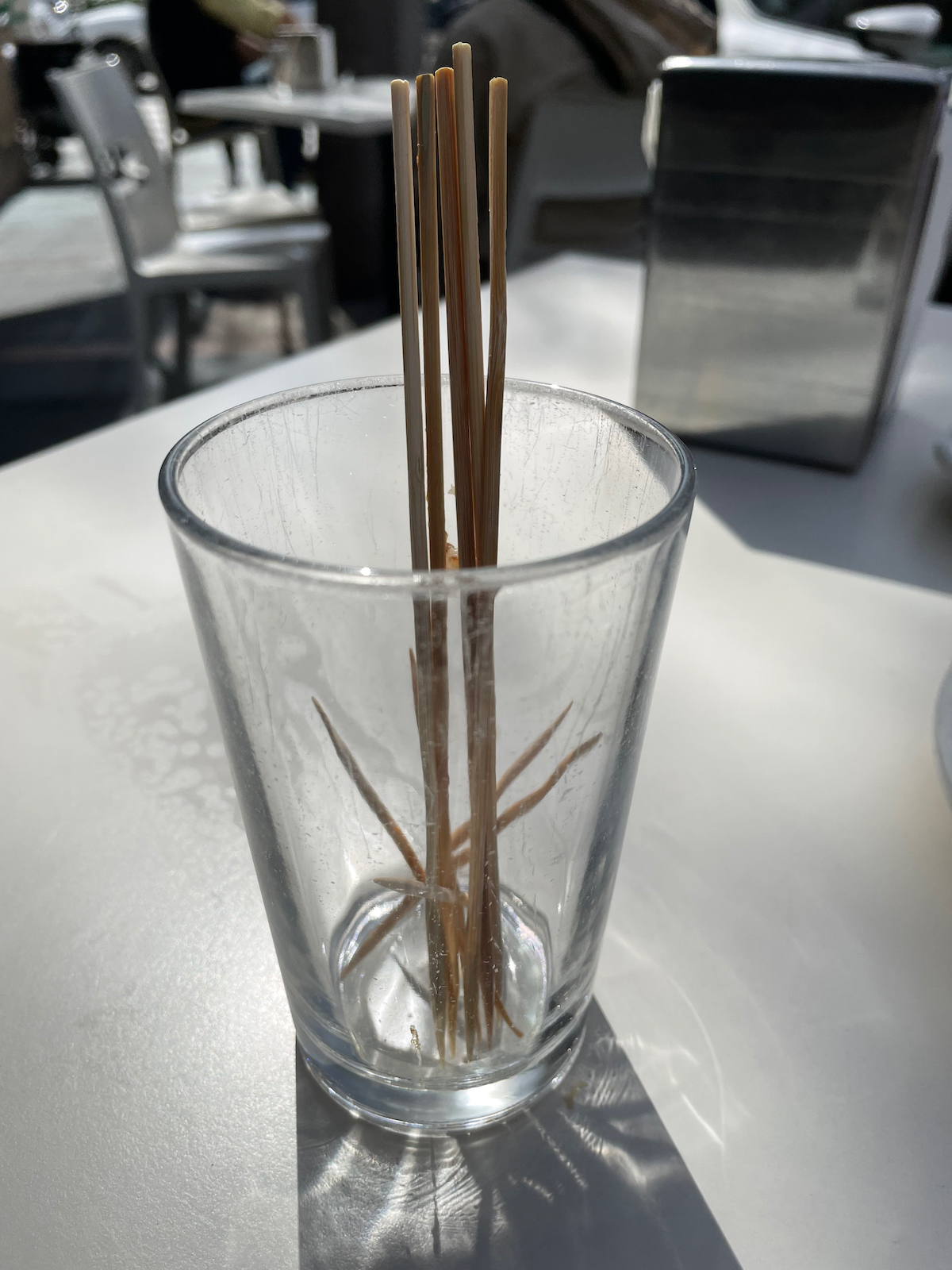
10) The bill. At this bar, the longer sticks are slightly more expensive than the shorter sticks. So, four beers and 10 Pintxos cost €39.50. Converted the total is $46.61 CAD. I will let you decide if that is expensive or not.

Dining in Other Parts of the Costa
We have eaten in all kinds of great restaurants in several other towns up and down the coast. You will not have to worry about finding a favourite restaurant.
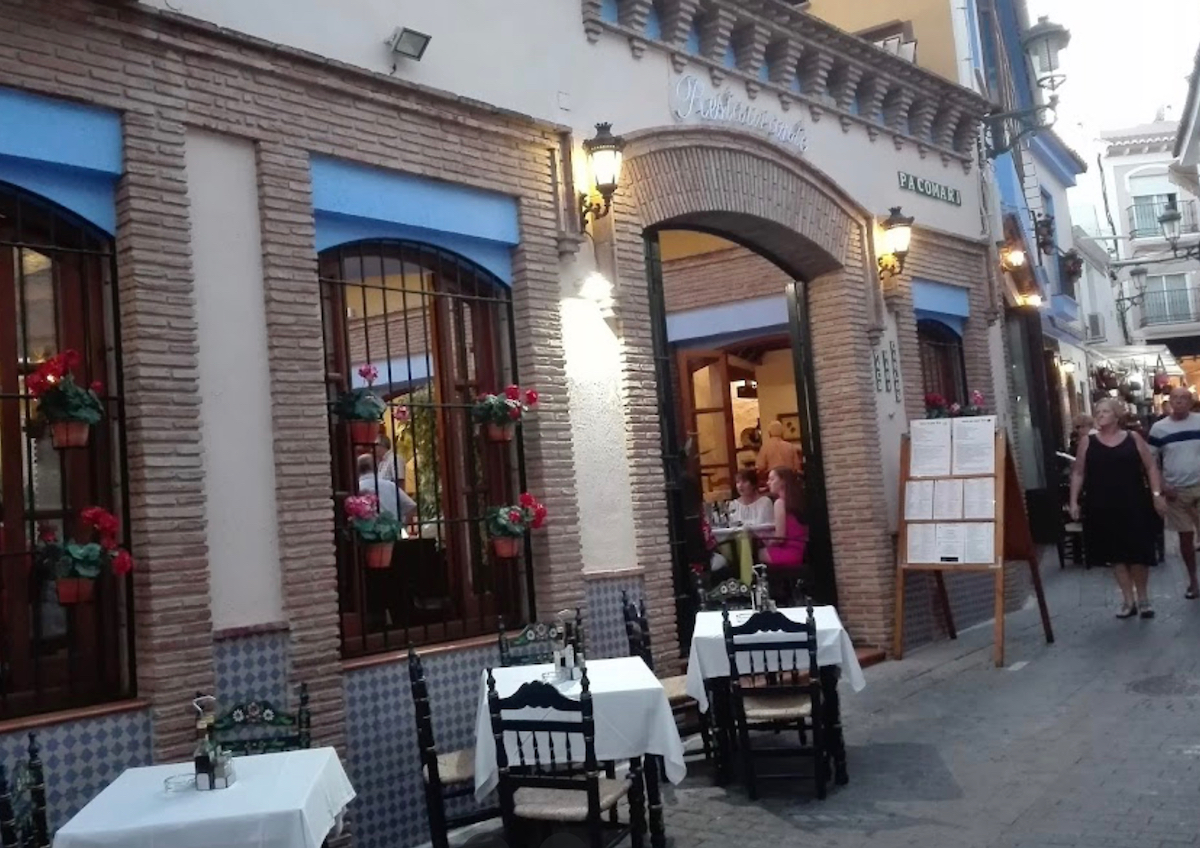
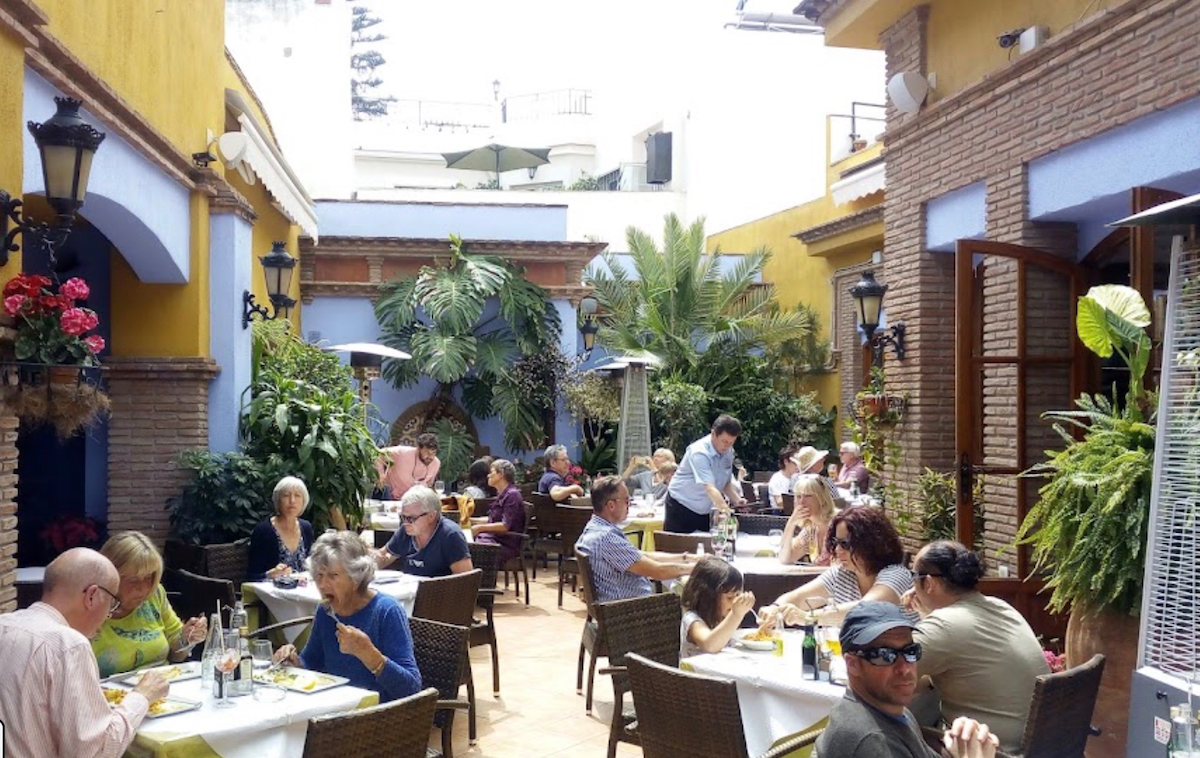
11) First up, probably my favourite restaurant in Nerja, is Pacomari. The next two images are from Google… they are better than the ones that I have. The attraction here is they have a great Menu Del Dia (daily special) at lunchtime. I have not been able to determine what the cost is this year, but in 2019 it was €9.95 for a three-course meal. The receipts you will see you in a minute are from then. A friend, who happened to be wintering in town, suggested we meet there. He is a chef, we went.
12) It has a lovely patio. You should have noticed at this point that every time we have eaten out it has been at lunchtime. That is generally the best time to go. Often, you will get these special offerings at lunchtime, and regardless, the food prices are typically cheaper than at dinner time for the same meal.
The other reason is dinner time in Spain can be late in the evening. I fondly recall asking the clerk at the front desk where we were staying in Seville a number of years ago for a good place to eat. He did provide one, but suggested we make sure we got there before 10 PM because all the restaurants would be full at that point. I assured him that we could probably arrive and be finished dining before then. 🙂
That is our second “restaurant selection” tip – ask the front desk clerk in your hotel where they would go to eat. Sometimes you can tell they are trying to direct you to a touristy place, but I always insist that they tell me where in the neighbourhood they themselves would go to eat. This has also provided great results over the years.
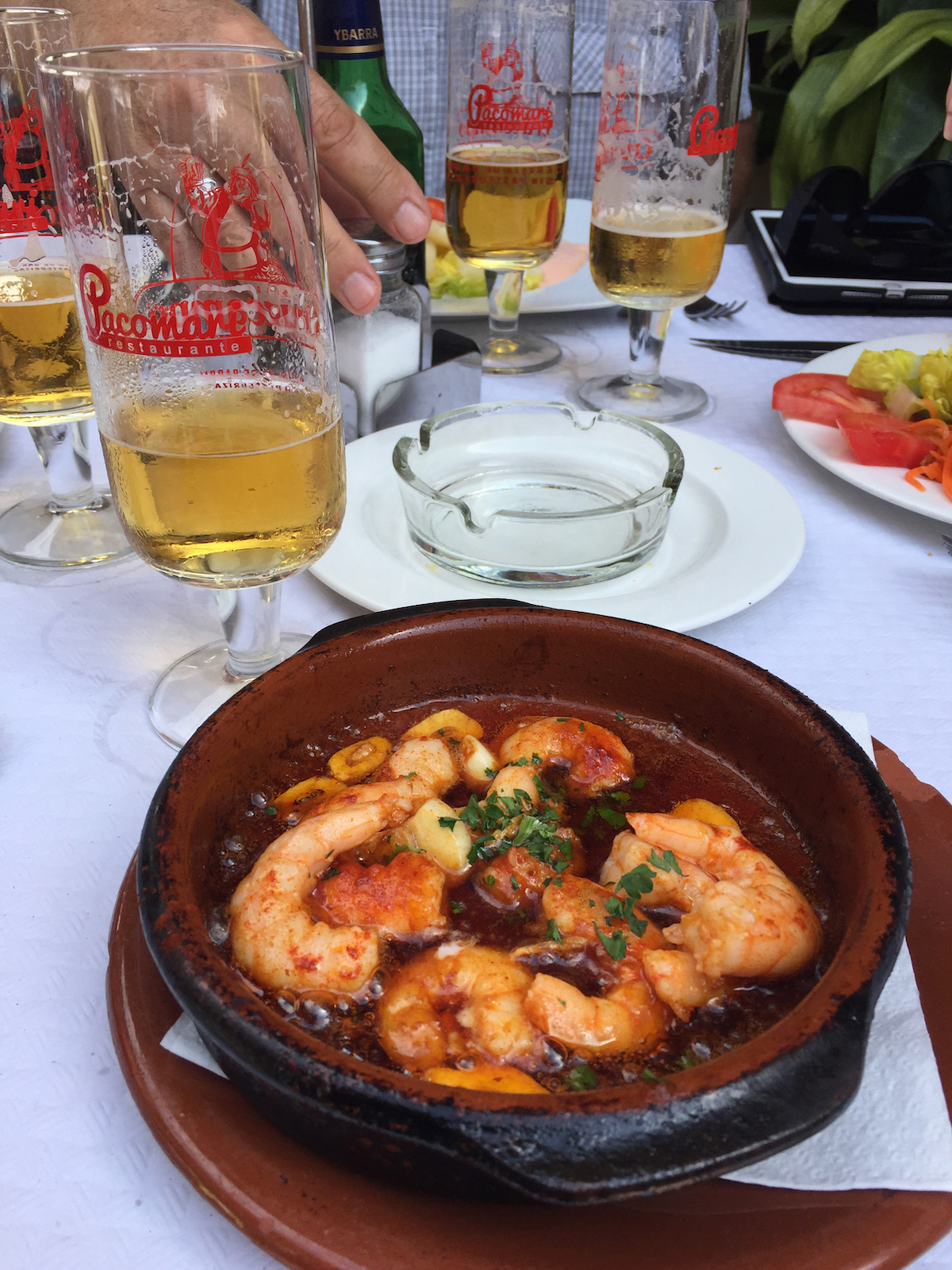
13) So, let’s check out a typical Pacomari three-course meal. A number of selections can be chosen from for each course. First up is now one of my favourite dishes, “Gambas al Pil Pil” or (Pil Pil Shrimp). This photo is of the first time I ever had this dish.
You’ll notice the ashtray. They still put them out on the patio tables in most restaurants here. Although, I do have to say, I cannot recall the last time I saw someone smoking while dining here on a patio.
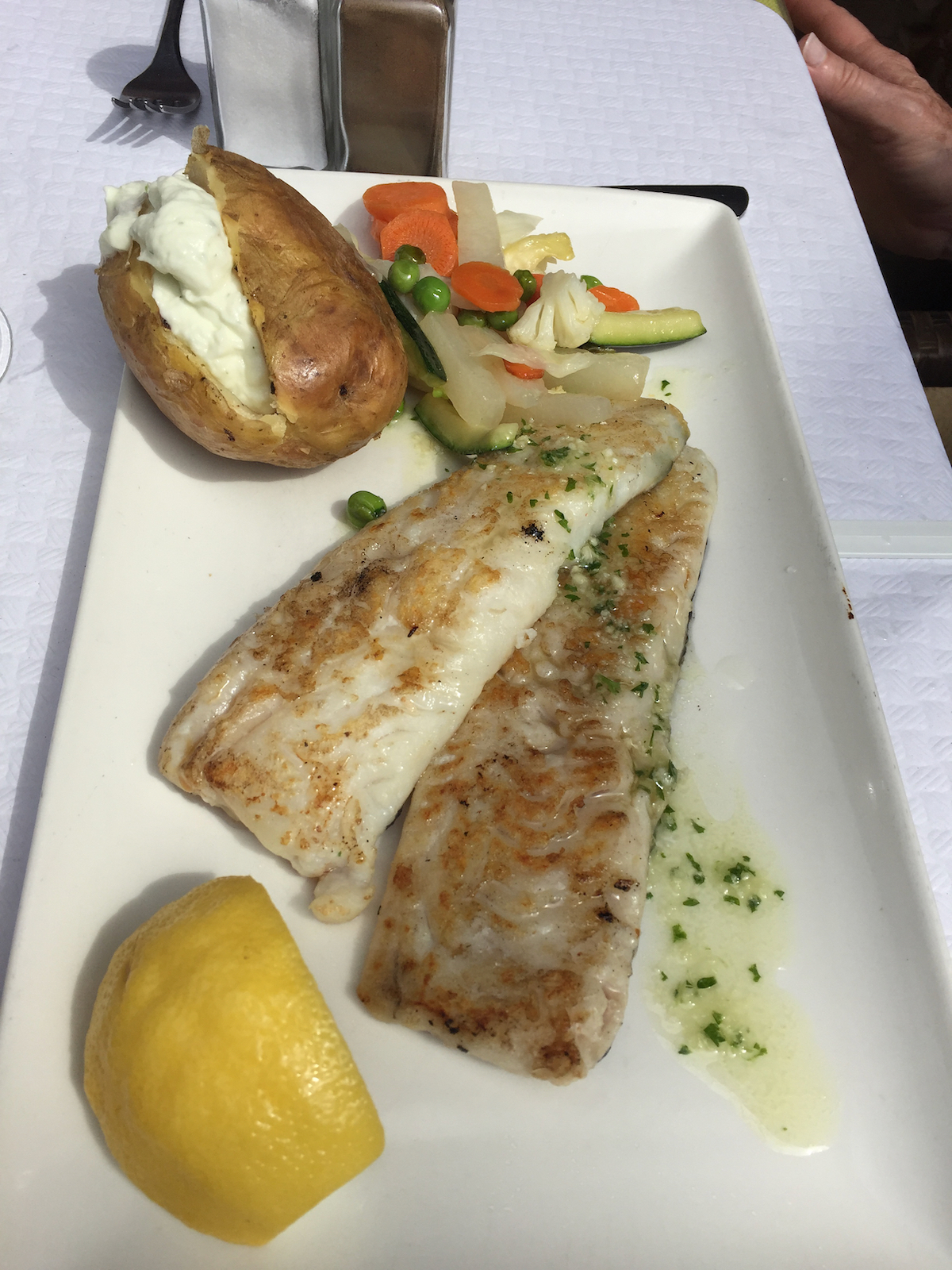
14) This was one of the Love-goddess’ entrées, grilled fish. You always get generous servings.
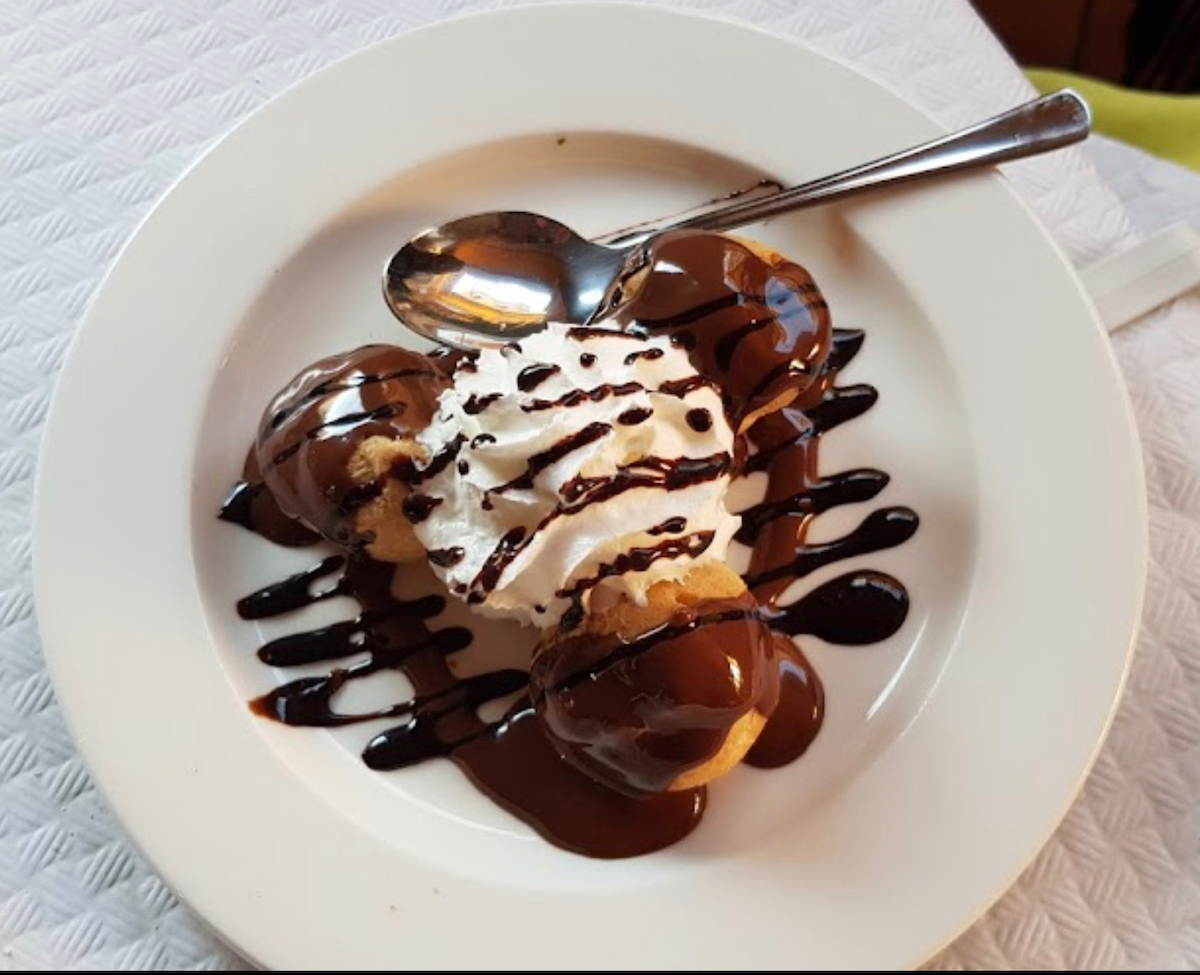
15) And finally, a typical dessert. I believe I had Crème Brûlée every time we ate here. Again, I scooped this image from Google. My desserts never lasted long enough to take a picture. 🙂
16) The bills for four people from two of our visits. On the left, we had four Menu Del Dia, five beers, two glasses of white wine, and one bottle of non-sparkling water. €59.40. That is approximately $83.00 CAD. Bill number two, four meals, four beers, and two gin and tonics. Mixed drinks are the one thing that are expensive in restaurants. Slightly more expensive than the first bill.

17) Here is another restaurant in Nerja that you might have heard about if you are a follower of Rick Steves’ travel show, AYO’s. Rick generally poo–poos the Costa Del Sol as a place to visit in the spring, summer, and fall… I agree, but he does love Nerja. And he talks about AYO’s on the beach at length. AYO has been in business since 1969. Here is a link to AYO’s website.
Ayo, the man, gained fame as was one of the five teenage boys who discovered the incredible La Cueva de Nerja (Nerja Caves). He is a legendary local figure.
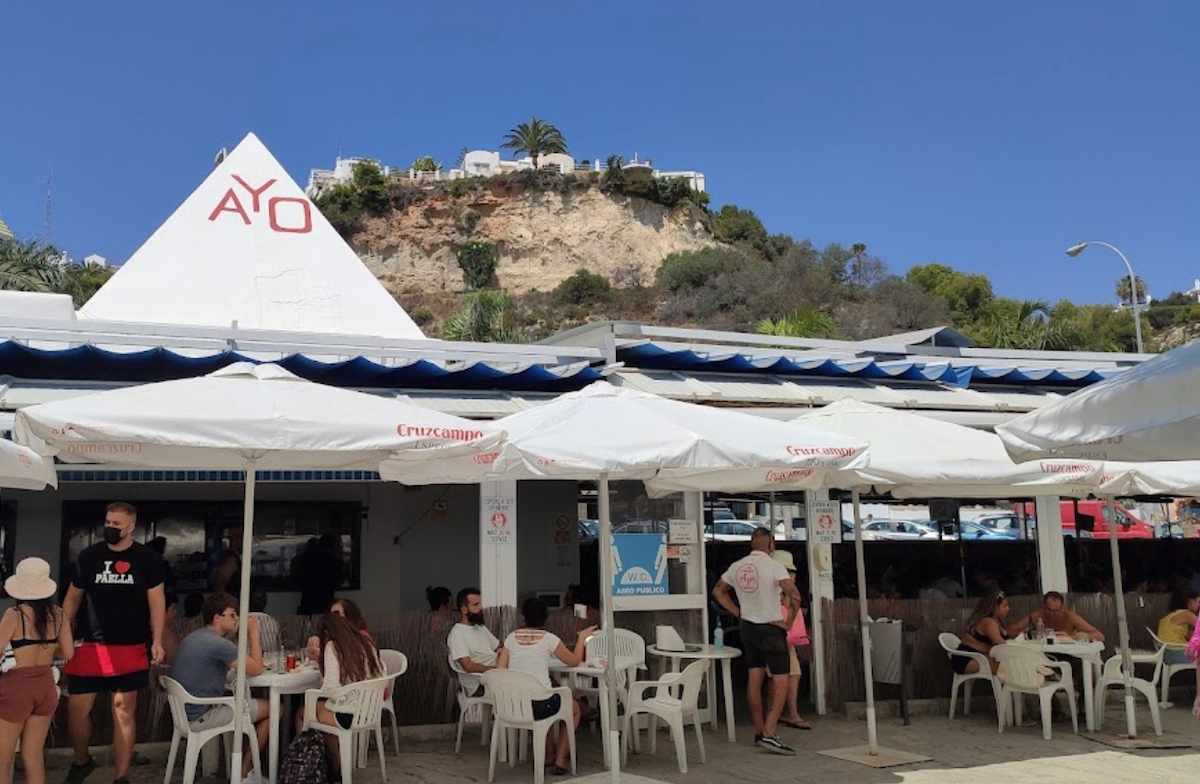
18) AYO’s schtick is all you-can-eat paella, cooked in large amounts over open fires. Ayo is at the far back of the picture. Watch a short Rick Steves clip here.

19) This photo was taken on a Sunday. As you can see, it is solidly full of diners. Sunday is a big day for families to get together, go out, and have family meals in a restaurant. We are squeezed in, in the shady back corner on this day.

20) Here’s the damage for four diners. This was in 2018. We had one sparkling water, one flat water, one small beer, two large beer, four all-you-can-eat paella meals, one coffee, and two cappuccinos. The price is $66.83 in Canadian dollars.

Dining in Another Part of Spain
Now we move north from the Costa Del Sol to the city of Granada. Granada is a must visit place when staying on the Costa.
21) This, Bodegas Castaneda, is absolutely my favourite tapas bar in Spain. And generally, bodegas are my favourite places to eat.
But, we are not going to talk about tapas today; that will be done in another full article somewhere down the road. This next restaurant visit is to Bodega Castaneta’s little restaurant that adjoins the main bar.

22) The four of us had been out “doing tapas”… which involves wandering from bar to bar having one drink and one thing to eat. Do these folks look like they need more drinks? 🙂 Nor did we need more food, I thought, after all we had consumed in our wanderings. But apparently, we did.

23) Let’s begin this detailed exploration with what we had to eat. The ladies shared this platter, Monte Abellon Blanco. Apparently, it was just as tasty as it was pretty.

24) I had the Pastel de Carne (meat pie). I was stuffed and this was the cheapest thing on the menu.

25) My buddy, Les, had Verbena Mediana. I still have no idea what that was.

26) And, we had six glasses of wine… not really needed in my mind. It was a lovely Rueda. Six glasses in Spain constitutes about one and a half bottles.

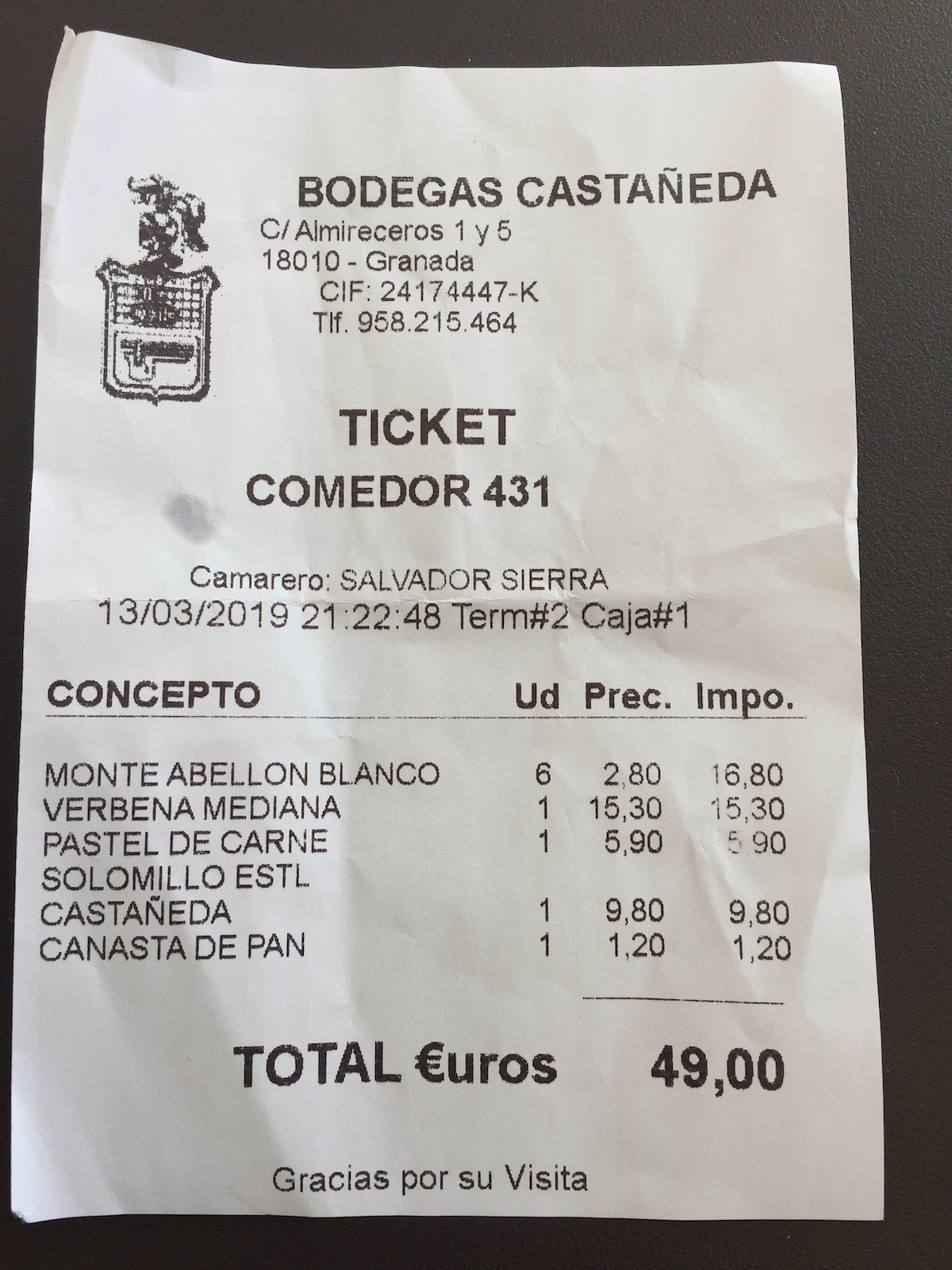
27) The final bill, €49.00, or currently, $68.55 CAD. This was in 2019. My overall opinion is that it is considerably cheaper for us to eat in restaurants in Spain than in Canada. I think the major difference is the price of the booze.
Speaking of bills, you will need to ask for your bill. They will not just drop it on the table, because it would be rude to try and rush you.
Final Thoughts
So, to sum it all up, the cost is reasonable, the food is fantastic, and the wine is delightful… make sure you eat out frequently when you are in Spain. A patio should always be your first choice at lunchtime.
Actually, to sum it all up, I am going to provide a short, bulleted list of my tips, suggestions. and tidbits of information so you have it all in one spot for easy reference.
Tips for Restaurant Dining in Spain
-
- The official lunch hour begins at 2 PM in Spain
- If you eat the bread on the table you pay for it, if you do not eat it, you do not pay
- Check out who is dining in a restaurant to help you decide if you want to go in. Look for places that appear to be full of locals
- Another suggestion for a restaurant selection is to ask clerks in hotels for places close by where they would actually eat
- Ask for an English menu (Menú inglés)
- Pintxo is another name for a Tapa
- Menu selections often come in three sizes and prices, Racion, Media (half) Racion, and Tapa
- Patio dining is a must at lunchtime; you’ll probably want to be inside in the evening on your winter getaways.
- You get better value at lunchtime
- Meals are typically cheaper than at home
- Sundays are very busy because families are out dining
- Tipping is normally not required, but it is a good idea to at least leave the change
- In Pintxo bars and restaurants they will probably count the sticks to determine the cost… don’t stick them in the planter! 🙂
- You have to ask for the bill, they will ordinarily not be inclined to bring it before you ask… that would be rude.