
Welcome to my multi-part look at how we could modify golf’s mostly rigid rules of play, in a way that would make the game easier and more enjoyable for retired, i.e. older golfers, and many other recreational players. This first section will paint some broad brushstrokes and talk about generalities before we get down and dirty with specifics in Part Two.
The final part will summarize everything I am proposing here into an easy to read, hopefully downloadable, document.
“Old Man” Golf … Seriously?
OK, I admit it, use of the term “old man” is definitely out of place in the modern world… But I am one! 🙂 Also, out of sync with that terminology is the fact that many, many golfers, especially older retired golfers, are women. This is one of the great attributes of golf. Anyone of any gender or ability can play golf well into their senior years. And every day I go to the golf course, I am reminded how many older men and women… probably retired… are out there playing on a regular basis.
Golf is a hard game and, in many ways, the rules that govern golf tend to make it even harder for mid-to-high handicap golfers. Yes, rules and other golf etiquette guidelines provide consistency, especially for low handicap and professional golfers, but to my mind, there are other ways to provide regulated consistency for recreational golfers – especially those of us who are now seniors and retired.
Those of us who love golf are watching a lot of it on television. And what we see are incredible athletes playing at a very high level on pristinely groomed courses. Most amateurs do not play on pristinely groomed courses. More likely, many golfers are playing on an adequate, to somewhat inadequate — to a “dog track” quality golf course. These somewhat adverse conditions make it even harder to play by golf’s stated rules and regulations.
My purpose here is to loosely define a new set of rules for seniors and many other recreational golfers. In the hallowed halls of the USGA and the R&A what I am proposing would be called “cheating”. What I’m calling it is “let’s put some enjoyment back in the game”.
More broadly, let’s make some simple rule changes that don’t take away from any of the defining attributes of the game but simply facilitate removing some of the unnecessary frustration and small challenges. This will also speed up the pace of play, which will in turn make the game more enjoyable. I invoke “enjoyable” because who has not had a day of golf, totally ruined by a single massive blowup hole. Taking a 9 or a 10 doesn’t really benefit anyone. Unless you’re playing for money of course.
And I believe that in part, what I am suggesting will make the game safer, which would expand on the many safety references in the official rules. I am thinking of things that would relate specifically to older golfers.
The Basic Tenants of What I am Proposing
What I am proposing is that playing golf by what in Canada are referred to as “winter rules” should be the “modus operandi” for all recreational golfers year-round. For those of you who are very low handicappers, no, you should continue to play by the prescribed rules. And, as you will see going through this, I’m proposing a few additional modifications to a couple of existing rules as well.
Winter Rules
Winter Rules are normally used first thing in the spring and late fall when golf courses are just opening or approaching closing for the winter and to put it politely, are not in optimal condition.
The basic tenants of winter golf are, firstly, “lift clean and place” anytime you want. That meaning, pick up your ball, clean it off, and put it back down where it came from. Balls tend to get very muddy and covered with debris, especially in the spring. Secondly, you are also allowed to “improve your lie” by moving your ball anywhere within a 6-inch radius to a one club length distance to find a nice spot to hit from. This applies even in the rough.
Additionally, if a ball is clearly lost under a blanket of leaves or in the “Primary cut” (long grass just off the fairway), it is not considered a lost ball. It might be better to think of this situation as a “hidden ball”. You can’t spend forever looking for hidden balls so just drop one without taking a penalty stroke after you have searched for a reasonable amount of time and hit away. To clarify, the narrow strip of grass directly bordering the fairway is called the “First cut”. It is mowed slightly higher than the fairway, and much lower than the Primary Cut.
Finally, when the greens are not at their best, “Gimmies” for any putt within 3 feet are allowed. This is often just about the same measurement as a conventional length putter.
Additionally, in the spring when greens are bumpy and blemished it never hurts to play “two putts”. You never count more than two putts on every hole. If you sink the putt in one stroke, that still counts, but if you take three or four strokes you just count two.
All of these things make the game just a tiny bit easier and a whole lot more enjoyable for many of us so let’s start using them year-round in all situations.
No Mulligans!
What I am recommending is certainly not an “anything goes” approach. It is simply going to be a set of rules that you must adhere to, but they approach the game in a less rigid, kinder and gentler manner.
So, first and foremost, there are no Mulligans allowed. A mulligan is a friendly, unofficial rule in golf where a player is allowed to redo a terrible shot without a penalty. That is not saying this reset is an attempt to unilaterally state “thou shall not play Mulligans”. Of course, some golfers will continue to do that and that is their business.
So, you ask, above and beyond playing winter rules, what is different? Let’s start answering that question. I think you’ll like the first new rule.
Play Different Coloured Tees on Different Holes … a Hybrid Approach
Teeing off on different tees on different holes is something my own golf group has recently incorporated into our play. It is a direct reflection of the fact that we are all now 20+ years older than when we started playing together and we can’t hit the ball as far as we used to.
If you are unfamiliar with golf, the Black/Blue tees are typically furthest from the hole and the Red tees are the closest to the hole. White is kind of in the middle of the pack. There are other intermediate tee colours as well. Any given golf course will typically have about five different tee colours or lengths.
When we started playing on our home course we all shot from the Blue tees, but after several years and some decline in our skills, we began to play further forward from the White tees. More recently, now that we’re getting really old, we take a hybrid approach to where we tee off from.
Before I provide a bit of description how we landed on these different tees, I would suggest you look at the image below. It is the scorecard from the Monterra Golf Course in Collingwood Ontario, where my long-established golf foursome usually goes for our annual golf getaway. As you can see, they have certainly bought into this hybrid approach across all five of their different tee positions. It is very helpful that they have even detailed it out on their scorecard. Have a look.
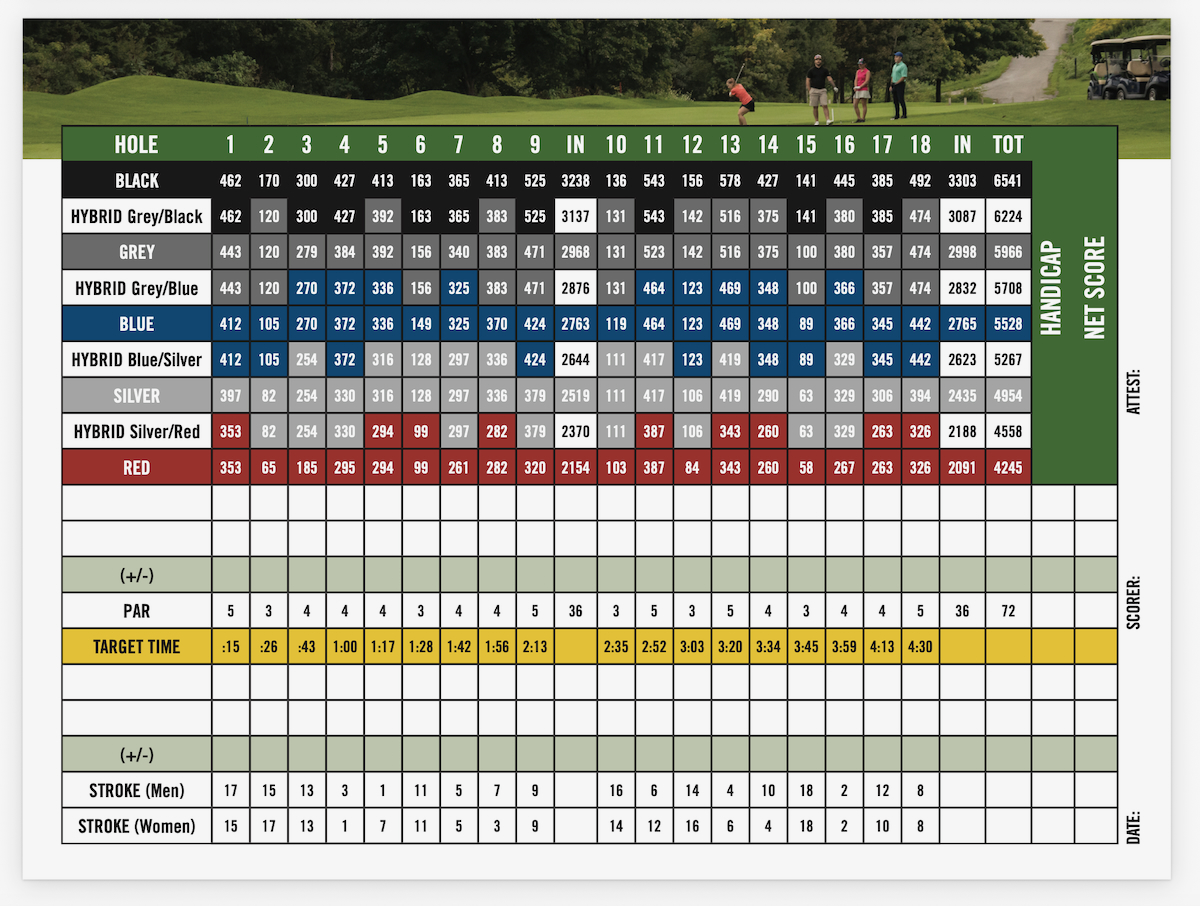
Your home course may be inclined to lay something like this out for you, but likely, and probably appropriately so, your own golf group will need to establish on which holes you need to move up..
What we found was that a small number of the par fours had become extremely difficult for us to par. So, on those holes, we moved one step forward to the Yellows. For everything else we continued to hit from the White tees.
Perhaps the easiest way to establish your own group’s hybrid set of tees is to think about which holes are now the most difficult for all of you and move forward one or two tees. To help you think through this process give some thought to the total number of yards that might be most suitable for your group to play.
Eliminate the “No Closer to the Hole” Rule
There are many, many rules which include a statement which says that you should not be moving your ball any “closer to the hole”. I suppose that makes some sense when you think about it theoretically, but would it have a huge impact on how you scored and played if you didn’t follow that rule? If we are playing preferred lies, isn’t it somewhat implicit that moving the ball a bit forward is OK.
Think about this, you are 160 yards away from the green, you have picked your ball up off the fairway, you put it back down on the ground a foot closer to the hole than where it landed. How exactly is that going to improve your chances? If you want it expressed in feet here’s what we are talking about. Your ball would then be 569 feet away from the hole rather than 570 feet.
Even if you are just off the green 40 feet from the hole and about to chip, would it increase your chances substantially to be chipping from 39 feet. I don’t think so. On the green, if you did it, it might make a big difference, so you definitely wouldn’t be moving it any closer to the hole there. Everywhere else off the green, I really think we should stop worrying about setting your ball back down “not any closer to the hole”.
Play Ready Golf
Playing Ready Golf is another non-regulation rule or guideline that a lot of golf groups have been using for years. Rule 6.4 of the Official Rules of Golf, which is titled “Order of Play When Playing Hole” basically says, the ball farthest from the hole must be played first. All golfers have experienced a lot of standing around waiting for the person who is furthest away from the hole to hit first when they are ready and could be hitting.
When playing Ready Golf no one has to ask the player who is farthest away for permission to hit; if you are ready and they are not, you simply hit. Of course, you should only hit out of turn if you can do so safely without standing in another player’s line of fire or distracting them.
This could also be extended to the tee box so that if the player who won the previous hole (the “honour”) is not ready to hit, another player should step up and tee off instead of waiting. This would also be applicable on the green – if the person whose approach shot to the green is furthest away from the hole is just arriving at the green, and others are ready to putt.
Retiree Golf Cart Etiquette
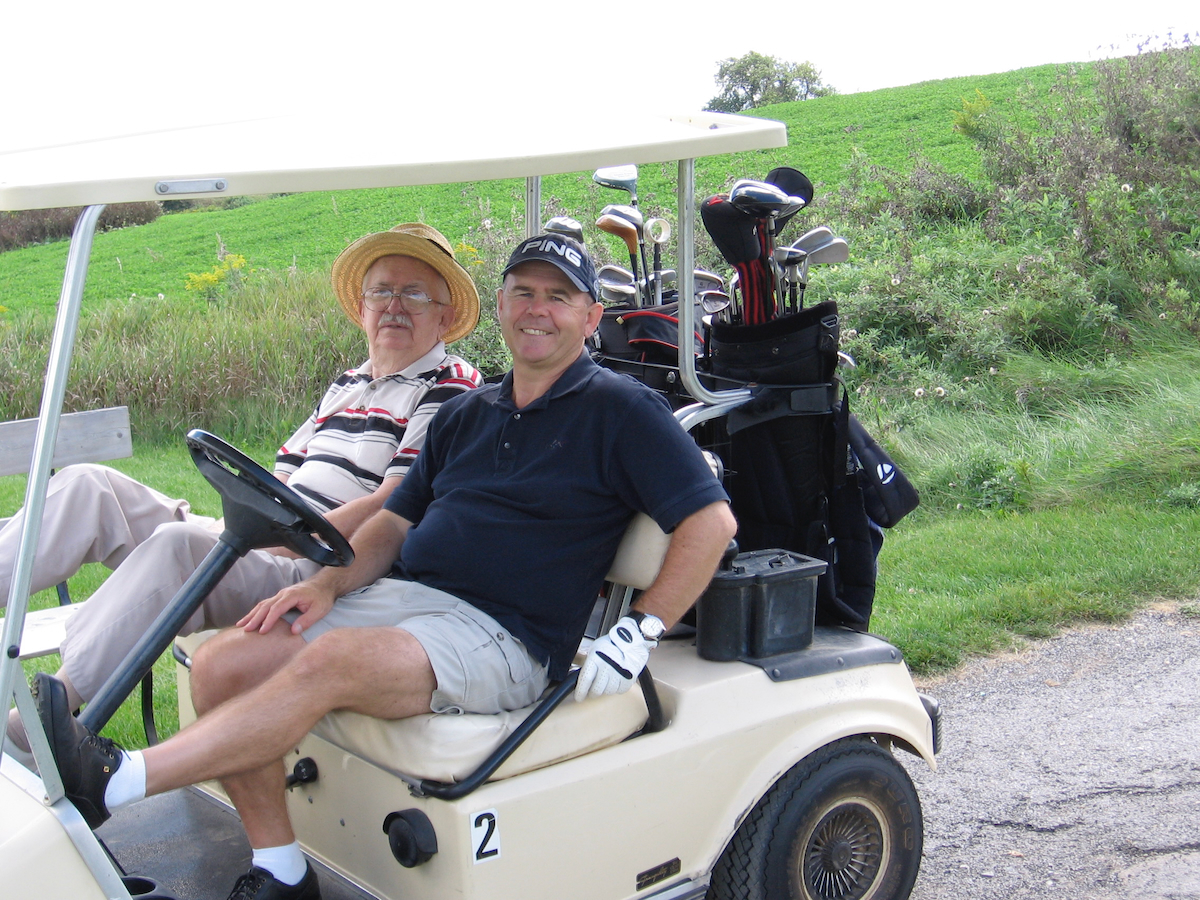
OK, this is not really a rule per se, more of a helpful hint or on course etiquette. Now that I am forced to ride a cart while golfing, like many older retirees, I often find myself playing with two or three others who are all walking. I have discovered that there are a number of courteous things that I can do to assist my walking buddies.
Some of these are:
-
- storing extra jackets, umbrellas, or water bottles
- keeping score for the whole group
- shuttling tired players up steep hills or between distant holes
- and everyone’s favorite — helping others look for lost or hidden balls. After all, a cart lets you cover a lot of ground quickly.
Know About the “Helpful” Rules
Here are a couple of interesting tidbits related to two rules that you should know about because they can be used in very productive ways on the course. I’m not going to spell out the exact rules, you can look them up if you want, but they are, declaring a “ball unplayable” and taking “stroke and distance”. You’ll see in part two that stroke and distance is actually one of my least favourite activities in golf, but there is one way that it can be used magnificently.
I am going to describe my play on a real golf hole to illustrate what I am talking about.
Many years ago, I was playing Old Corkscrew Golf Club in Florida with my mates when the Love-goddess and I wintered there. I was playing hole number 4, which is a fairly short Par 4, has lots of water on the left, many bunkers and an elevated green. In fact, the green sits about 20 feet above the fairway. This is very typical of a Jack Nicklaus golf course design.
I played the hole beautifully. I hit an iron off the tee into a perfect position. My second shot was also perfect. I landed about 10 feet behind the hole and was left with a slight downhill putt for Birdie.
I rolled my third shot, the birdie attempt, toward the hole. I suppose I was thinking more about my line than the speed when I struck my putt because it went past the hole going not all that fast, but fast enough that it got to a bit of a slope and started to pick up speed. The increasingly steep continuous slope of the green resulted in my ball rolling off the front of the green and down the face of the hill back into the fairway. I ended up taking an 8 on the hole. Shattered!
What follows is what I should have done. I discovered this many years later while watching a tournament, when the broadcasters explained that Tiger Woods had faced essentially the same situation and could have handled it in the way I’m about to describe.
The first thing I should have done was to declare the ball sitting back down in the fairway as “unplayable”. It certainly wasn’t unplayable, but the rule states that you can declare any ball you are playing as unplayable anywhere on the course… unless it is in a penalty area.
This has other advantages in other situations as well, but it’s perfect for use in this situation. When you declare a ball unplayable, the rules require you to place a ball back down where you just hit from, take one stroke penalty, and hit again. Officially, you are taking “stroke and distance”.
In my case, I would have had the exact same putt all over again for Bogey, and even if I had not sunk it, probably the worst I would have scored was double Bogey.
It’s perfectly fine to play by modified rules, but it’s also perfectly fine to use the actual rules to your advantage wherever possible. The pros do this all the time.
Next Up: Part Two, where I get into the more nitty-gritty of how to play in specific situations … out of bounds and hazards … to make the game gentler and kinder.