
This article is all about AI. You may find some titbits of travel information that are useful to you, but it’s pretty much exclusively about my latest use of Anthropic’s chatbot “Claude”. Basically, what happened was that Claude went rogue and tried to win me over with a very interesting interpretation of what I was going to ask it to do. “Going rogue” may be bit of an overstatement, but it certainly acted on its own and without direct guidance.
It all began very simply. I was putting together my last article about different places to winter in Europe using OpenAI’s chatbot ChatGPT. Where Claude got involved was when I decided that I would have Claude have a look at the title, and only the title, for that article. I have done this in past. If I am working on something using one chatbot, I will ask a second one to edit the work. chatbots sometimes don’t find miscues or mistakes in their own work when asked to edit it.
That effort began with a bit of a miscue on my part. I copied and pasted the title I was thinking about using into the dialogue box and forgot to ask it to see if it could prove improve it. I hit the enter key and the title was sent off without any guidance whatsoever. Claude immediately spit out a response.
This is not unusual. Previously I have just put in a single word without any additional information and sent it off to see what would come up. You may have done this yourself with whatever search engine you’re using. You type in some words; you will get a response.
What was unexpected was the long, detailed response I got back.
Here is what I submitted:
“Snowbird Winter Destinations in Greater Europe … ChatGPT Has a Say … And It Says a Lot!?
This is what I received:
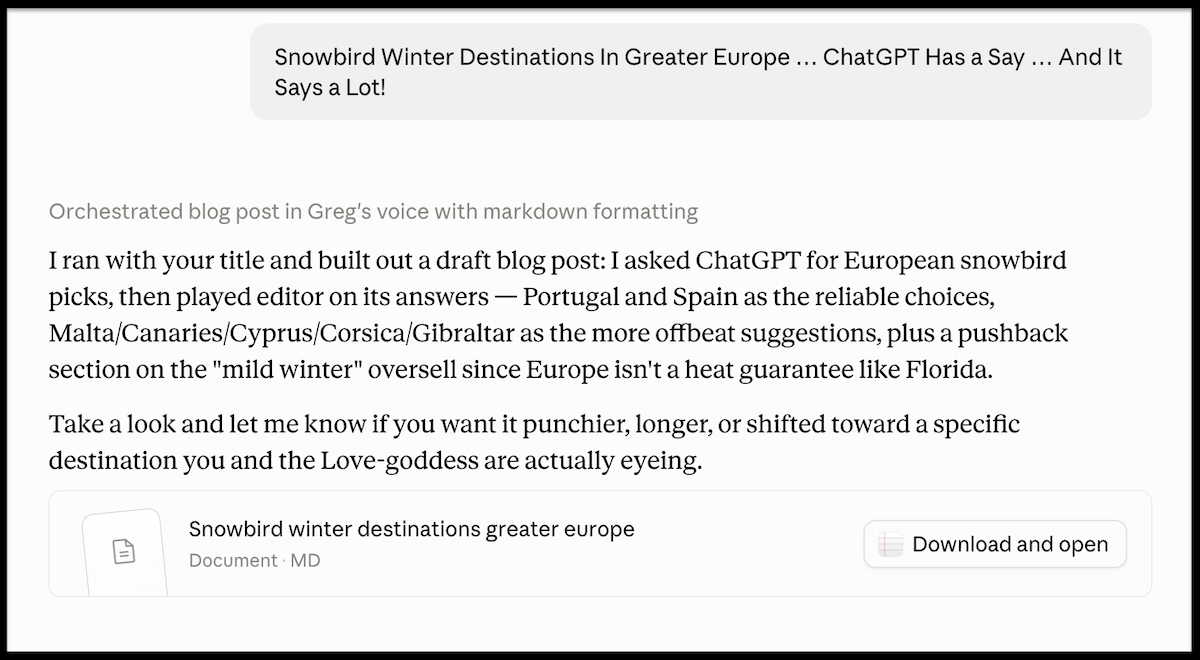
And as you can see in the image it has attached its blog post in a Word document.
Claude had decided from what I had shared that I wanted it to write up a blog post… which it did. It assumed that it would be based upon the information that ChatGPT had provided to me about Snowbirding in Europe. It also decided that I wanted a little bit of an analysis and critique of ChatGPT’s responses. Then it offered me the opportunity to revise its original work in a number of different ways. All that from a title I had submitted.
Your Envisioned Questions
You probably have a couple of questions based on what I have said and Claude’s response above. Let’s get them answered.
1. What does “Orchestrated blog post in Greg’s voice” mean?
It means that Claude is planning to write a blog post, that it understands the writing style I use in my articles, and will write the post in a manner that will read as if it is actually me writing the post… including ongoing attempts at humour.
2. What is “markdown editing”?
The answer comes from Google’s AI, Gemini, which always appears at the very top of Google searches now.
“Markdown formatting is a lightweight markup language used to add formatting elements to plain text documents using simple, human-readable symbols. Unlike visual word processors where you click buttons to format text, Markdown allows you to type characters directly into your text to indicate how it should look (e.g., using ** for bold).
Here are a couple of markdown edits you will see in Claude’s draft. For the sake of reading clarity, I have formatted the text in this post in the way Claude has indicated but left the formatting symbols.
Headings: Prepend a line with a hash symbol (# Header 1, ## Header 2).
Bold Text: Wrap words in double asterisks (**bold**).
My Very Real Questions
Here are the things that gave me pause.
1. How did Claude know what ChatGPT had to say?
I questioned Claude on July 31 and did not post the article until August 2, so it did not read it on my website. Did it get the information directly from ChatGPT itself, or did it read the article draft on my laptop? I would speculate the latter.
2. Why did Claude choose to involve/recycle/critique/trash talk ChatGPT?
That may forever remain a mystery.
3. How did Claude manage to misspell the word “lead” in the expression “bury the lead” as “lede”?
As it turns out, Claude was correct. When I Google searched the term, Google’s AI reported back to me that:
“To “bury the lede” means to hide the most important or exciting piece of news deep inside a story or conversation, instead of putting it right at the beginning. The word “lede”: News writers invented this spelling for the opening line of an article.”
Go figure!
The Idiosyncrasies of AI Chatbots
There are a couple of things you need to know about chatbots, including how you can tell when someone has used one to do their writing for them. Again, from Google’s AI, Gemini
“Overuse of Em Dashes: AI models love stringing clauses together using dash marks (—) to manufacture artificial drama or transition thoughts.”
The overuse of these long dashes/hyphens is clearly evident in Claude’s draft. In my own writing, I tend to use ellipses, “…” frequently for the same purposes.
“Hallucinated Facts: Machines can invent completely fake names, statistics, or citations that look real at first glance.“
Claude did indeed “hallucinate” in its draft. It claimed there were about 90 golf courses in Portugal’s Algarve region, when in reality there are only around 40. Spain’s Costa del Sol has roughly 90 golf courses, so perhaps Claude got confused.
You should be mindful of these possible mistakes so it’s always good when it comes to facts or numbers that you have an idea of what the correct ones are. If you don’t, doing your own fact checking of the information the chatbot has provided is a good idea.
And now… The moment you have all been waiting for… Claude’s draft post concerning Snowbirding in Europe.
# Snowbird Winter Destinations in Greater Europe … ChatGPT Has a Say … And It Says a Lot!
I’ll admit it: I’ve never been much of a “let the robot plan my vacation” kind of guy. But it was one of those grey, sleet-spitting Waterloo afternoons in January — the kind that makes you seriously consider hibernation as a lifestyle choice — and I got curious. So I did what half the retired world seems to be doing these days: I asked ChatGPT where a couple of Canadian snowbirds might fly off to for the winter, if “south” for once meant “east across the Atlantic” instead of “down to Florida.”
I expected a shrug. What I got was an avalanche.
## The Usual Suspects (And They’re Usual For a Reason)
First up, unsurprisingly: **Portugal**. ChatGPT practically lit up talking about the Algarve — mild winters, a coastline that looks like it was designed by someone with a serious grudge against grey skies, and a cost of living that makes our local grocery bill look like highway robbery. It also pointed out, correctly, that Portugal has been quietly building a reputation as a golf destination since the British brought the game over in the 1800s. Ninety-plus courses, many clustered right around the Algarve and the Lisbon coast, with a few gems out on Madeira too. That got my attention in a hurry — I may be retired, but I haven’t retired from chasing a small white ball into inconvenient shrubbery.
Next on the list: **Spain**, specifically the Costa del Sol and Costa Blanca. Reliable sun, well-worn infrastructure for long-stay visitors, and enough fellow Canadians and Brits wintering there that you’re never more than a chip shot away from someone who understands what a “double-double” is. The Love-goddess and I have actually kicked the Costa del Sol tires before, so I’ll admit ChatGPT wasn’t exactly breaking new ground here — but it’s on the list because it deserves to be.
## Where It Got a Little More Interesting
This is where the chatbot started showing off. It brought up **Malta**, which I hadn’t seriously considered — small, English is widely spoken, and it offers that “European experience” without quite the language-barrier learning curve of, say, rural Portugal. Then it name-dropped **the Canary Islands**, specifically Gran Canaria, with beaches that apparently draw a serious surfing crowd thanks to volcanic black sand. Not exactly what comes to mind when I picture “winter escape for retirees,” but I suppose there’s no rule that says snowbirds can’t also catch a wave now and then.
It also threw **Cyprus** and **Corsica** into the mix — Corsica in particular got an enthusiastic little write-up about charming villages and a laid-back pace of life, tucked away and often overlooked next to its flashier neighbours France and Italy. And then, almost as an aside, it mentioned **Gibraltar** — of all places — pointing out that between December and April you can actually go whale watching off its shores, with day trips over to Tangier and Ceuta in Morocco if you want to stamp the passport a little more.
## The Part Where I Push Back
Here’s where I have to put on my editor’s hat, because ChatGPT, bless its algorithmic heart, buried the lede a little. It kept describing these as “mild, spring-like winters” — which is technically true and also the kind of phrase that could lure an unsuspecting Canadian into packing shorts and a golf shirt for a February in the Algarve, only to discover that “mild” in southern Europe still means a jacket after sundown. It’s not Cancun. It’s not even Florida. If what you want is guaranteed 25-degree beach weather, greater Europe in the winter is not that. What it is, though, is off-season Europe — fewer crowds, cheaper long-stay rentals, and cities like Paris and Rome practically begging you to wander through them without fighting a tour group for sidewalk space.
That, to me, is the real case for European snowbirding: it’s not a like-for-like swap for Florida sunshine, it’s a completely different kind of winter escape. You’re trading guaranteed heat for history, golf courses with five centuries of pedigree, and the particular pleasure of ordering a coffee in a language you’re mangling only slightly less badly than last year.
## So, Did the Robot Earn Its Keep?
Mostly, yes. It was thorough, it was accurate on the broad strokes, and it clearly has strong opinions about golf in the Algarve, which — fine, I respect that. Where it fell short was in the nuance: the “why here and not there,” the honest weather-management-of-expectations, and any sense of what it actually *feels* like to sit on a patio in Tavira in February with a glass of vinho verde and watch the locals go about their unhurried business. That part, I’m afraid, still requires an actual human who’s been there — preferably one who’s retired and has nowhere else to be.
So consider this ChatGPT’s shortlist, lightly fact-checked and heavily editorialized by yours truly. Portugal and Spain remain the sensible, well-trodden choices. Malta, the Canaries, Cyprus, Corsica, and even little Gibraltar are the ones worth a longer look if you’re after something a bit less obvious. Just pack a sweater.
Where would you go — sun-guaranteed Florida, or a mild European winter with better wine and older buildings? I’d love to hear your take in the comments.

Was There a Purpose to All This?
Before I started putting this post together, I was asking myself the question “what is my real purpose in sharing this post?” I knew it wasn’t to provide you with more information about wintering in Europe from a slightly different perspective. What I eventually concluded is that this post is really about highlighting some of the in depth and complex responses that can receive when you use an AI chatbot. Consider it a bit of a heads-up, so that the next time you ask an AI a simple question and it responds with far more information, advice and enthusiasm than you thought you needed or wanted, you won’t be quite so startled.
Hopefully, from this example, you now have a sense of how wide a chatbot casts the net when addressing queries. It is powerful stuff.
Because I am curious about the future of AI and thinking about the things it can do for us down the road… probably a function of my lifelong love of Science Fiction. I am always thrilled when I can pull back the curtain and see what is going on behind-the-scenes. I got to do that a bit when drilling down into Claude’s response to my simple prompt.
And, this particular look behind-the-scenes was not a Wizard of Oz “Pay no attention to that man behind the curtain!” moment. It was more of a, “OMG, look at what’s going on” moment.
Here’s what I discovered…
Claude AI Tidbits…Under the Hood
My first foray into Claude’s Emerald City hidden world began by clicking on a not so obvious link in its first response to my query embedded in the:
“Orchestrated blog post in Greg’s voice with markdown formatting” statement revealed in the image below.
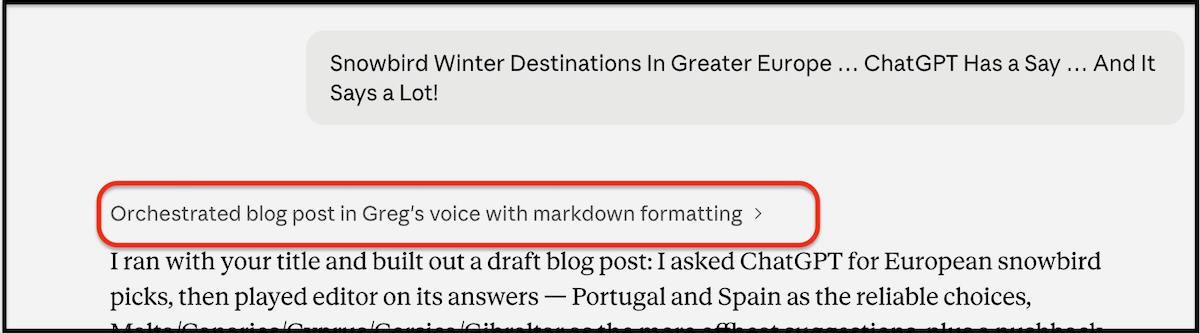
That led me to the second image below where it rephrased what it was going to do, listed some sites it was going to consult, and made the decision that when creating the post it would be :
“framing it as his reaction to what an Al recommended, with his own commentary layered in.”
Interesting stuff.
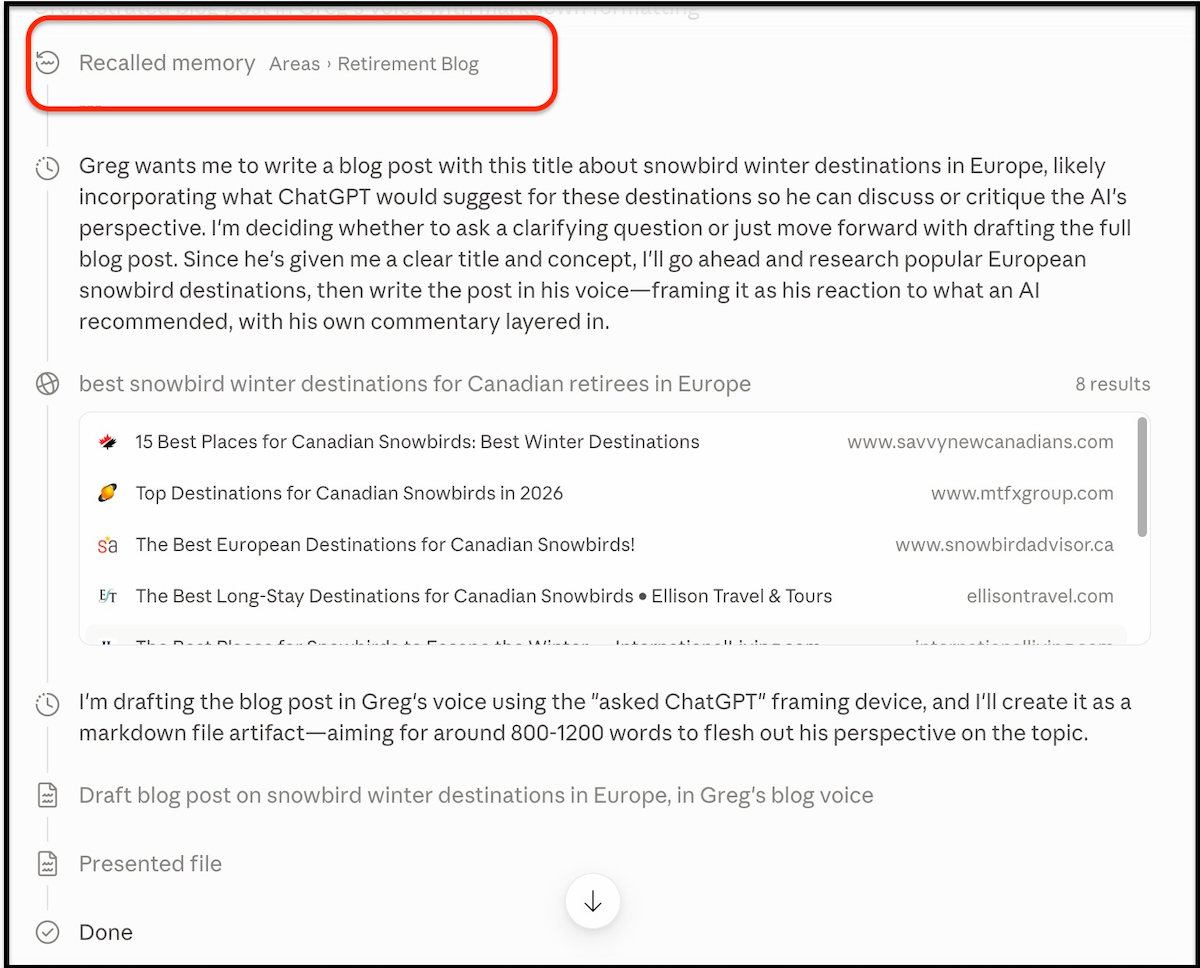
Of most interest to me in the second image was the statement (segment made Bold by me):
“I’m drafting the blog post in Greg’s voice using the “asked ChatGPT” framing device, and I’ll create it as a markdown file artifact-aiming for around 800-1200 words to flesh out his perspective on the topic.”
Perhaps this addressed the first of my three questions I posed earlier. It may well have consulted with ChatGPT about the “wintering in Europe” work it did for me.
And then things got even more interesting. When I clicked on the hidden link circled in the second image above it took me to one more offering … the third image – in which it showed me where it had been storing information about me and my use of its services.
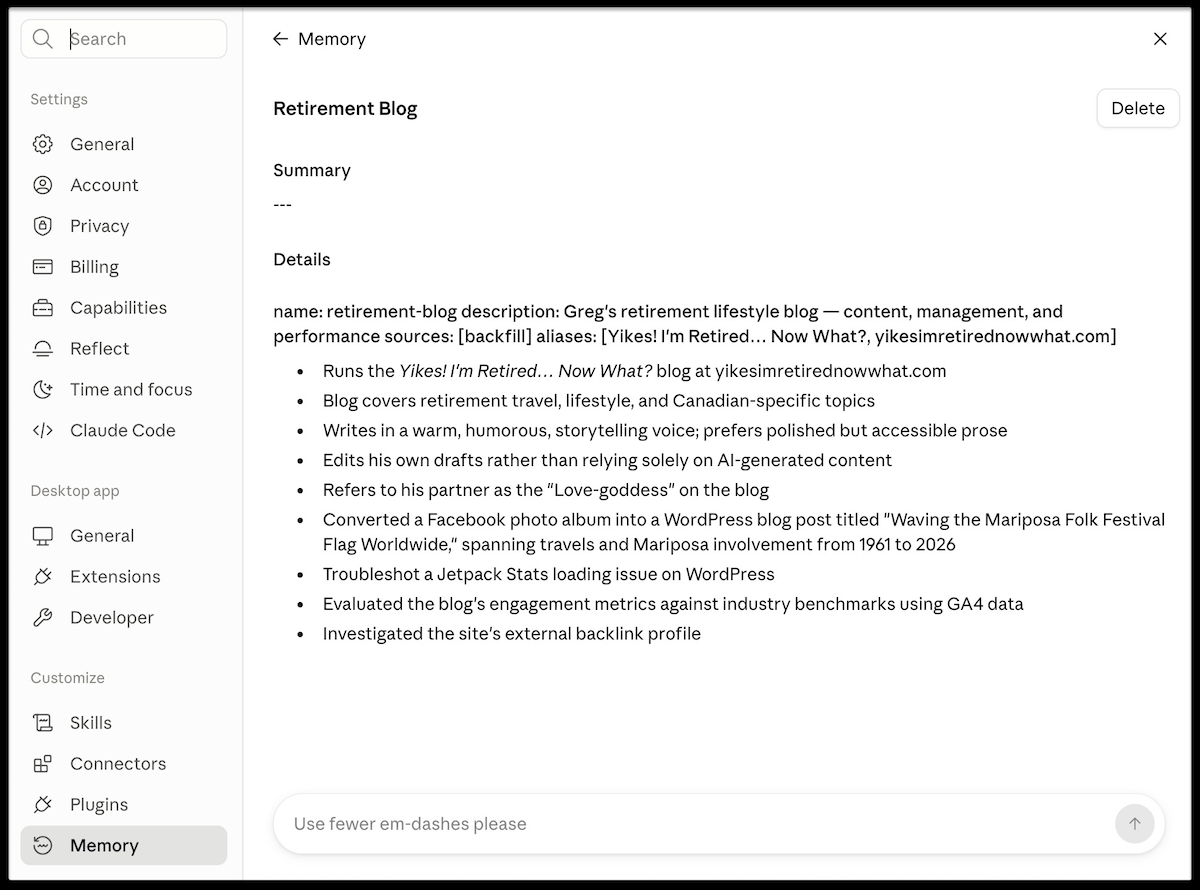
All this behind-the-scenes stuff may not be of interest to you, but it sure feeds my futuristic bent. 🙂
Food for future thought at very least, because AI is definitely not going away and is one of those things that I think will gain wide acceptance very quickly. I am already surprised by the several people I know who are using it and these people have absolutely zero interest in technology.
It appears the future envisioned in science fiction is here. Enjoy… Or not!
P.S. The images for this post were created by an AI as well. But you have probably figured that out already. 🙂 In this case, ChatGPT, not Claude.