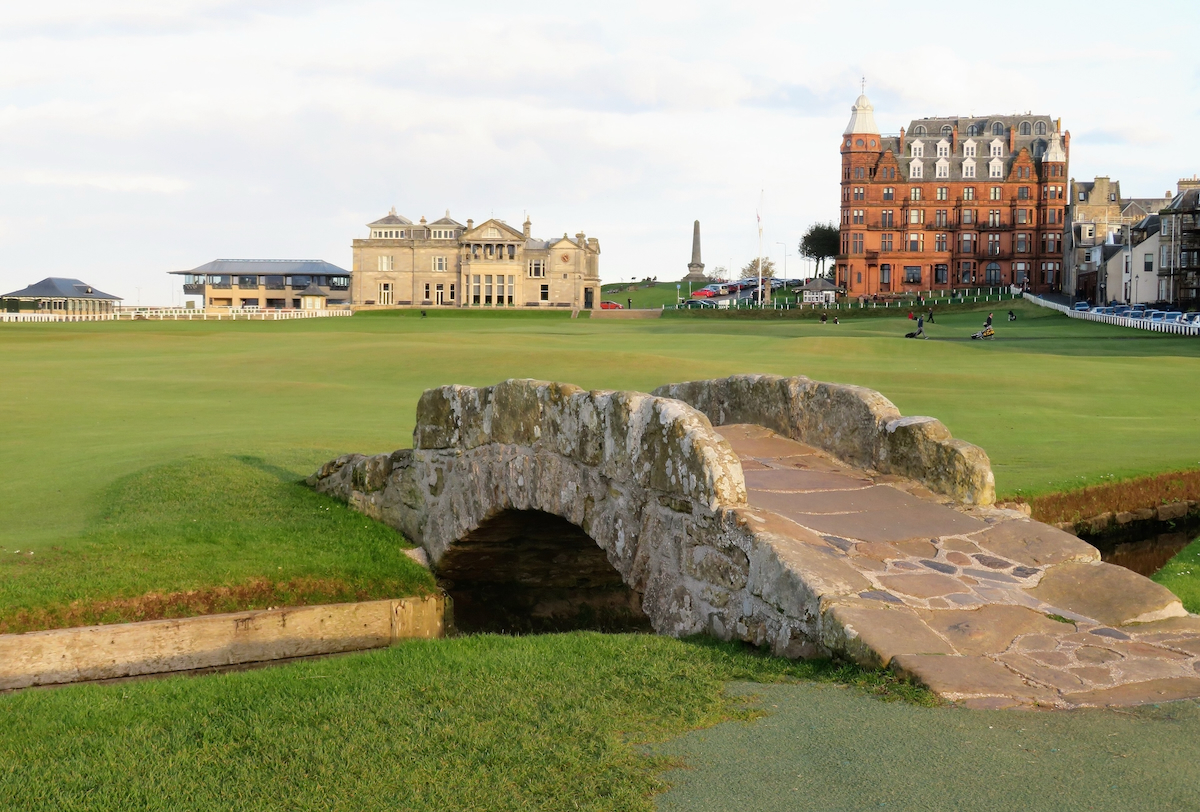
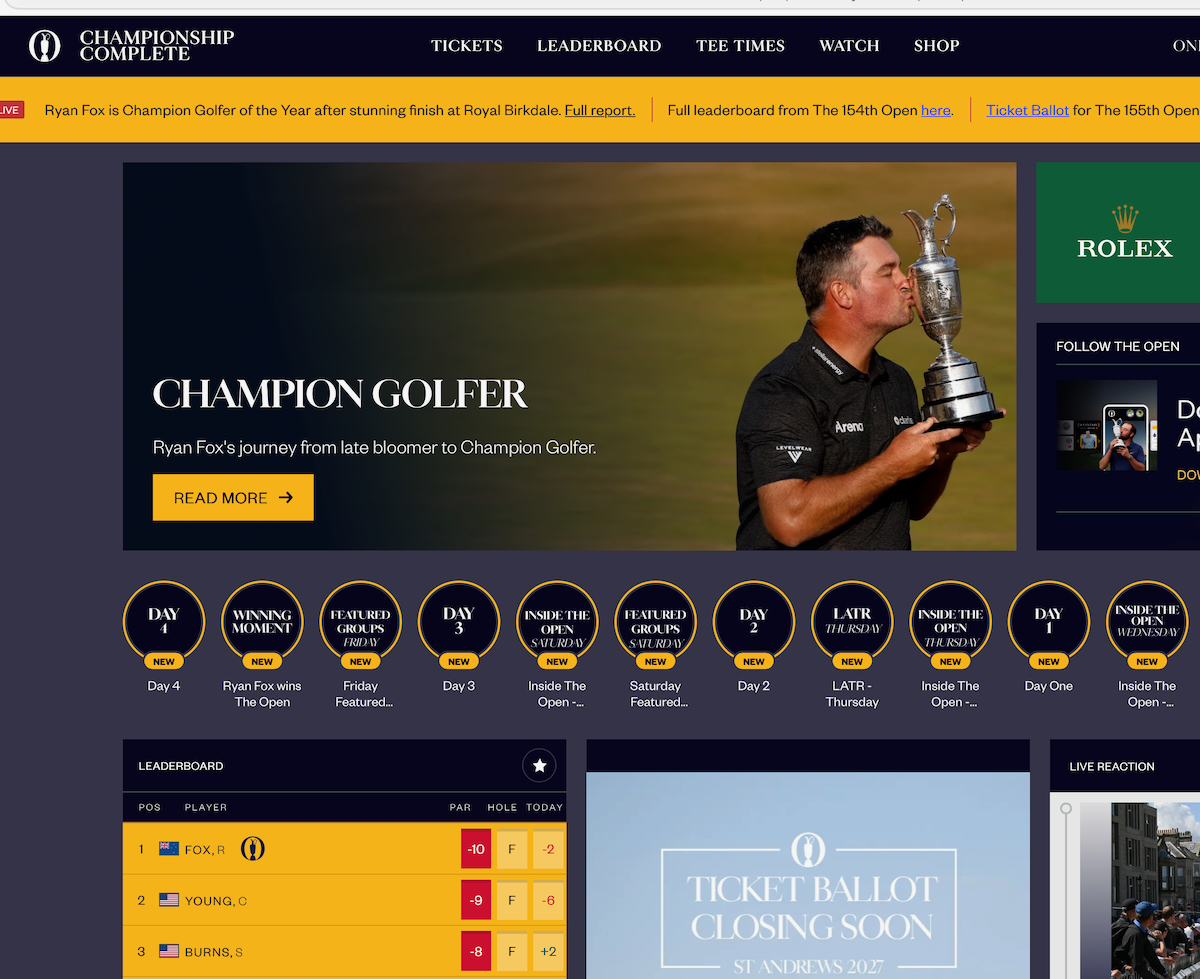
A sports betting pool, artificial intelligence, and the world’s oldest and most prestigious golf tournament. If that’s not a recipe for intrigue, what is? This year, I decided to put two AI chatbots, ChatGPT and Claude, to the test by asking each of them to select a team of six golfers for a pool built around “The Open” Championship in the UK
Technically, I No Longer Participate in Sports Pools
My golfing associates participate in a pool for every Major tournament during the golf season. I opted out a few years ago…not because I objected to coughing up $25 or $30 a few times a year (which I would almost certainly lose anyway). It was more about having to do all the work to come up with picks for each of the events. I consider myself to be a profoundly lazy person and to me, in retirement, that seems like a whole lot of work with which I don’t want to get involved.
That said, when my favourite Major—the Open Championship—rolled around this year, I thought it would be both entertaining and instructive to see how a couple of AI agents would fare against a group of seasoned, knowledgeable golfers. The pool organizer kindly let me enter two AI-generated teams without paying the entry fee… and I’ll explain why in a moment.
The other participants had no idea initially that the entries hadn’t been submitted by real people. As far as they knew, they were simply competing against two more golfers. The results were, to put it mildly, eye-opening.
To be fair, I did briefly suspend my self-imposed golf pool boycott last year for the Masters tournament. That pool was a little different. It was organized by friends of one of my golfing buddies and attracted 125 entrants, so the prize pool was considerably more enticing.
Apparently, the prospect of winning real money was enough to overcome my aversion to work. I happily handed over my $30 entry fee and spent far more time than I’d like to admit selecting my golfers. Unlike our regular pool, this one paid the top four finishers rather than operating on a winner-take-all basis.
I finished… fifth. Sheesh. To borrow Marlon Brando’s famous line from On the Waterfront, “I coulda been a contender.” That near miss was apparently all the evidence I needed that golf pools and I were no longer meant to be. Boycott reinstated.
The Rules of the Game
For all you golf pool enthusiasts out there, here’s how this pool works:
-
- The organizer uses a gambling website’s betting odds to rank all 156 players in the field.
- The top 50 are then divided into five groups of 10 golfers each.
- Each participant selects one golfer from each of those five groups, plus one additional golfer from those ranked outside the top 50.
- Participants also name one Alternate from Group 3 and another from Group 4.
- After the second round, if one of the selected golfers from any group misses the cut, an Alternate can be substituted in his place.
- As the tournament unfolds, the organizer tracks every team’s scores. At the end, only the three best individual scores from each six-player team are counted toward the final total.
- The participant with the lowest combined score, just like in golf, wins the pool—and the prize money.
If you’re a golfer, you’ll probably have no trouble following the format. If you’re not, don’t worry. The details aren’t nearly as important as the outcome.
The Con Job
Yes, entering the two AI agents required a bit of a con job—one that the pool organizer agreed to help me pull off.
Rather than identify the entries as Artificial Intelligence, I decided to give them pseudonyms so they would appear to be real people. Because I’m genuinely fascinated by all things AI, I searched Google for scientists whose initials happened to be A.I. I’d like to think you can guess why those initials appealed to me.
Google suggested names such as Alexander Ivanović and Alexander Ilyich, two Russian scientists. Since claiming they were Russian acquaintances might have raised a few eyebrows, I decided they would instead be Ukrainian refugees. During the war in Ukraine, many refugee families settled in our region, and the Love-goddess and I played a very small role in helping some of them get established. It was admittedly a major stretch—but it was the most remotely plausible backstory I could invent.
The story was as follows, as refugees, they couldn’t justify paying the entry fee but wanted to test their golf-picking skills against a group of local golfers. Even after dropping the rather obvious “A.I.” clue, no one seriously questioned their authenticity. I revealed their true identities after the second round.
To make the arrangement a little more appealing, I promised that if either AI entry won the pool, I would buy a round of drinks for everyone at our next golf game. Normally, the winner uses part of their prize money to buy the group a round anyway, so no one was giving anything up. In fact, everyone still had a chance to win the money and let the “AI guy” pay for the drinks.
Funny how quickly people embrace new technology when free beer is involved. 🙂
The Participants’ Teams
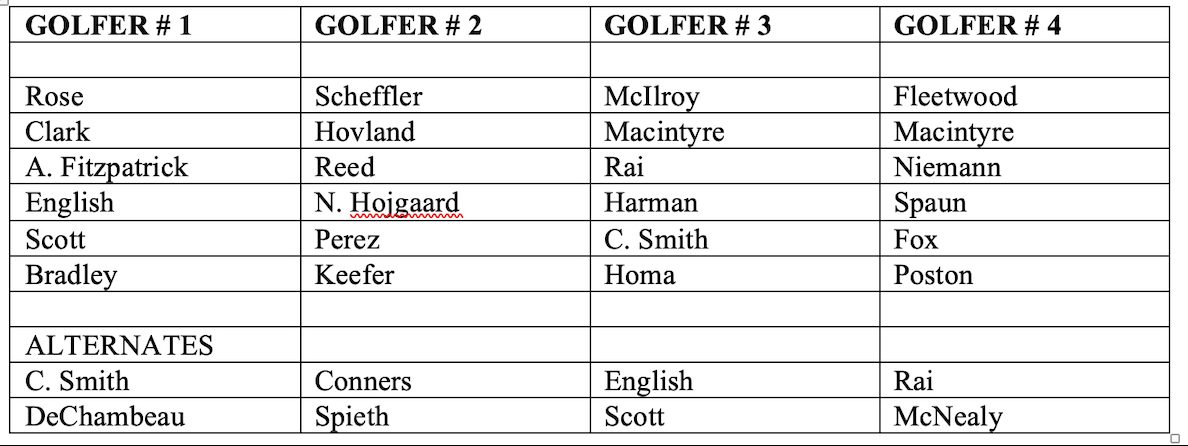
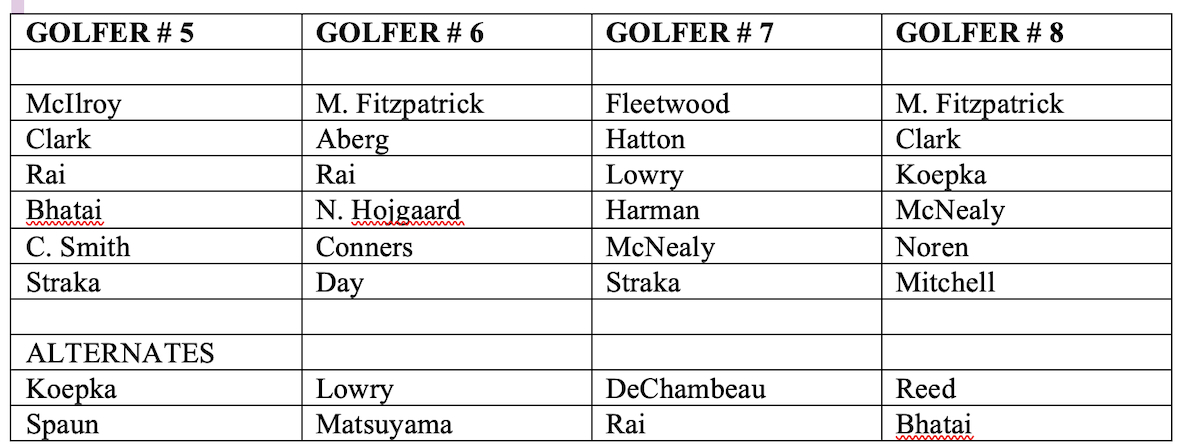
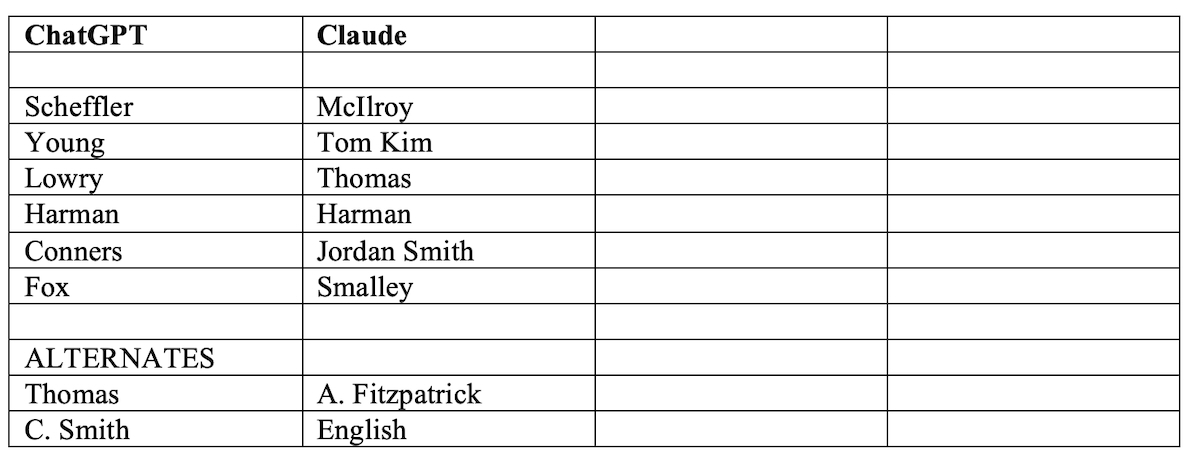
So here are the teams chosen by the eight participants and the two imaginary human, AI agent.
The Use of ChatGPT and Claude
Now let me explain how I put ChatGPT and Claude to work.
One thing I’ve learned from experimenting with AI is that the quality of the answers is often directly related to the quality of the questions—or, in AI terminology, the prompts.
From the outset, I decided not to give the two AI agents identical instructions. That would have made for an interesting comparison, but not a particularly realistic one. Instead, I took two completely different approaches to see whether one strategy would outperform the other.
ChatGPT
The prompt I gave ChatGPT was intentionally straightforward. I didn’t ask it to justify its picks, weigh recent form, or consider weather conditions. I simply gave it the betting odds, which served as a proxy for the golfers’ relative strengths, and asked it to make its selections.
The prompt read:
“Please group the top 50 golfers in the following list, as ranked by their odds of winning this week’s Open Championship, into five groups of 10, with everyone else placed into a sixth group. Then, select the golfer from each of the first five groups—and one from the sixth group—who you think will post the best score this week.”
I then provided the complete list of competitors, beginning with:
-
- Scottie Scheffler (+750)
- Rory McIlroy (+900)
- Matt Fitzpatrick (+1600)
- Tommy Fleetwood (+1600)
- Jon Rahm (+2500)
…followed by the remaining 151 golfers.
In total, 156 players teed it up at the 2026 Open Championship at Royal Birkdale.
ChatGPT’s Response:
Here it is:
“Using your supplied odds order, here are … my score picks for Royal Birkdale.
Scheffler, Cameron Young, Lowry, Harman, Conners, Ryan Fox
The strongest course-fit lean is Lowry/Harman: Royal Birkdale is a demanding links setup, while Scheffler remains the deserved top choice. The event runs July 16–19 at Royal Birkdale.”
Claude
With Claude, I used a multi-step multi-prompt approach when asking it to come up with picks. Basically, I fed it the six different groups individually and asked for an analysis of each group. The following was the ask for the first group.
The first prompt read:
“Out of the following 10 golfers, who would you expect to perform the best at the open championship this week?” – Followed by the list of golfers.
But, to demonstrate the “thinking” that went into these choices by the AI agent, here is Claude’s rationale around the third group. The third group included the following golfers:
Justin Thomas +6000, Patrick Reed +6000, Joaquin Niemann +6500, Bryson DeChambeau +6600, Patrick Cantlay +6600, Shane Lowry +6600, Aaron Rai +6600, Brooks Koepka +7000, Alex Fitzpatrick +7000, Jordan Spieth +8000
Claude’s response:
Its response was considerably more detailed than ChatGPT’s
“This group is a lot more volatile — these are mostly players with either concerning recent form or feast-or-famine profiles. Here’s how I’d stack them:
Best of the bunch:
- Justin Thomas — The strongest recent form here. He’s been the Tour’s best around the greens of late and strung together six top-20 finishes in his last seven events heading into The Open, even after only returning from back surgery in early March. His Open history isn’t great (just one top-30 in nine prior starts), but the current form is real.
- Alex Fitzpatrick — Easily a top-10 tee-to-green player on Tour right now. It’s worth throwing out his missed cut at the Scottish Open given how well he’s otherwise striking it, and he already has a T17 at the 2023 Open under his belt.
- Aaron Rai — Already has a major this year (the PGA Championship) and is one of the most accurate drivers in the world, which should be a real weapon on Birkdale’s notoriously narrow fairways. His individual Open history is weak (nothing better than T19 in four tries), but the overall game and current form both point up.
Live longshots:
- Joaquin Niemann — Having his best major season ever, with a T18 at the PGA and a tie for seventh at the U.S. Open — his best major finish of his career. The concern is his Open track record specifically: he’s never finished better than T53 in six prior starts, so the course/event itself hasn’t suited him historically.
- Jordan Spieth — The sentimental pick, and not just sentiment: his Open record is spotless (12 starts, 12 cuts made), and he won this exact tournament here in 2017. But his ball-striking has been shaky in his last few starts, and he hasn’t had a top-10 finish anywhere since last summer’s Memorial.
- Patrick Reed — Inconsistent overall, with a missed cut at the U.S. Open and a rough stretch before Scotland, but his iron play was much improved last week in a T13 finish, and he remains arguably the best chipper in the world.
More question marks than answers:
- Shane Lowry — Former Champion Golfer of the Year here, but hasn’t had a good major season, with a T30 at the Masters as his best showing this year.
- Patrick Cantlay — Concerning trend: he’s missed four of his last six major cuts, and while his overall Open record is solid, that recent pattern is hard to ignore.
- Brooks Koepka — Has a T6 at Birkdale from 2017 to lean on, but he’s missed the cut in his last two starts and has been dealing with a hand injury that forced a withdrawal from the Canadian Open.
- Bryson DeChambeau — I’d fade him the most in this group. He’s missed the cut in all three majors so far this year, and even though he remains elite off the tee, it’s hard to trust the iron play and short game to hold up for four rounds right now.
Bottom line: Justin Thomas and Alex Fitzpatrick look like the sharpest form plays in this particular group, with Aaron Rai and Niemann as the higher-variance value options underneath them.”
The Results
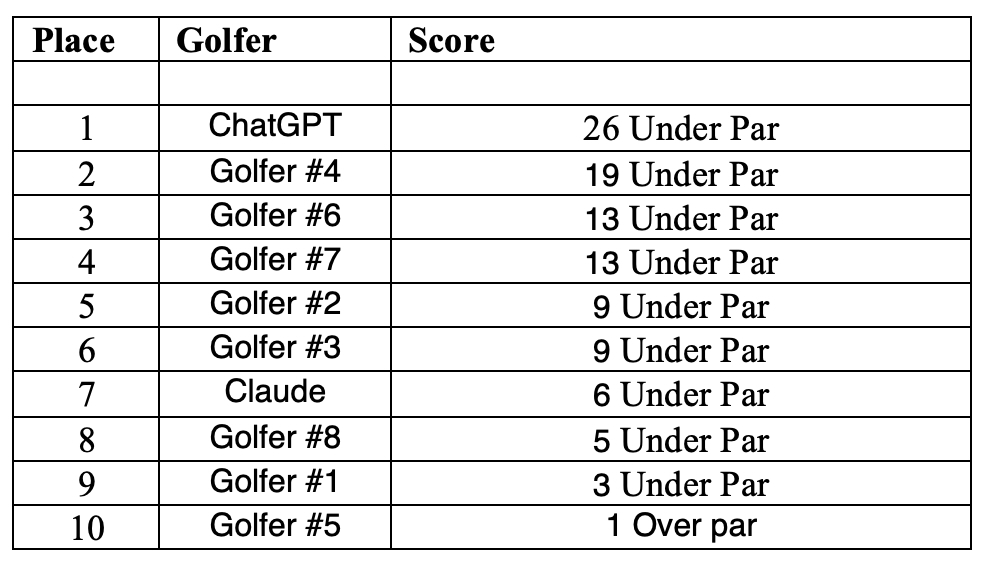
And now … drum roll … the final results! ChatGPT crushed the field!
What I’m Doing with the Money Instead of Wasting it in a Sports Pool … The Imaginary Money That Is
Just because I don’t participate in sports pools anymore, it does not mean that I do not like a challenge – or that I am not willing to risk small amounts of money. It simply does not represent a decent ROI, and it involves more work than I’m prepared to do to pick a team.
After thinking about it for a couple of years, I came up with an alternative competition…one that I’m playing entirely against myself while my golfing buddies continue entering their pools.
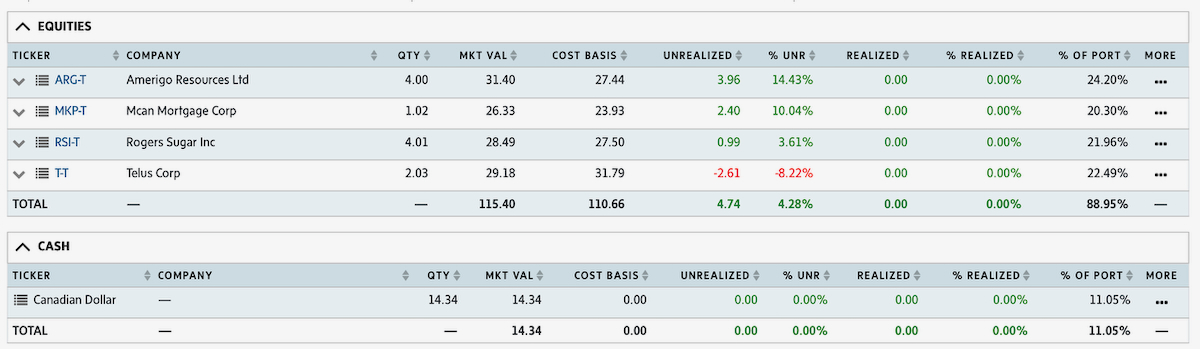
Instead of spending $25 or $30 on each tournament entry, I deposit that same annual amount into an imaginary investment account. Whenever one of the golf pools comes around, I use the equivalent entry fee to “buy” one or more dividend-paying stocks.
I’ve deliberately limited my purchases to reasonably priced, dividend-paying companies. Every dividend is automatically reinvested using a Dividend Reinvestment Plan (DRIP), allowing me to accumulate additional shares over time. Unlike a golf pool entry, which is over in four days regardless of the outcome, these investments continue compounding year after year.
To me, that’s a much more interesting long-term experiment. Until now, my golf pool-loving friends have had no idea I was running this little side project. Today, they find out.
I’ve been tracking the portfolio using The Globe and Mail’s portfolio tracker, treating every purchase as though it were real. Here’s what the portfolio looks like today…Monday, July 20…even after a rather unpleasant day in the markets as investors reacted to developments involving Iran.
Circling Back to ChatGPT
After everything was said and done, I found myself wondering why ChatGPT hadn’t explained its reasoning the way Claude had. It had simply made its selections and moved on, whereas Claude had provided a detailed rationale for each choice.
So, a few days after the tournament was over, I went back to ChatGPT and asked a simple follow-up question:
“How did you arrive at your selections?”
Its response was every bit as detailed as Claude’s. It explained the factors it had considered, the relative importance it gave each one, and even included links to the sources it had relied on.
Here’s what it had to say.
“My process was not a hidden statistical model or a claim to predict the result precisely. I used:
- Your odds list as the base ranking. Betting odds reflect a broad market view of each player’s form, talent, and expected fit that week.
- Links-golf suitability. Royal Birkdale rewards controlled driving, iron play, imagination around the greens, and avoiding big mistakes.
- Major/Open history and recent form. I preferred golfers with evidence they could handle firm, exposed links conditions.
- A mix of safety and upside. In the top groups, I leaned toward dependable elite players; in the long group, I sought players with a realistic high-end outcome.
Here is the reasoning behind each original selection:
Scottie Scheffler, Group 1:The safest pick in the entire field. He was the betting favourite, had the best tee-to-green baseline, and entered as defending Open champion. He delivered a T4 finish.
Cameron Young, Group 2:I valued his high ceiling more than the steadier alternatives in that group. His driving gave him a chance to create scoring opportunities even on a demanding course. He nearly won, finishing second at −9.
Shane Lowry, Group 3:This was a course-fit pick: former Open champion, excellent wind player, and naturally comfortable in links conditions. It did not become one of the three scores that carried the card, but it was a defensible pre-tournament choice.
Brian Harman, Group 4:Similar logic to Lowry: a previous Open champion with a patient, accurate style that often travels well to links golf. Again, he was a fit-based selection rather than a pure odds choice.
Corey Conners, Group 5:Chosen for reliable ball-striking and bogey avoidance—qualities that are especially valuable at a difficult major. He finished T14 at −4, a strong return from that tier. Final leaderboard
Ryan Fox, long group:This was the key upside pick. He had shown he could win on British/European-style setups and had the kind of aggressive scoring potential that made him more appealing than his long odds suggested. He turned that into the winning score, including a 62 on Saturday and a closing 68. AP report”
Incredibly interesting stuff!
And Finally…
A bit of a lesson on creating images with an AI Chatbot.
After I had completed the first draft of this article, it was time to start gathering images to enhance the presentation. First and foremost, I needed a title image. I had considered using an image from the Open website, but then I thought better of it, since doing so could risk copyright infringement. So once again I turned to ChatGPT and entered some guidelines to produce an original image I could use. As is often the case, after I told it what I wanted, it asked me to upload a photo of the person who would appear in the image.
I have done this many times before, and typically, after giving it instructions, I follow up with additional prompts to make the image more to my liking. This time, though, I used the original image without modifications, partly to show you how quickly and easily a chatbot can do this work, and partly to demonstrate that, AI can be remarkably capable without being infallible. It still needs human looking over its shoulder.
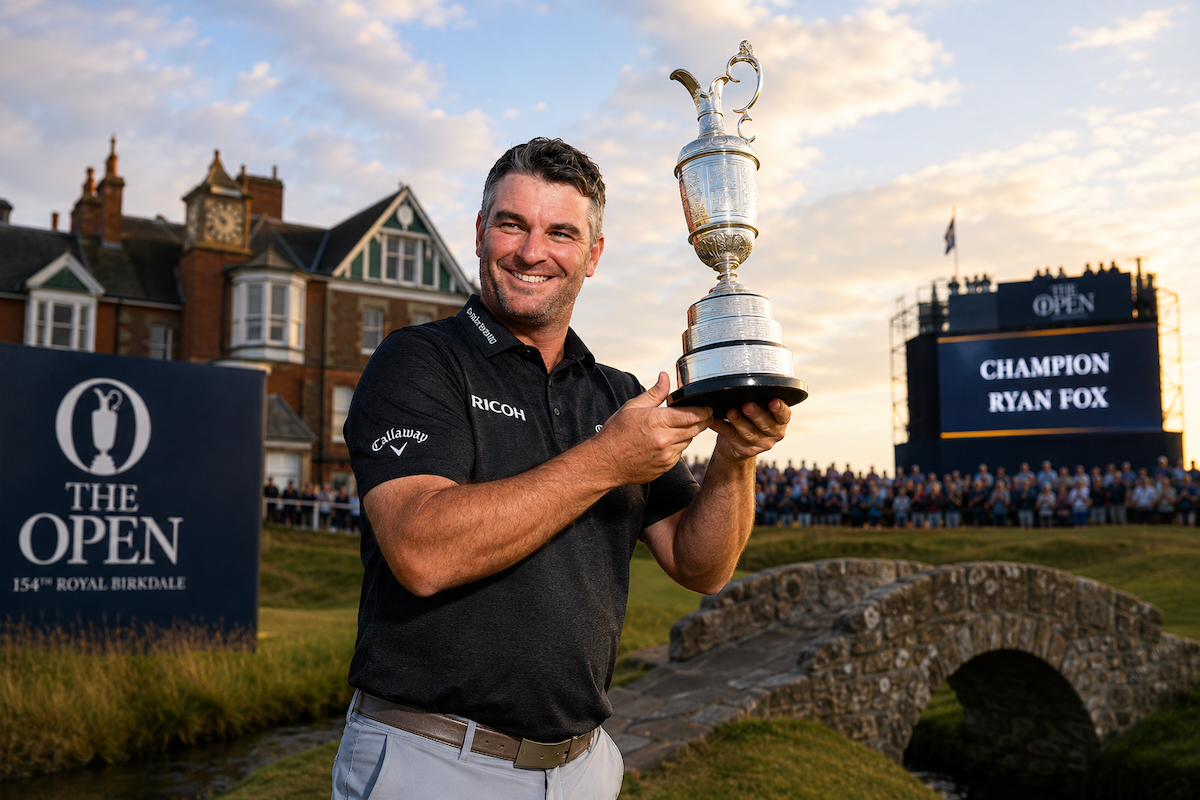
The major issue I had with the image was that it incorporated the Swilcan Bridge at St Andrews. Fair enough, St Andrews is one of the great historic sites on which the Open Championship is played, and while the bridge is an iconic symbol of The Open Championship. I didn’t think it was appropriate to use it here, since this tournament was played at Royal Birkdale. Good job, ChatGPT, but not perfect!